Specialized Intelligence:
The Guide to Agentic AI Platforms
Built on Your Data
Table of Contents
Specialized intelligence is an agentic AI platform model in which AI is trained on a company’s own data, processes, and judgment. The result is accurate, auditable, expert-grade work that improves with every use.
A general-purpose model accessed through a prompt gives every competitor the same averaged output. A specialized intelligence platform is different. It compounds proprietary advantage over time.
The enterprise AI market has moved through three phases, and the buying conversation has moved with it. In Phase 1, access to large language models was the product. In Phase 2, where most platforms sit today, no-code agent and workflow builders are the product, and speed-to-build is the value proposition.
Phase 3 is now underway. Specialization is the product, and the value proposition is AI trained on your data, your processes, and your judgment that gets better the more your teams use it.
The question leaders ask has shifted too. It used to be “how do we build agents faster?” It is now “how do we make sure our AI is measurably better than our competitors’?” This guide explains what specialized intelligence is, how it works, and how to evaluate it.
What Is Specialized Intelligence?
Specialized intelligence is an architectural approach that builds deep, domain-specific capability instead of broad, general-purpose understanding.
A general model is trained on public data and answers from aggregate patterns. A specialized intelligence platform is grounded in proprietary data, domain vocabulary, regulatory logic, and the workflows professionals actually run. The result is precision that holds up to professional and regulatory scrutiny, not a plausible-sounding approximation.
According to Gartner, domain-specific language models deliver higher accuracy and stronger compliance than general-purpose models, and rank among the top strategic technology trends for 2026.
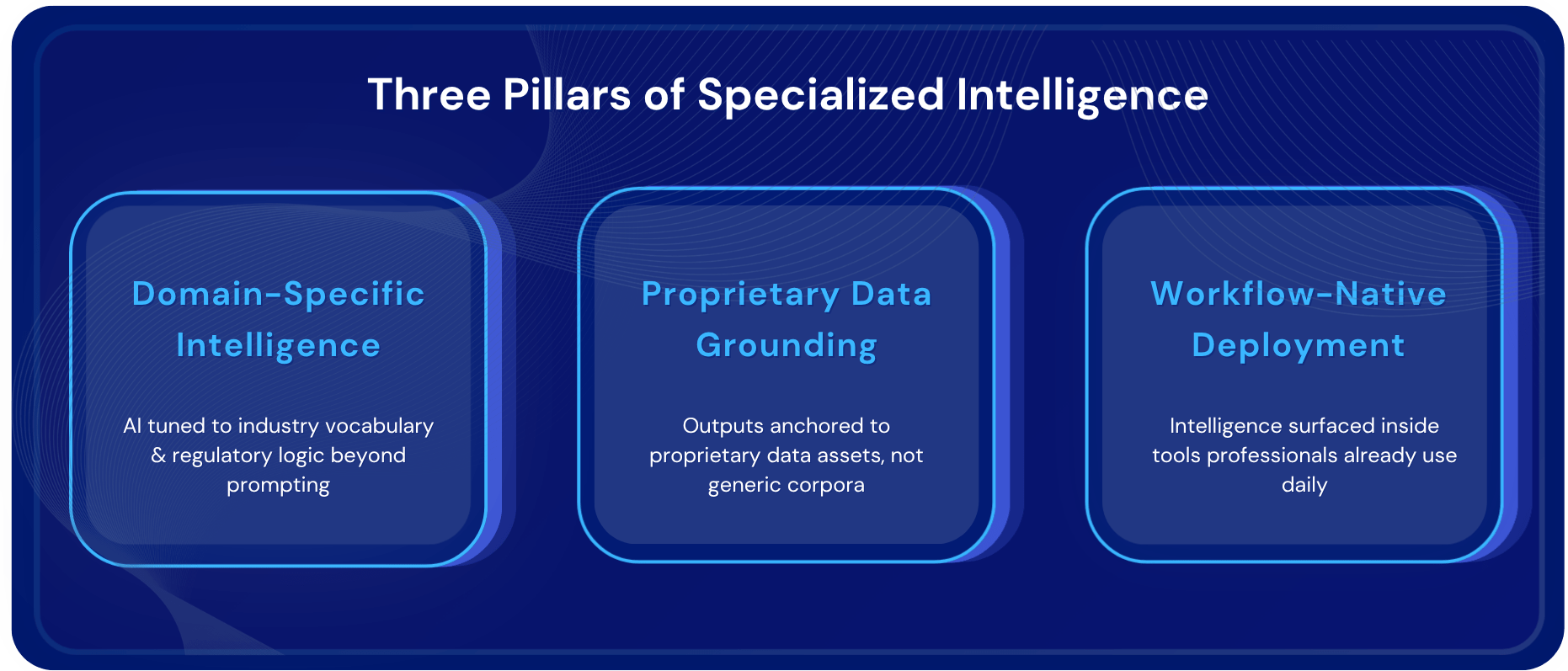
Four properties define specialized intelligence:
- Domain grounding. AI tuned to industry vocabulary, entities, and regulatory logic, beyond what general-purpose prompting can reach.
- Proprietary data anchoring. Outputs anchored to a company’s own data assets, not a generic public corpus.
- Workflow-native delivery. Intelligence surfaced inside the tools teams already use, which removes the adoption friction that kills standalone AI tools.
- Compounding with use. The system learns from each decision, override, and outcome. Accuracy and organizational context improve over time instead of resetting with every session.
The Market Shift: From Access to Speed to Specialization
Specialized intelligence is best understood as the third phase of enterprise AI. Each phase solved the limitation of the one before it.
LLM access
Speed to build
Specialization
This shift is not theoretical. MIT’s GenAI Divide report found that roughly 95% of generative AI pilots delivered no measurable business impact.
MIT identified the root cause as a “learning gap”: generic tools that do not retain organizational knowledge or improve from feedback. The report concludes that bridging the divide requires moving from static tools to adaptive systems. That is precisely the boundary between Phase 2 and Phase 3.
S&P Global found a similar pattern: 42% of companies abandoned most AI initiatives in 2025, with the absence of domain grounding and workflow integration as the recurring cause.
How a Specialized AI Platform Works: The Core Layers
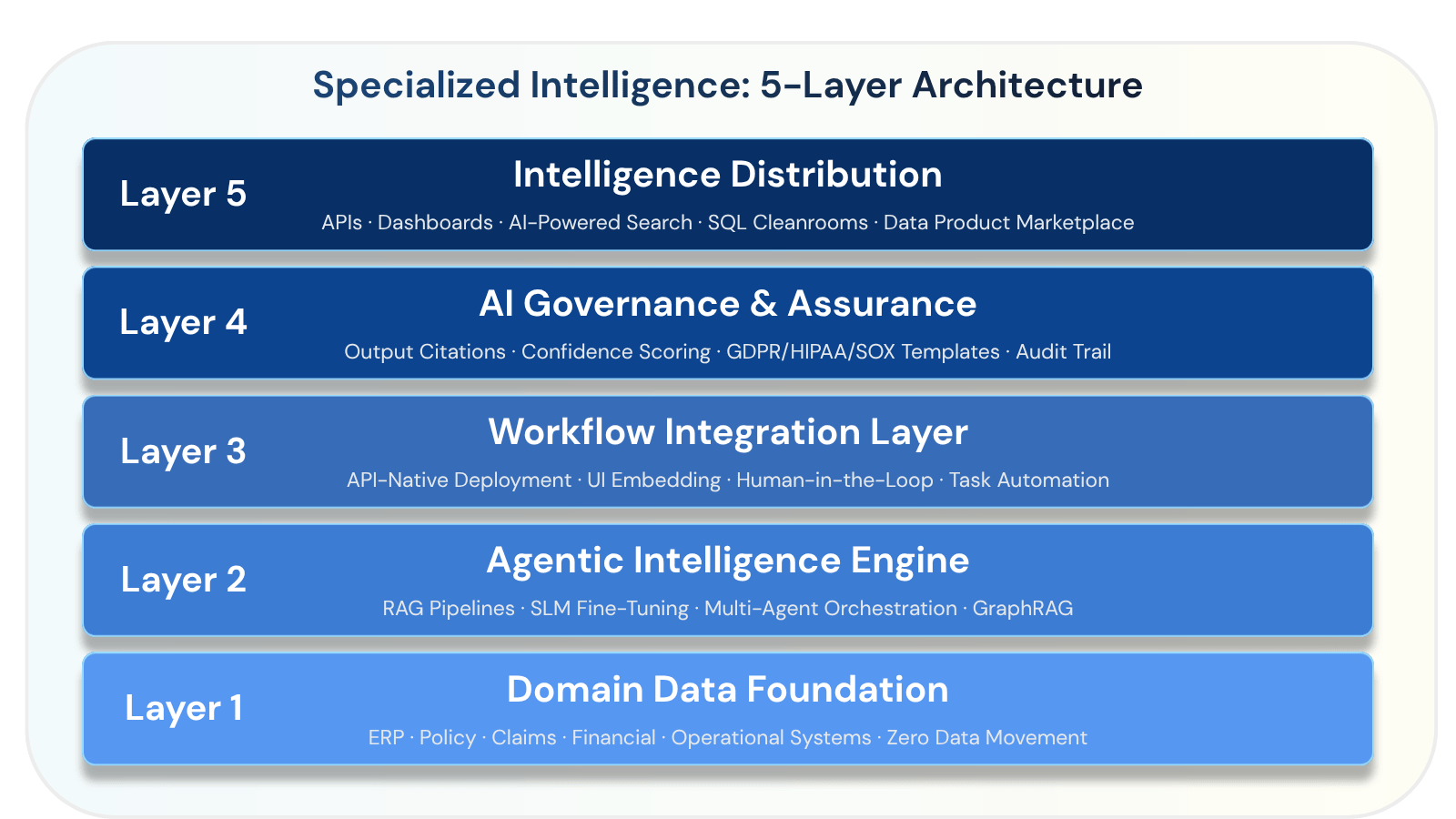
A specialized intelligence platform connects domain data, agentic reasoning, and governed delivery in a continuous loop. Outputs are grounded in business context rather than generic training data, and every result is traceable.
As NVIDIA notes, specialized AI creates organizational value through domain expertise and deep business-process integration. That is a different objective from consumer tools optimized for breadth. Five layers do the work:
The problems specialized intelligence solves:
- General-model accuracy gaps create compliance exposure.
- Isolated proprietary data sits unused.
- Standalone interfaces see near-zero adoption.
- Missing governance blocks regulated industries from deploying explainable AI.
- Integration complexity slows everything down and raises cost
Specialized Intelligence vs. General AI vs. Vertical AI vs. Copilots
These categories are not mutually exclusive. Many organizations run all of them. What matters for buyers is which architecture delivers the accuracy, governance, and integration depth a given decision requires.
McKinsey’s 2025 State of AI report found that organizations reporting significant financial returns from AI were roughly twice as likely to have redesigned end-to-end workflows first. That is a direct argument for the workflow-native model.
When to choose specialized intelligence: choose it when output accuracy carries downstream consequences, such as underwriting risk, clinical recommendations, regulatory filings, or financial forecasting. It is also the right choice when governance requires every output to trace back to a verified source.
Key Benefits of Specialized Intelligence
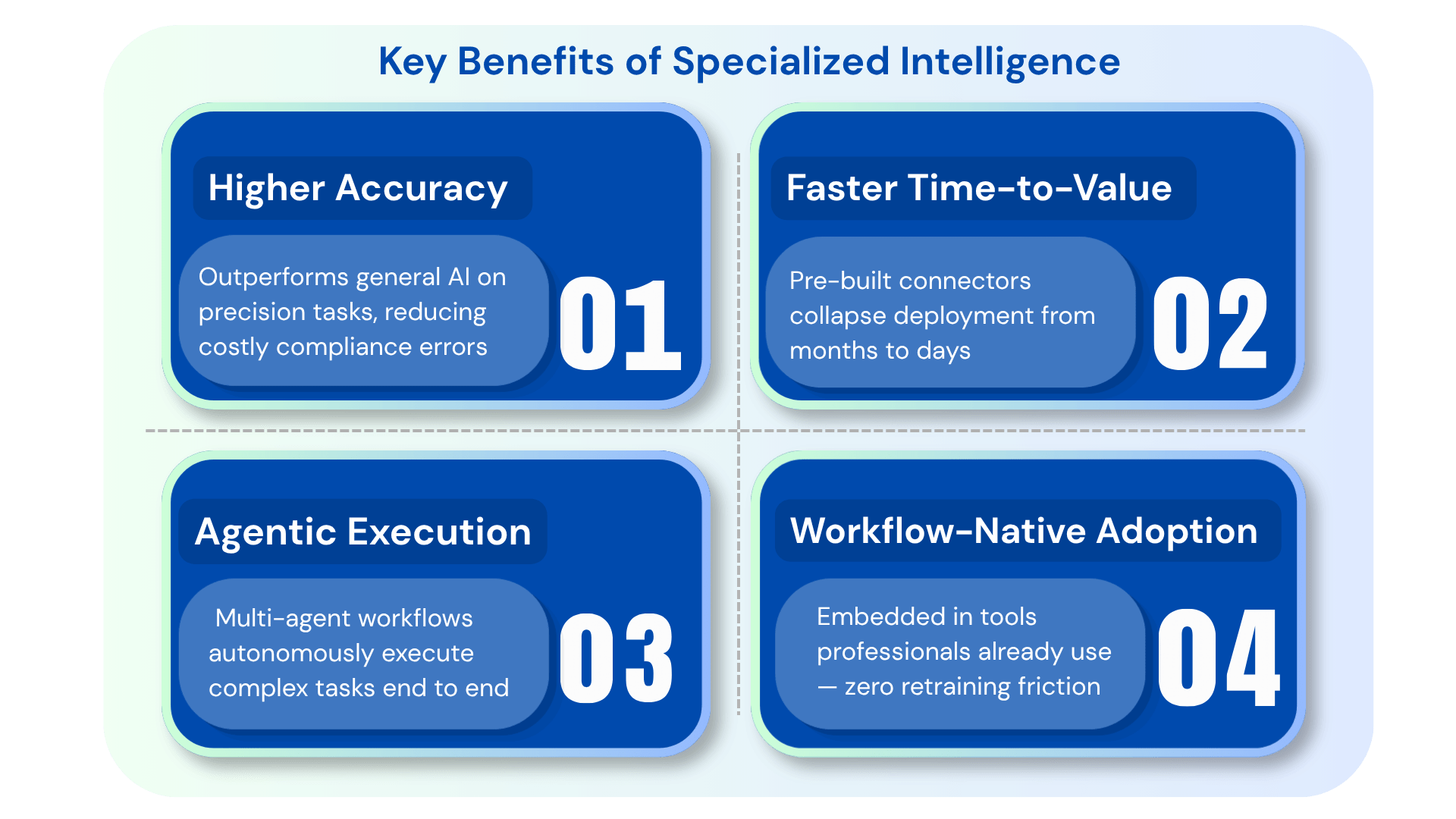
Accuracy that holds up, and adoption that sticks. Specialized models operating on proprietary data outperform general models on precision tasks. That reduces the error rates that carry financial, regulatory, and reputational cost.
Because intelligence is embedded in existing tools, specialists keep working the way they already do. Adoption sustains where standalone interfaces stall.
Faster time-to-value through agentic execution. Pre-built domain connectors and workflow templates collapse deployment from months to days. Multi-agent orchestration moves teams from generating recommendations to executing complete workflows, cutting manual processing time and freeing experts for judgment-intensive work.
A compounding advantage. This is the benefit unique to Phase 3. Because the system learns from each decision and outcome, the gap between your AI and a competitor’s widens with use.
Speed-to-build can be matched. An advantage that compounds on your proprietary data and judgment cannot be copied.
Specialized Intelligence Applications Across Industries
The common thread across industries is high-stakes domain knowledge, proprietary data that general AI cannot see, and workflow complexity that generic agentic tools cannot safely navigate.
SAP’s 2026 AI themes report identifies specialized foundation models as surpassing general-purpose LLMs in performance and economics for structured, domain-specific work.
Financial Services & Insurance
Insurance is a defining case for specialized intelligence. The hard part is not any single decision. It is the coordination across teams that must act on a single account or regulatory change.
A specialized platform extracts and interprets submissions, loss runs, and statements of value with a model fine-tuned on insurance documents. It routes referrals by authority, operationalizes regulatory and ISO updates across actuarial, product, underwriting, compliance, and filings, and maintains audit lineage from origin to filing. The decisions are quick. The work around them is where weeks disappear.
Healthcare & Life Sciences
Specialized intelligence converts clinician-patient interactions into structured documentation. It aggregates data across disparate EHR systems to surface at-risk cohorts. It also structures and validates clinical-trial data, enforcing schema requirements before formal regulatory submission.
Energy, Manufacturing & Supply Chain
Specialized agents ingest sensor and equipment data, apply domain degradation models, and generate maintenance recommendations that reduce unplanned downtime across operational sites. They feed governed intelligence directly into operational decisions
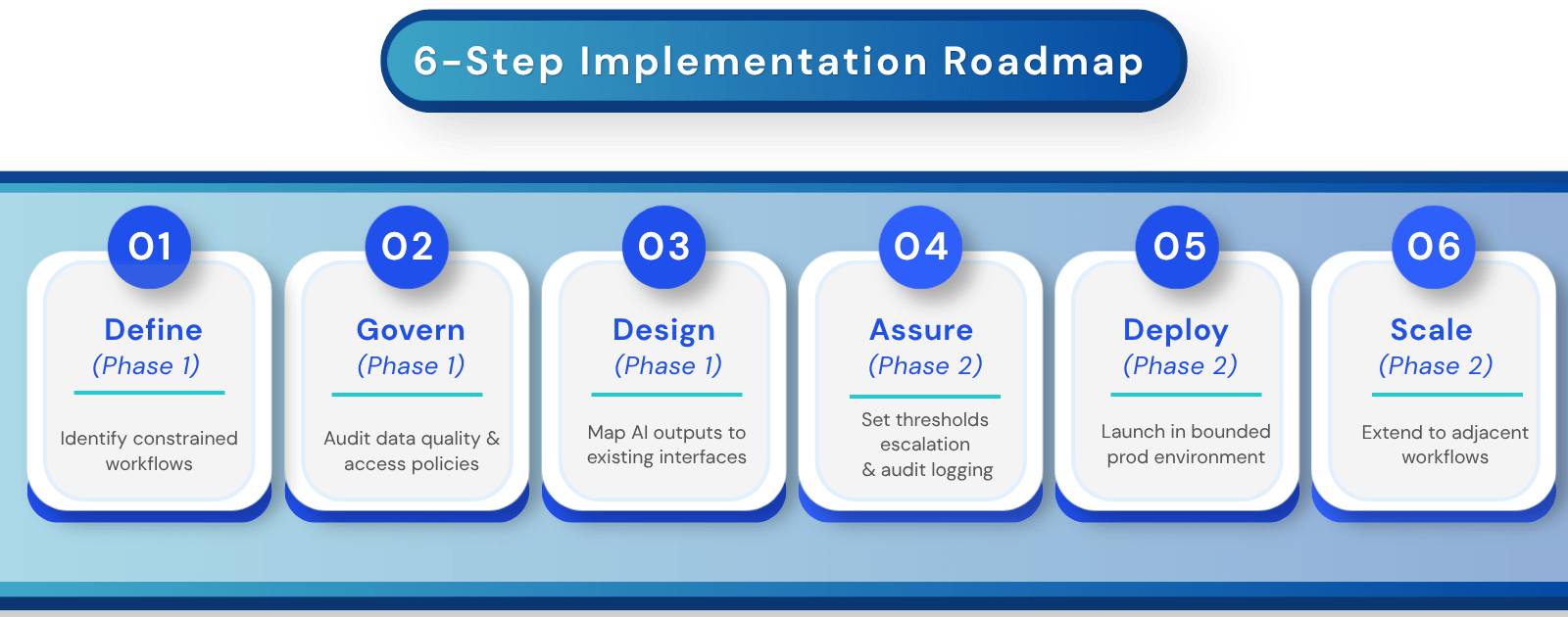
How to Implement Specialized Intelligence: A 6-Step Path
Unlike traditional RPA or standalone autonomous systems, specialized intelligence embeds workflow automation inside governed AI pipelines.
Gartner predicts that 40% of enterprise applications will feature task-specific AI agents by the end of 2026, up from under 5% in 2025. That makes deployment timing a competitive variable.
- Define. Identify the workflows where AI accuracy or volume capacity is most constrained today.
- Audit data. Map domain data sources, ownership, and quality, and set access policy. A specialized platform is only as accurate as the data it runs on.
- Design for the workflow. Map how outputs will surface inside existing interfaces. AI that demands a parallel tool faces adoption barriers model quality alone cannot overcome.
- Govern. Define confidence thresholds, escalation paths, citation standards, and audit logging before any agent touches production.
- Deploy. Launch in a bounded production environment with active monitoring. Measure accuracy and adoption against pre-defined baselines, and refine fine-tuning from real failure modes.
- Scale. Extend to adjacent workflows using pre-built connectors, then package domain intelligence as governed data products for internal or external distribution.
Specialized Intelligence Is the Foundation for Agentic AI
Agentic AI is the operational expression of specialized intelligence. Its promise depends entirely on the domain accuracy, governance, and proprietary-data grounding of the intelligence layer beneath it.
An agent’s output becomes the input to the next workflow step, so general-purpose accuracy thresholds are not enough for regulated or high-stakes work. Human judgment remains the essential guardrail wherever ethics and discretion are required. Agents must also operate on live, governed data, because agents working from stale public training data produce outputs that do not reflect current operational reality.
Governance is what makes this safe at scale. Lineage makes every agent decision auditable, and privacy controls hold across large, sensitive datasets.
The 2026 Gartner Hype Cycle for Agentic AI notes that only about 17% of organizations have deployed AI agents so far, while more than 60% expect to within two years. Closing the specialized-intelligence gap beneath those agents is now a strategic priority, not a technical detail
The Arivonix Specialized Intelligence Platform
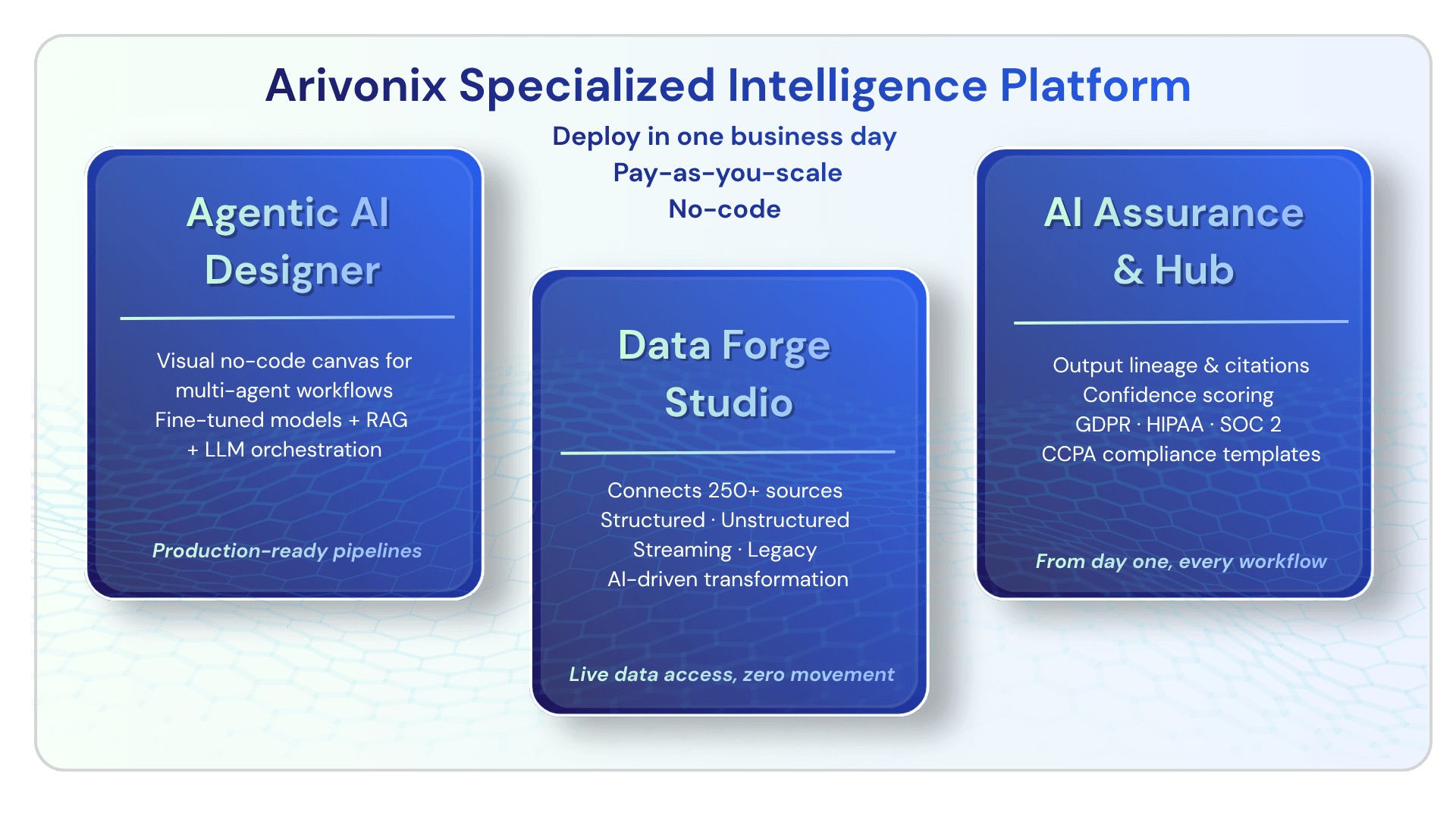
Arivonix is built on a simple premise: specialized intelligence should be deployable without a multi-year infrastructure program. The platform spans domain data ingestion, agentic transformation, governed orchestration, and intelligence distribution, through a single no-code interface that business and quantitative experts can operate directly.
Core capabilities. The Agentic AI Designer is a visual no-code canvas for building multi-agent workflows that combine fine-tuned models, RAG, and LLM orchestration into production pipelines. Data Forge Studio connects 250+ structured, unstructured, streaming, and legacy sources with live access and AI-driven transformation. Data-Centric AI Assurance enforces lineage, confidence scoring, and compliance templates across every workflow from day one.
Speed, scale, and specialization. Agent Arivon turns natural-language prompts into end-to-end data solutions, and the Data Products Hub distributes governed intelligence as entitlement-controlled products via APIs, dashboards, and SQL cleanrooms. Pre-built connectors take the first workflow live within a business day.
Because the platform is grounded in your data and improves with use, that first workflow is the start of a compounding advantage, not a one-off build
How to Evaluate Specialized Intelligence Vendors: A Buyer’s Checklist
Look for platforms that pair expert-level domain grounding with professional-grade agentic orchestration, intuitive no-code tooling, and deep governance. Five questions separate Phase 3 platforms from repackaged Phase 2 builders:
- Domain depth: Are there pre-built connectors and workflow templates for your specific industry?
- Compounding: Does the system learn from your decisions and outcomes, or reset every session?
- Agentic orchestration: Does it support true multi-agent execution with human-in-the-loop escalation?
- Governance architecture: Is policy enforced natively, with full output traceability and lineage?
- Aligned pricing: Does consumption-based pricing tie vendor incentives to your outcomes?
Frequently Asked Questions About Specialized Intelligence
What does specialized intelligence mean in simple terms?
Specialized intelligence is AI trained and governed for a specific domain and a specific company rather than for general-purpose use. It applies a company’s own data, expert knowledge, and precise vocabulary to produce accurate, auditable outputs, and it improves the more it is used.
How is specialized intelligence different from general AI?
A general AI tool answers from aggregate public training data with no business context. Specialized intelligence integrates proprietary data, applies domain-tuned models, embeds outputs into real workflows, and meets the governance and accuracy thresholds that consequential decisions require.
Is specialized intelligence the same as an agentic AI platform?
Agentic AI is how specialized intelligence executes work. It perceives inputs, decomposes tasks, acts through connected tools, and monitors its own outputs. An agentic AI platform delivers durable advantage only when the intelligence beneath it is specialized to your data and domain.
Why do most enterprise AI pilots fail, and how does specialization help?
MIT’s research attributes most failures to a “learning gap”: generic tools that do not retain organizational knowledge or improve from feedback. Specialized intelligence closes that gap by grounding AI in proprietary data and letting it compound with use.
How long does implementation take?
No-code specialized platforms can take a first workflow live in about one business day using pre-built connectors and domain templates. Full rollout across multiple use cases is measured in weeks, not months.
Is specialized intelligence relevant for mid-market organizations?
Yes. No-code deployment and consumption-based pricing have changed the economics. Organizations with smaller teams can deploy cost-effectively and scale as value is proven. The real qualifier is having domain workflows where accuracy and governance matter more than general-purpose breadth.
See specialized intelligence on your own data and workflows
Talk through where it fits, what it would take to deploy, and the advantage it can compound for your team.