
The Insurance Analytics Gap: Defined and Closed by Arivonix AI
Summary: Insurance data analytics is where modern insurers win or fall behind — yet most are still operating with fragmented systems, manual workflows, and disconnected data. Critical functions like underwriting, pricing, and claims remain stuck in the past, unable to keep pace with…
Summary:
Insurance data analytics is where modern insurers win or fall behind — yet most are still operating with fragmented systems, manual workflows, and disconnected data. Critical functions like underwriting, pricing, and claims remain stuck in the past, unable to keep pace with the real-time demands of today’s market.
The numbers reflect this clearly: according to the Capgemini Research Institute’s World P&C Insurance Report 2024, only 8% of property and casualty insurers are regarded as underwriting “trailblazers” consistently leveraging AI-driven insights and automation for pricing and risk assessment. (source) Nearly three out of four insurers face inconsistencies due to poor data access and limited analytics capabilities.
Arivonix AI bridges this divide with an AI-powered, end-to-end data fabric that unifies siloed systems, automates decision-making, and enables real-time insurance data analytics across the entire enterprise.
The Problem: Legacy Infrastructure Meets a Real-Time World
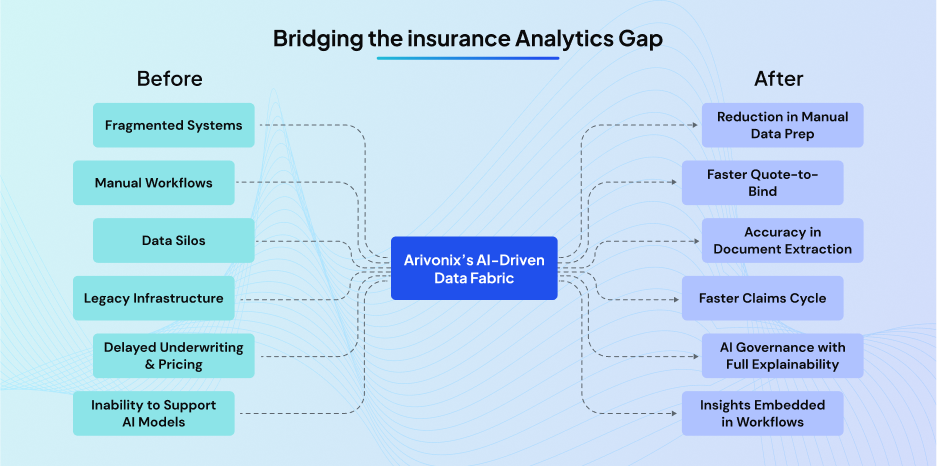
Modern insurance is data-intensive by design, but most insurers aren’t built to support that. The average carrier manages hundreds of data sources across policy, claims, risk, actuarial models, and third-party feeds. However, these data streams are often siloed, unstructured, or locked in legacy systems that don’t communicate.
Underwriting decisions are delayed because risk data lives in five different systems. Pricing is inconsistent because actuaries and underwriters lack shared models or real-time updates. Claims handlers manually review scanned loss runs or PDF files sometimes waiting days for critical information. And as AI adoption becomes more common, insurers hit a wall: their data simply isn’t in the shape to support AI, explainability, or regulatory traceability.
Even InsurTechs, despite their modern branding, struggle when plugging into incumbent systems. Their point solutions fall short because they lack context, governance, and integration depth. The result is an ecosystem with plenty of ambition but limited execution.
The Cost of Doing Nothing
When analytics are weak, the whole insurance value chain suffers:
- Underwriters make conservative decisions due to lack of visibility leading to missed opportunities or mispriced risks.
- Pricing teams work on outdated assumptions, causing margin leakage.
- Claims teams lose time chasing data, opening the door to fraud, customer frustration, and higher loss ratios.
- CIOs and CDOs invest in AI tools, only to discover the underlying data can’t support consistent or explainable models.
This gap between AI ambition and operational readiness has become the defining challenge for insurance leaders in 2025.
How Arivonix AI Closes the Gap: A Purpose-Built Solution
Arivonix AI is not just another analytics dashboard or claims bot. It’s a full-stack, cloud-native data fabric designed specifically for the demands of insurance integrating, governing, and activating data across the enterprise. Here’s how:
1. Unified, Real-Time Data Layer
Arivonix AI connects policy, claims, actuarial, and third-party data sources into a governed, queryable layer. It harmonizes structured and unstructured data (like scanned loss runs or broker submissions) using AI-powered data ingestion and lineage tracking. This means underwriting, pricing, and claims teams always work off a single source of truth updated in real time.
2. AI-Embedded Underwriting & Pricing
We embed risk-scoring models, pricing algorithms, and underwriting logic directly into the data layer. These aren’t black-box predictions—they’re transparent, traceable, and tunable. Underwriters can see the “why” behind every recommendation and adjust logic to reflect product-specific needs or regulatory constraints.
3. Automated Claims & Loss-Run Processing
Arivonix AI uses advanced OCR, NLP, and AI validation to turn loss runs, adjuster notes, and FNOL documents into structured, searchable data—processed in minutes. This automation reduces time-to-decision, minimizes manual errors, and enhances fraud detection accuracy.
4. Built-In Governance and Auditability
Our platform includes full data lineage, model explainability, role-based access controls, and audit trails—ensuring compliance with regulatory frameworks and internal governance policies. This is especially critical in AI-driven decisions, where explainability and fairness are required.
5. Business-Ready Insights Where They’re Needed
Arivonix AI delivers insights not just to dashboards, but directly into underwriting and claims systems. Alerts, recommendations, and forecasts are context-aware, showing exactly where decisions are made. Whether it’s a real-time claim severity score or a policy-level risk adjustment, the intelligence is embedded, not bolted on.
The Result: Smarter Insurance, Without the Overhaul
With Arivonix AI, insurers don’t have to replace legacy systems or run expensive transformation programs. They can augment what they have unlocking real-time intelligence from day one.
Outcomes include:
- 70%+ reduction in manual data prep time
- 15–20% faster quote-to-bind cycles
- 98% accuracy in AI-driven document extraction
- 25%+ reduction in claims cycle time
- Regulatory-ready governance for all AI models
Closing Thought
Analytics is no longer a competitive edge; it’s the cost of staying relevant. But for most insurers, the infrastructure gap remains too wide to cross with traditional tools. Arivonix AI is a bridge. We’re turning raw, scattered data into a strategic asset fueling faster, smarter, more profitable decisions across the entire insurance lifecycle.
If you’re an insurer looking to modernize without disruption, Arivonix AI is how you get there.
Written by Karthik
Vice President of Strategy