
As electrification accelerates, DERs (distributed energy resources) surge, and extreme weather events become more common, one thing is clear: the grid must be able to adapt in real-time. Static infrastructure and rigid workflows simply won’t cut it. Grid flexibility—the ability to rapidly reconfigure, respond, and rebalance—is emerging as the most critical capability utilities can develop. Yet, most utilities aren’t equipped to make this shift. Not because they lack the hardware, but because they lack the operational intelligence layer to coordinate it all. That’s where Arivonix AI comes in.
The New Demands on the Modern Grid
From rooftop solar and EV chargers to extreme heatwaves and winter storms, today’s grid faces highly dynamic and decentralized stressors:
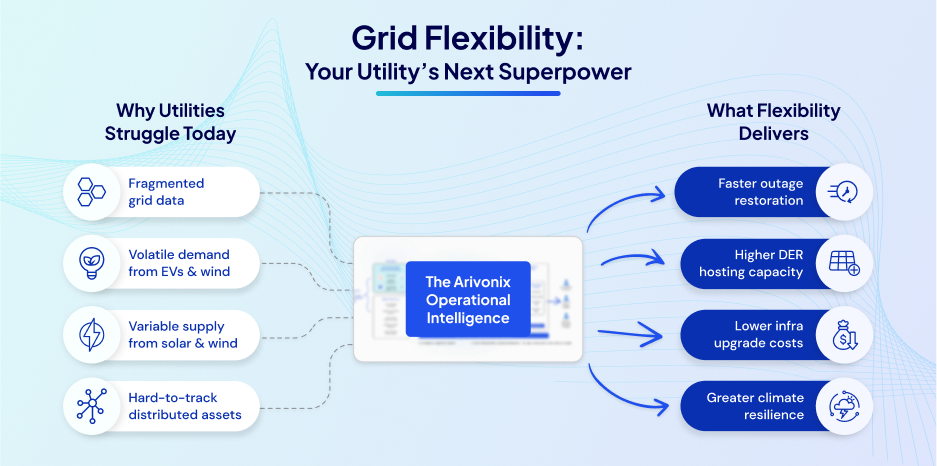
- Demand is volatile. Heat domes, polar vortexes, and EV charging surges create unpredictable peaks and troughs.
- Supply is variable. Solar and wind resources fluctuate by the hour—or the minute.
- Assets are distributed. DERs, microgrids, and battery storage sit behind the meter and at the edge of the grid.
- Customers expect reliability. Outages, price spikes, and poor response time erode public trust and regulatory goodwill.
Traditional grid planning and operations weren’t designed for this level of complexity. Load forecasting models built on historical averages, centralized control paradigms, and one-size-fits-all outage response no longer suffice.
The solution? Flexibility.
What Does Grid Flexibility Actually Mean?
Grid flexibility isn’t just about hardware. It’s about real-time intelligence, decision-making, and coordination.
At a foundational level, grid flexibility means the ability to:
- Shift load in response to supply constraints or pricing signals.
- Shape DER contributions to minimize disruption and maximize benefit.
- Reconfigure operational workflows during outages, events, or peaks.
- Respond to grid events with context-rich, automated actions.
- Adapt to new conditions as they arise—without a manual overhaul.
And most importantly: do all of this at scale, with speed.
Why Utilities Struggle to Operationalize Flexibility
Despite billions in smart grid investments, many utilities remain stuck in inflexible operations. Why?
- Siloed data systems prevent real-time insights across the network.
- Manual workflows slow down response to rapidly evolving events.
- Limited DER visibility makes hosting capacity unpredictable and planning reactive.
- Rigid SCADA and ADMS environments aren’t built for adaptive logic or external data integration.
Utilities are equipped with the tools—but not the intelligence—to make grid flexibility a reality.
Arivonix AI: The Operational Core of a Flexible Grid
At Arivonix AI, we believe grid flexibility starts with operational intelligence. Our platform empowers utilities to move from reactive to adaptive, and from fragmented systems to unified decision-making.
Here’s how:
- Real-Time Reconfiguration, Powered by Unified Data
Arivonix AI brings together data from AMI, DERMS, SCADA, GIS, and external sources—turning it into live, actionable intelligence.
- Monitor real-time grid conditions at the feeder and node level.
- Detect anomalies or overloads before they cascade.
- Trigger reconfiguration logic automatically during events—based on customizable no-code rules.
- Intelligent DER Orchestration
DERs can be a liability—or a powerful tool—depending on how they’re managed. Arivonix AI provides real-time situational awareness and decision support for:
- Instant interconnection viability analysis.
- Hosting capacity forecasts using historical, telemetry, and weather data.
- Smart coordination of DERs to support grid needs, not disrupt them.
- Load Shaping Through Predictive & Event-Driven Automation
Arivonix AI doesn’t just react—it anticipates.
- Forecast load at localized levels using enriched data streams.
- Automate event-driven actions (e.g., notifications, dispatch, demand response) tied to weather, policy, or asset conditions.
- Surface real-time flexibility windows where grid adjustments can be made without service degradation.
- Operational Agility Without IT Bottlenecks
With Arivonix AI low-code/no-code workflow engine, utilities can continuously refine and deploy new operational logic—without writing a single line of code or opening a service ticket.
As policy shifts, interconnection rules evolve, or new load patterns emerge, Arivonix AI lets teams adapt in hours—not quarters.
The Payoff of Flexibility: Resilience, Cost Efficiency, and Speed
Utilities that embed flexibility at the core will gain:
- Faster restoration times during outages
- Lower infrastructure costs through smart DER utilization
- Higher DER hosting capacity without expensive grid upgrades
- Stronger resilience to climate volatility and extreme events
- Improved regulatory outcomes through measurable ROI and customer impact
Flexibility Isn’t Optional—It’s the Future
The old model of predict-and-plan is dead. The new model of sense-and-respond is here.
With electrification trends only accelerating, utilities need the ability to adapt their operations in real time—at every level of the grid.
Arivonix AI provides the operational intelligence layer that makes that possible.
Ready to make grid flexibility your utility’s superpower?
Let’s talk. We’ll show you how Arivonix AI can help you build the adaptive, intelligent, and resilient grid your future demands.