
Your AI Isn’t Learning Your Company: The Case for Custom AI for Business
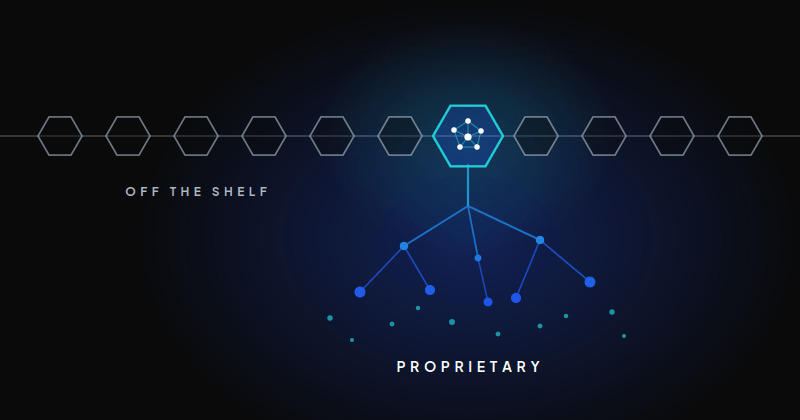
Every company buying AI right now is buying more or less the same thing: a handful of foundation models, licensed through the same few clouds and wrapped in the same no-code tools. That worked as an advantage while the technology itself was scarce.
It stopped working the moment your competitor could buy the exact same capability, which happened faster than most boards have priced in. The case for custom AI for business starts with that uncomfortable fact about what everyone else already has.
Stanford’s 2025 AI Index Report put a number on how fast it happened. The cost of running a model at GPT-3.5 performance fell more than 280-fold in under two years, from about $20 per million tokens in late 2022 to roughly $0.07 by late 2024.
Capability that used to be scarce and expensive now gets priced like a utility. When intelligence itself gets that cheap that fast, it stops working as an advantage and becomes a baseline expectation, the AI equivalent of having a website.
So the real question was never which model to buy. It is whether your AI knows anything about your business that a competitor’s AI doesn’t.
What Generic AI Gives You
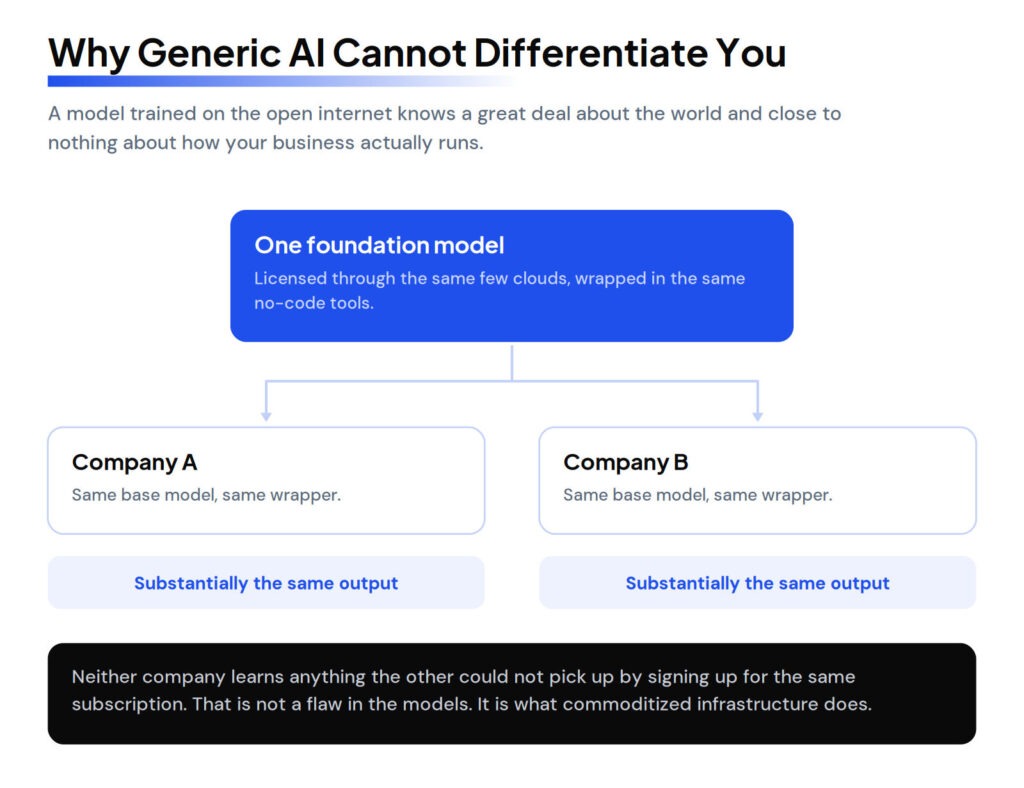
A model trained on the open internet knows a great deal about the world and close to nothing about your customers, your pricing exceptions, or the judgment calls your best people make a dozen times a day without writing them down.
Two companies in the same industry, running the same base model, get much the same output. Neither one learns anything the other couldn’t pick up by signing up for the same subscription.
None of that is a flaw in the models; it is just what commoditized infrastructure does. Electricity never made one factory more competitive than the factory next door on the same grid, and the AI layer most companies have deployed so far behaves the same way.
What Custom AI Model Development Looks Like
Custom AI model development rarely means training a model from scratch. Almost nobody needs to, and almost nobody should. The work is grounding a capable base model in the data, workflows, and decisions that make your business run differently from the one down the street.
That means the way your best account managers handle a renewal conversation, or the signals your underwriters weigh before overriding a system recommendation. It means the support cases your team resolves in ways that never made it into a manual.
Every one of those interactions is proprietary the moment it happens. Custom AI development that captures and learns from them, instead of treating each one as disposable, turns routine daily work into a compounding asset rather than an expense that resets to zero every quarter.
The shift is far enough along that Gartner named domain-specific language models one of its top strategic technology trends for 2026. Its analysts expect that by 2028, more than half of the generative AI models enterprises use will be domain-specific rather than general-purpose. Domain specific AI has moved from a niche technical choice to where the market is already heading.
The AI Data Moat
When the model is a commodity, your data is the one thing left that a competitor can’t buy off a shelf.
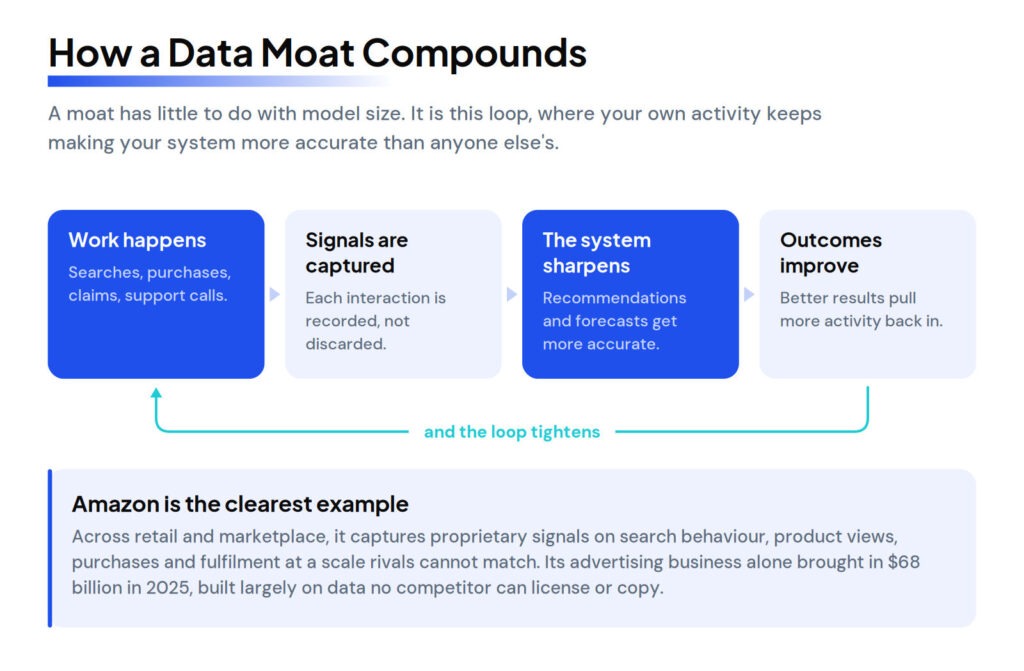
McKinsey’s work on building AI competitive moats points to Amazon as the clearest example. Across its retail and marketplace businesses, Amazon captures proprietary signals on search behavior, product views, purchases, and fulfillment at a scale rivals without that transaction history can’t match.
That data feeds back into sharper recommendations, better demand forecasting, and tighter ad targeting, and the payoff is measurable. Amazon’s advertising business alone brought in $68 billion in 2025, built largely on data no competitor can license or copy.
An AI data moat has little to do with model size and everything to do with that feedback loop, where your own activity keeps making your AI more accurate than anyone else’s. The gap it opens gets harder to close the longer the loop runs.
Why This Is a Board-Level Question Now
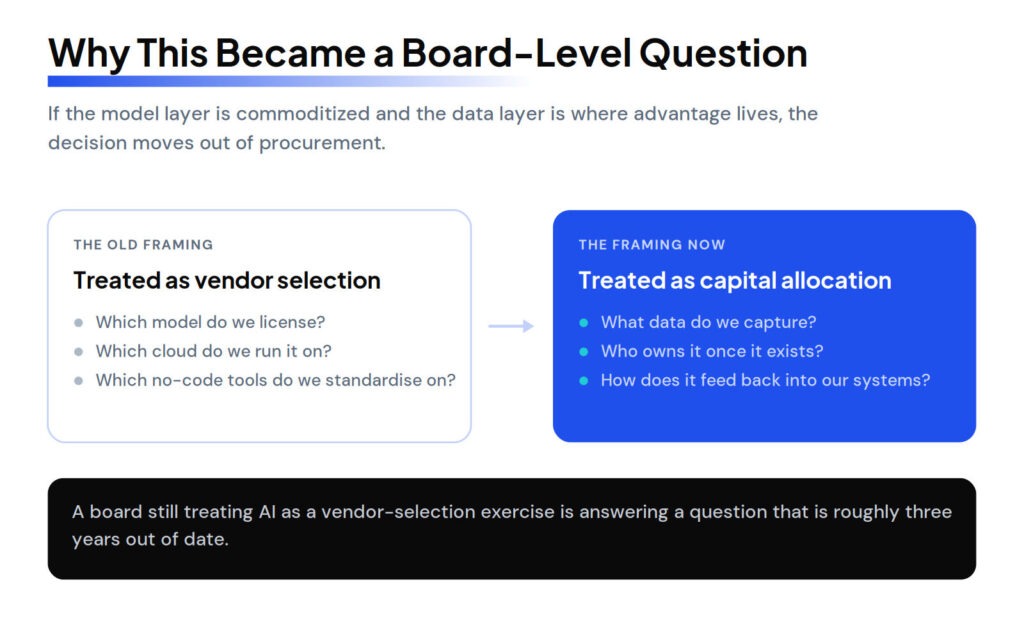
Enterprise AI differentiation used to sit inside an IT procurement decision. It doesn’t anymore.
If the model layer is commoditized and the data layer is where the advantage lives, then choices about what data you capture, who owns it, and how it feeds back into your systems belong next to choices about capital allocation and market positioning. A board still treating AI as a vendor-selection exercise is answering a question that is roughly three years out of date.
We’ve made a version of this case before from the technical side: once every competitor has the same no-code tools and agentic AI frameworks, speed-to-build stops being a differentiator. This is the business argument underneath that one. The tooling was never the moat. What you build with it, on data nobody else holds, is.
Where Arivonix Fits
This is the problem our custom AI solutions are built to solve. Our guide to specialized intelligence in agentic AI platforms walks through how that grounding gets built into a working system, layer by layer, rather than parked as a roadmap item for later.
A data moat only counts if you can show what your AI learned and where it learned it. In the systems we’ve built, that discipline is what separates a working moat from a slide about one. Our approach to data-centric AI assurance keeps that lineage documented as the system learns, so the advantage holds up in front of a board or a regulator instead of living in a pitch deck.
Companies that run their AI as a shared utility will get shared results. The ones investing in custom AI for business, grounded in data nobody else holds, end up with something a competitor can’t simply go out and buy.