Data Virtualization vs Data Replication in a Modern Data Fabric Architecture
Gartner expects organizations to abandon 60 percent of AI projects through 2026 when those projects are not backed by AI-ready data, and in the same research, 63 percent of organizations said they either lack the right data management practices for AI or are not sure they have them. Teams tend to blame the model or the prompt when a project stalls, but the weak point usually sits further down: the data itself, scattered across systems that were never designed to talk to each other, let alone feed an agent making decisions in real time.
That is the gap a data fabric architecture is meant to close: a connected layer that gives AI systems governed, current access to data wherever it happens to live. “Data fabric” is the umbrella term, though. The architectural choice sits underneath it, and it comes down to two approaches. Data virtualization queries data where it sits. Data replication copies it somewhere new. For AI workloads, that choice carries real consequences for speed, cost, and how defensible your governance is.
Two Ways to Get AI the Data It Needs
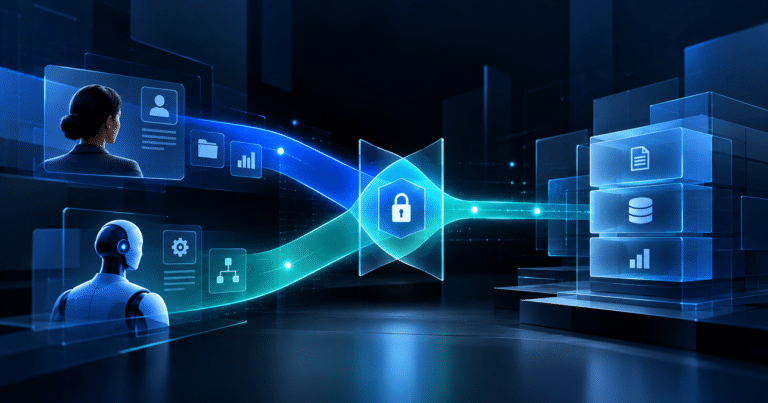
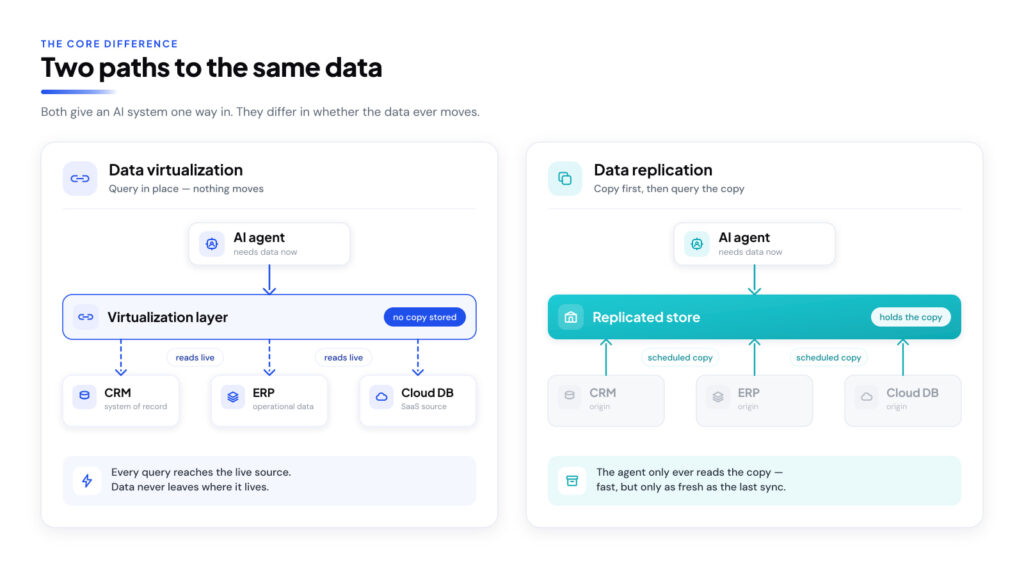
Data virtualization creates a query layer over your existing systems. When an application or an AI agent asks for data, the virtualization layer translates the request, sends it to the source systems in parallel, and returns a combined result. Nothing moves and nothing gets duplicated. The data stays where it lives, and every query reflects whatever is true in the source at that moment.
Data replication takes the opposite approach. It physically copies data out of the source systems into a new location, such as a warehouse, a lake, or a dedicated analytical store, either on a schedule or continuously. Once the copy exists, queries run against it instead of the original system. That takes load off production databases and gives consumers a stable, fast target to query.
Most real deployments end up using both. For AI workloads, the useful question is which workloads belong on each.
Data Pipeline Architecture: Where Each Approach Runs
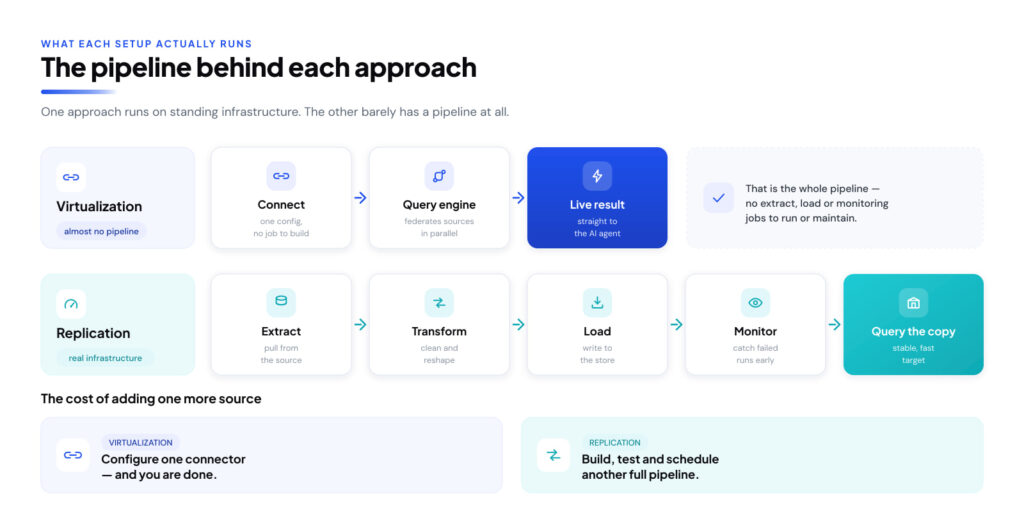
The pipeline architecture looks different depending on which approach a workload uses. A virtualization-based setup has almost no pipeline to maintain. There is a connection layer and a query engine, and adding a new data source means configuring a connector rather than building and scheduling a fresh extraction job.
A replication-based setup runs on real pipeline infrastructure: extraction jobs, transformation logic, load schedules, and the monitoring that catches a failed run before someone notices stale data downstream. That infrastructure is what gives replication its performance advantage, since queries hit a purpose-built copy instead of a live production system under load. It is also what makes replication slower to extend. Every new source is another pipeline to build, test, and maintain.
Governance Implications
Fewer copies, fewer places data can drift
Governance gets simpler with fewer copies of the same data. A virtualization layer centralizes access rules, masking policies, and audit logging in one place, so a change to who can see a sensitive field takes effect everywhere at once. Replication multiplies that surface area. Every physical copy is another place where permissions can drift out of sync with the source, and another place an auditor has to check.
The same principle runs through AI data governance more broadly. The harder it is to say where a piece of data lives and who touched it, the harder it is to prove that oversight happened at all. It is the same case we made for provable AI oversight, where being able to show the work is the whole point. The same logic applies one layer down, at the data itself.
Where replication still wins on governance
Centralization is only one of the pillars of data governance. Regulated environments often need immutable, timestamped snapshots for audit, a record of what the data looked like at a specific point in time. A live virtualization query cannot provide that by definition, since it always reflects the current state. In those cases, a replicated, versioned copy is what the audit standard requires.
Real-Time Access Tradeoffs for AI Workloads
Feeding AI real-time data raises the stakes on this tradeoff in a way traditional BI dashboards never did. A retrieval-augmented generation system answering a customer question needs the current account balance, not last night’s snapshot. A virtualization layer delivers that by default, since every query reads live. The cost shows up in query performance. Pulling from several live sources under real concurrency can add latency that a dashboard tolerates and an agent-facing application often cannot.
Change data capture is the middle path most mature architectures land on. Instead of a nightly batch job or a fully live federated query, streaming integration through CDC captures only what changed in a source and propagates it continuously, often within seconds. IBM’s explanation of change data capture points at this use case directly, noting that keeping source data current is what lets retrieval-augmented generation systems work from live information instead of a stale snapshot. CDC gives AI workloads most of virtualization’s freshness at closer to replication’s performance.
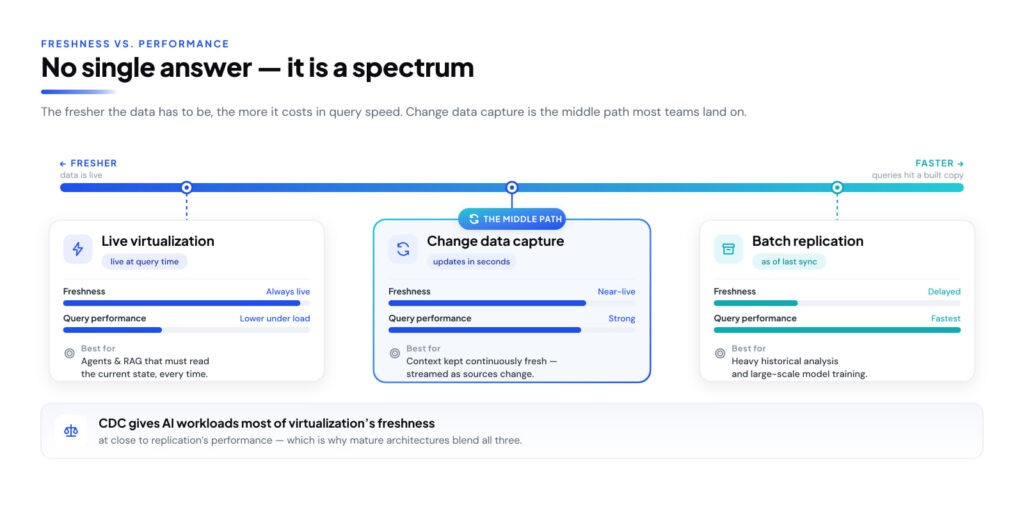
Making that hybrid pattern work at scale takes real data orchestration: coordinating which workloads hit the live virtualization layer, which run against a CDC-fed replica, and which still depend on scheduled batch replication for heavier historical analysis. That orchestration layer is where a lot of data fabric architecture projects succeed or stall. The architecture diagram is the easy part. Keeping it correctly routed as sources and workloads change is the ongoing work.
Virtualization and replication at a glance
| Data virtualization | Data replication | |
|---|---|---|
| How data is accessed | Queried in place, across the source systems | Copied into a separate store and queried there |
| Data freshness | Live at query time | As current as the last sync |
| Query performance | Bound by the live sources under load | Fast against a purpose-built copy |
| Pipeline overhead | Connectors, little to maintain | Extraction, transformation, load, monitoring |
| Governance surface | Centralized in one layer | Multiplied across every copy |
| Best-fit AI workloads | Agents, RAG, real-time decisions | Model training, historical analysis, audit snapshots |
So Which Architecture Wins for AI?
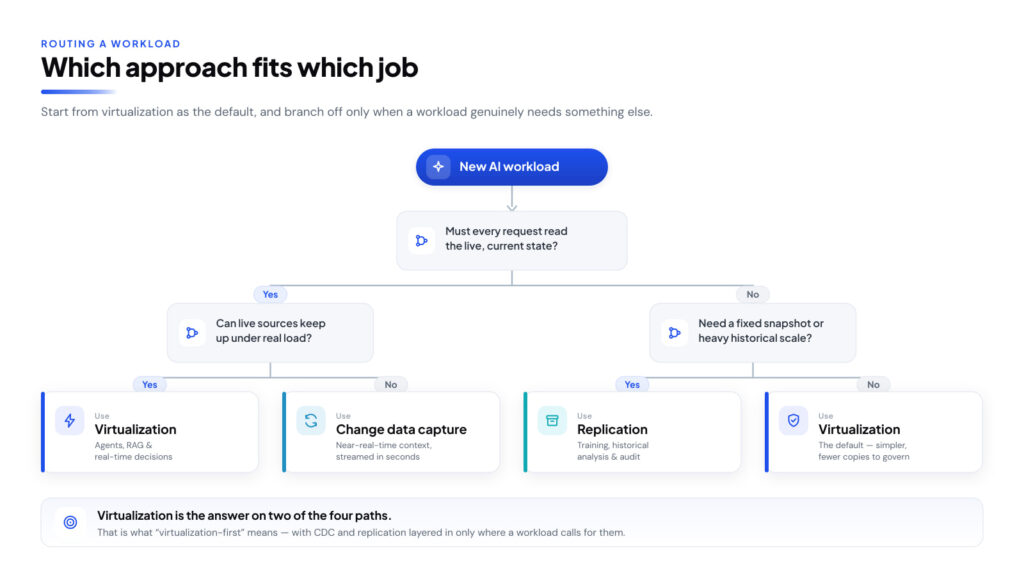
For most AI workloads, virtualization should be the default access layer. AI agents and retrieval systems ask a different question than a quarterly report does. They need to know what is true right now, from a source that is still authoritative, with governance that holds up when someone asks how a decision got made. A virtualization-first architecture is built to answer that. Databricks’s overview of data virtualization frames the core business case around centralized governance and reduced duplication rather than raw throughput.
Replication keeps its place where performance at scale matters more than freshness. High-volume model training, large historical analysis, and workloads that need a stable, versioned snapshot for audit are better served by a copy built for the job. As one comparison of the two approaches puts it, the right answer depends on what a given workload needs from the data, which is why a single platform-wide default rarely holds up.
A data fabric architecture built on that reasoning, with virtualization as the default and replication and CDC layered in where a workload calls for them, is what makes the “AI-ready” label mean something. Gartner describes data fabric as a composable architecture assembled from interoperable technologies, something a team keeps building on as its sources and workloads shift.
Where Arivonix Fits
This is the layer our approach to data-centric AI assurance is built around: governed, traceable access to current data, so an AI agent’s decision can be tied back to the exact data it acted on, even as copies elsewhere drift out of date.
That same architecture supports the Agentic AI Designer directly. An agent is only as reliable as the data it reasons over, and a data fabric that blends virtualization, CDC, and targeted replication well is what keeps that data both current and accountable as agents take on higher-stakes decisions.