
Human-in-the-Loop AI Governance: Where Human Oversight Belongs When AI Agents Act
Ask a compliance officer in 2024 what worried them about AI, and the answer usually came back to a single bad output. Maybe a wrong figure in a report, or a recommendation skewed by biased data that a reviewer caught before it reached a customer.
Ask the same question now, and the worry has shifted from one wrong answer to something that keeps moving. An agent plans a task and acts on it, then moves to the next step before anyone looks.
That shift is why human-in-the-loop AI governance has moved from a line in an AI policy to a standing item in planning reviews. Generative AI mistakes sat still long enough for a person to catch them. Agentic AI doesn’t wait. If step one is wrong, steps two through five inherit the error before anyone sees the workflow.
Requiring a person to approve every single AI action sounds safe. In practice it works like a supervisor countersigning every email a call center sends. It holds up while volume is low, then becomes the reason nothing ships once volume climbs.
So the useful governance question skips past whether to keep people involved. Of course they should be. What matters is where in the workflow a person needs to stand, and what power they hold once they get there.
What Human-in-the-Loop Means for Agentic AI
The term gets used loosely, and that looseness causes real confusion. In its strict sense, human-in-the-loop (HITL) means a person reviews and approves a specific AI decision before it takes effect.
That is a higher bar than someone simply knowing AI is involved, and a higher bar than a person checking the AI’s work after it has already run.
The Three Positions of Human Oversight: In, On, and Out of the Loop
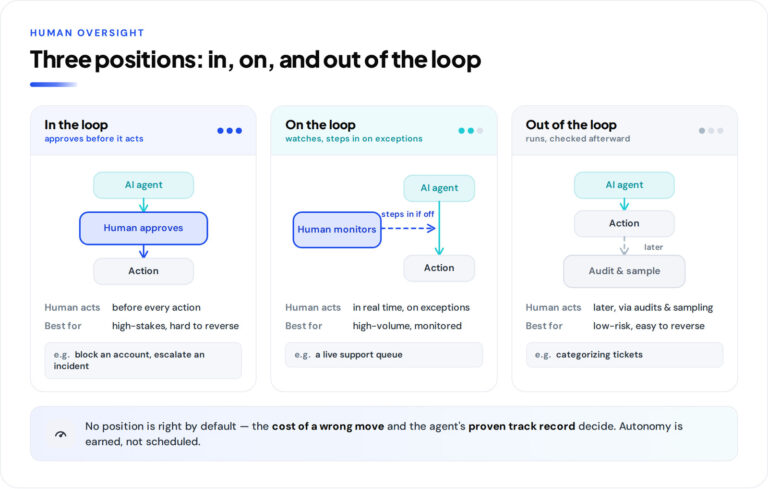
Governance teams usually work across three positions, and the labels matter because each one carries a different guarantee.
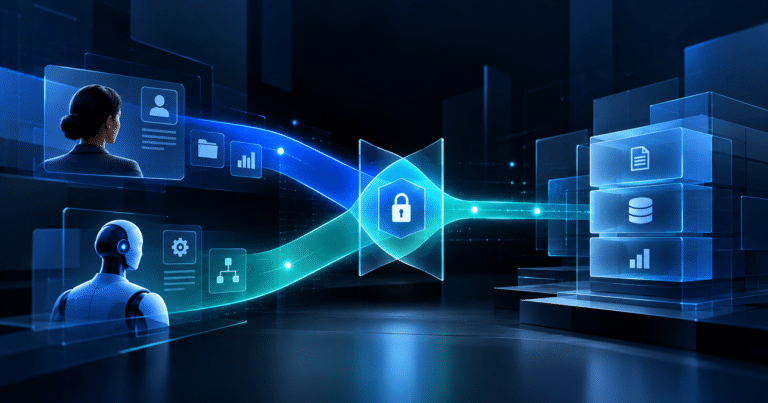
In the loop puts a human on the action before it happens. It fits high-stakes calls such as blocking an account or escalating an incident to leadership, where a wrong move is expensive and hard to walk back.
On the loop lets a human monitor the system in real time and step in when something looks off, without signing off on each action. This suits high-volume work where line-by-line review was never realistic.
Out of the loop lets the system run on its own, with checks applied later through audits and sampling. It only fits low-risk, high-volume tasks that are easy to reverse.
None of these positions is automatically right. The choice depends on what happens if the agent gets it wrong, and how often it has already proven it gets things right. Autonomy is earned through a track record, and a date on the calendar is no substitute for one.
Why the “Panic Button” View of Oversight Falls Short
Plenty of organizations still treat human-in-the-loop as a fallback, something bolted on for the moments when AI misbehaves. That made sense for chatbots and content generators, where a bad output just sits on a screen until someone reads it.
It stops making sense the moment an agent can move money or change a customer record without waiting for permission.
Forrester analyst Craig Le Clair has made the distinction plainly. Generative AI tends to fail in visible ways that a reviewer can catch, while agentic AI shifts to a model where the system plans, acts, and can go wrong well before it reaches any oversight checkpoint. By the time a person notices, the workflow may already be several steps past the point where a fix was cheap.
The takeaway is to build oversight into the architecture and stop treating it as an emergency stop. Routine work such as categorizing tickets or drafting a first-pass reply can run with light supervision. Financial approvals, medical triage, legal actions, and anything that can’t be undone need a checkpoint designed in from the first day.
What the Data Shows About Getting This Wrong
The risk here shows up in the numbers. Gartner projects that over 40 percent of agentic AI projects will be canceled by the end of 2027, and the firm ties the failures to escalating costs, unclear business value, and weak risk controls rather than to the models themselves.
McKinsey’s research on scaling agentic AI frames the same gap from another angle. Nearly two-thirds of organizations worldwide have experimented with agents, yet fewer than 10 percent have scaled them to real value.
Deloitte’s research on AI agents adds a governance-specific figure: only about one in five companies has a mature governance model for autonomous agents, even as adoption plans keep accelerating.
That distance between ambition and governance maturity is where projects stall. Teams that hand an agent access and authority before deciding who owns oversight, what triggers escalation, and how a decision gets reversed are the ones that end up in Gartner’s cancellation column.
The upside is just as concrete. An NBER field study of roughly 5,000 customer support agents recorded a 14 percent increase in issues resolved per hour when AI assisted human agents instead of replacing their judgment. The software handled speed and pattern matching while the people kept the final call. That pairing is what human oversight of AI agents is meant to protect.
What Regulation Already Requires
This has moved out of best-practice territory and into compliance.
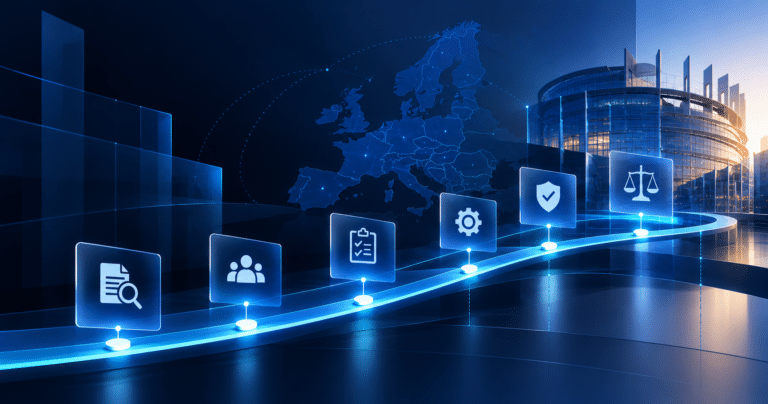
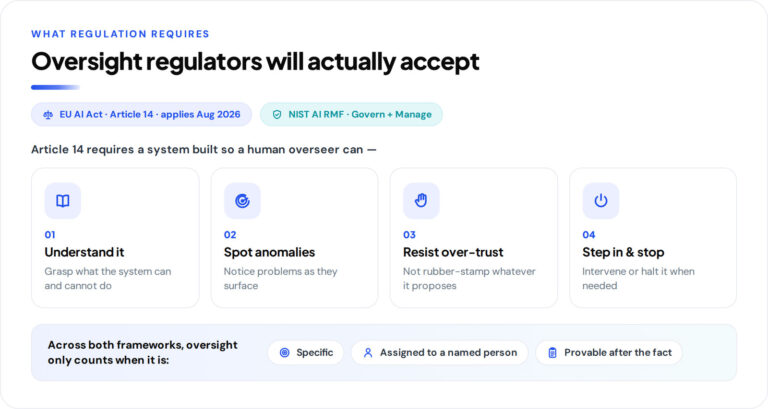
Article 14 of the EU AI Act makes human oversight a hard design requirement for high-risk AI systems, and those obligations started applying in August 2026. A system has to be built so a human overseer can grasp what it can and can’t do, spot anomalies as they surface, resist the pull to over-trust its output, and stop it when needed.
Regulators reviewing high-risk deployments look at whether that oversight is real or just there on paper. A reviewer who signs off on whatever the AI proposes, without the training or the interface to catch a problem, doesn’t meet the standard, even with a human technically in place.
The NIST AI Risk Management Framework carries a similar expectation through its Govern and Manage functions, pushing organizations toward documented, auditable oversight and away from an informal sense that someone is watching. Across both frameworks the direction is the same: oversight has to be specific, assigned to someone by name, and provable after the fact, or it doesn’t count.
Match the Level of Oversight to the Risk
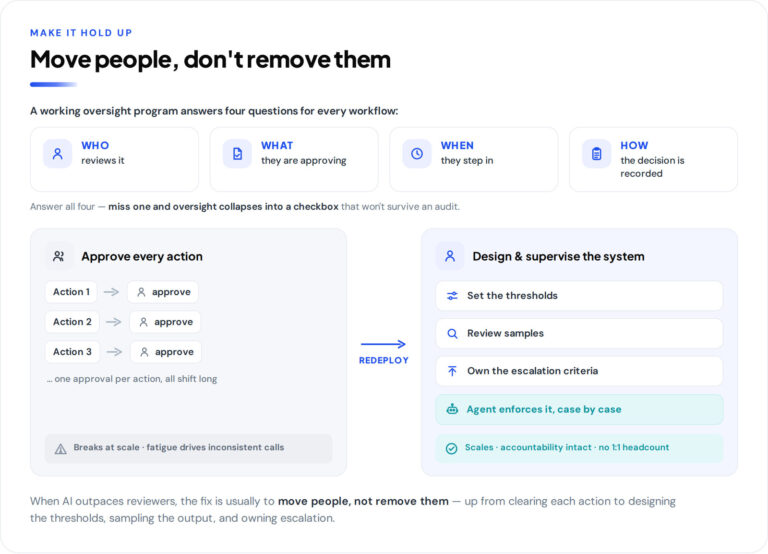
A human signature on every AI action is the kind of control that collapses under its own weight. It slows the work to a crawl and breaks down at scale. People can’t hold steady judgment across thousands of decisions in one shift, and the fatigue that creeps in produces the same inconsistent, biased calls that automated checkpoints were built to remove.
A better approach sizes the checkpoint to four things: how costly an error would be, how much volume the workflow carries, how reliable the system has proven itself, and what the relevant regulation demands. A newly deployed agent handling financial approvals belongs in the loop. A proven agent triaging low-value support tickets can run on the loop, with a person reviewing samples and setting thresholds instead of clearing each case by hand.
Building Human-in-the-Loop AI Governance That Holds Up
A working oversight program answers four questions for every AI-driven workflow: who reviews it, what they are approving, when they step in, and how the decision gets recorded. Miss one of the four, and oversight tends to collapse into a checkbox, the kind that won’t survive a regulator’s audit or the fallout from a real incident.
This is where redeployment comes in. When AI moves faster than reviewers can keep pace, the fix is usually to move people rather than remove them: from approving each individual action to designing the thresholds, reviewing samples, and owning the escalation criteria the system then enforces on its own.
That keeps accountability intact without turning governance into a headcount problem that grows one-for-one with the number of agents.
Where Arivonix Fits
This is the problem Arivonix built its Agentic AI Designer to handle. The platform treats oversight as something teams place on purpose, so a checkpoint sits exactly where it belongs in a workflow, sized to the risk of what the agent is doing at that step.
That control runs through the same layer described in our guide to specialized intelligence in agentic AI platforms, so a low-risk agent handling routine volume and a high-risk agent making decisions with real financial or regulatory weight both answer to one documented standard.
For teams that have to show, not just say, that human oversight is working, our approach to data-centric AI assurance builds the audit trail into the workflow itself rather than bolting it on after deployment. That is what separates responsible AI governance you can prove from the kind you can only claim.
Most teams running agentic AI in production already sense where their oversight is thinner than it should be. The workflows that move money, touch regulated data, or make decisions that are hard to undo are usually worth checking first.