
How to Evaluate an Enterprise AI Agent Platform: A CIO’s 12-Point Checklist
Most of the vendor decks landing on a CIO’s desk right now use the word “agentic” the way software once used “cloud-native”: a label stuck on after the fact, describing the marketing more than the build.
That distinction matters more than it sounds. Gartner estimates that of the thousands of vendors marketing agentic AI, only about 130 are building systems that meet its definition. The rest are chatbots, robotic process automation, or assistants that got relabeled.
So anyone drawing up a shortlist of the top AI agents on the market runs into a filtering problem before the feature comparison even starts. That is why evaluating an enterprise AI agent platform takes a different checklist than evaluating ordinary software.
The usual AI vendor selection criteria still apply. Uptime, integrations, and support tiers all matter. But an agent platform adds a harder question underneath them: what happens when the system is making decisions and taking actions on its own, and can you see, control, and prove what it did.
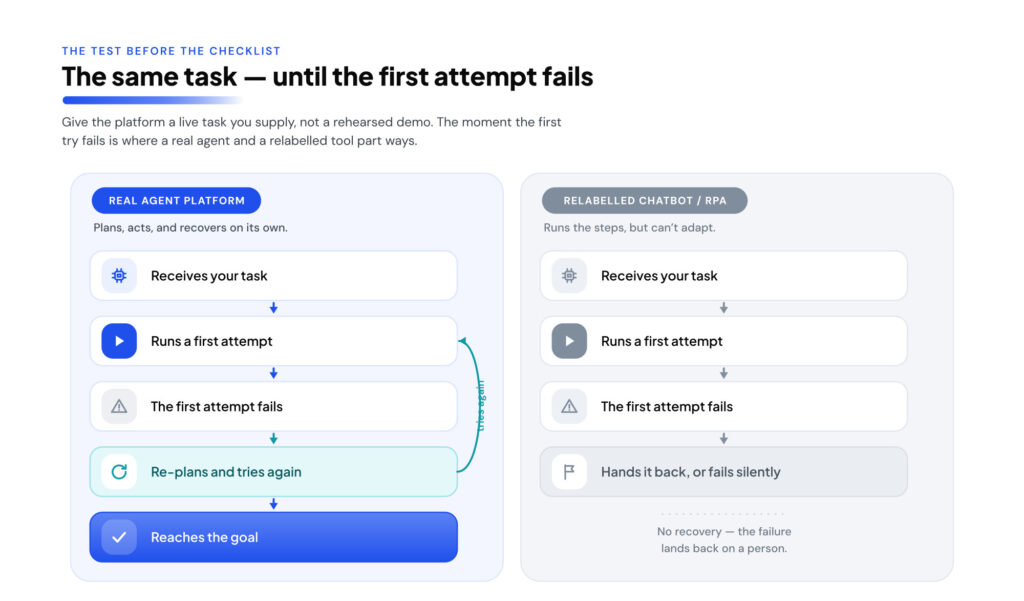
The twelve points below are organized around the criteria that separate a platform ready for production from one that will still be in pilot a year from now.
First, Confirm You’re Buying a Real Agent Platform
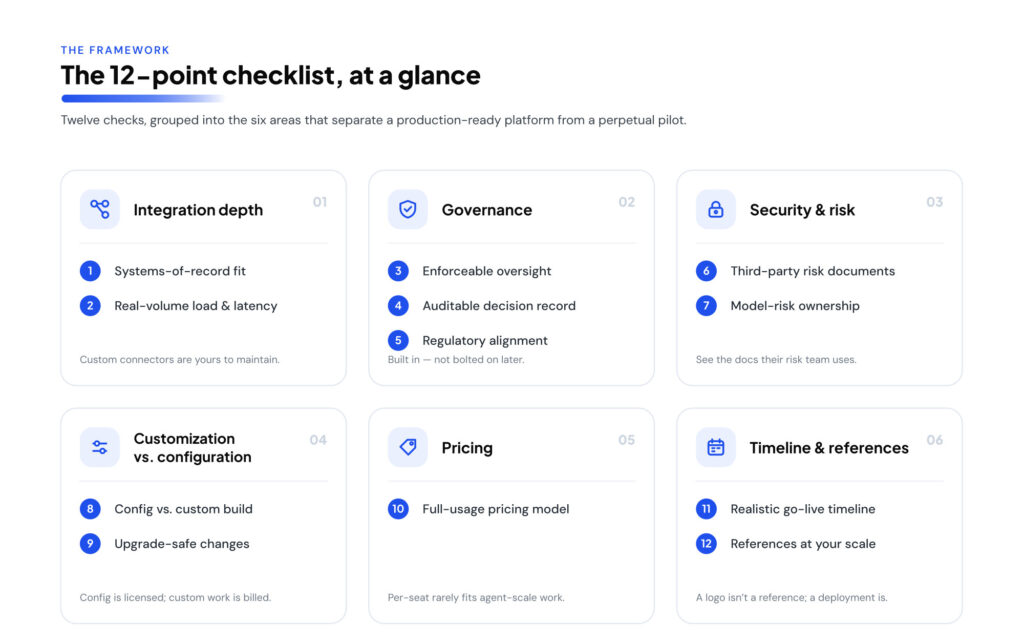
Before scoring any vendor against the list below, settle the more basic question: can this system plan its own next step and act on it, or is it a workflow tool that calls a language model when prompted?
Ask for a live run against a task you supply, not a rehearsed demo, and watch what happens when the first attempt fails. A real agent replans. A relabeled chatbot or automation tool hands the failure straight back to a human, or worse, fails silently.
Integration Depth
1. Confirm compatibility with your systems of record
Ask exactly which of your core systems the platform connects to natively, and which need custom middleware. Every custom connector is a maintenance cost your team inherits once the vendor’s implementation staff move on.
2. Test the platform against your real data volume and latency
A demo running on sample data proves very little. Push the platform through a realistic slice of your production volume before you sign, and watch how response times hold up as load climbs.
Governance Capabilities
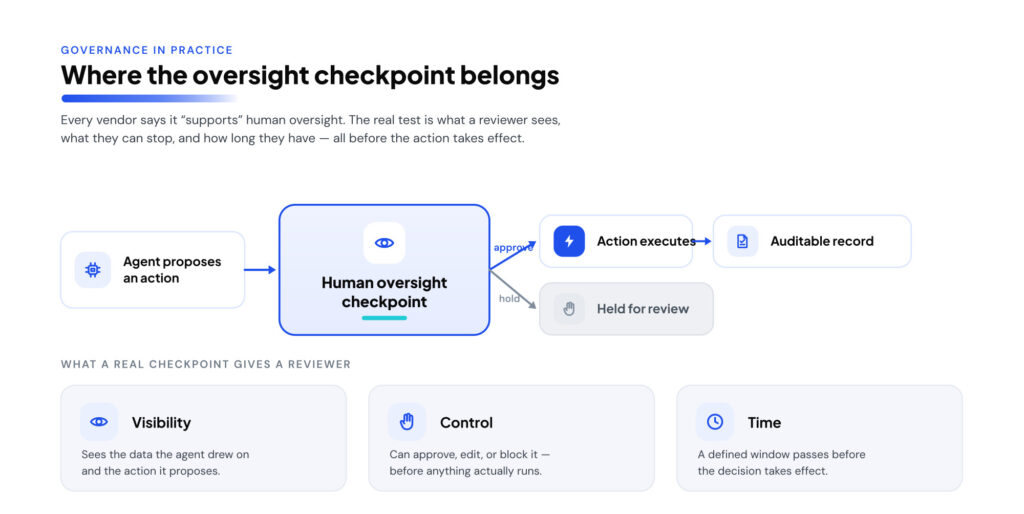
3. Ask how oversight is enforced in practice
Nearly every vendor will say their platform “supports” human oversight. The better question is how a reviewer intervenes: what they see, what they can stop, and how long they have to act before an agent’s decision takes effect.
We’ve written in more depth about where that oversight checkpoint belongs and how to size it to risk in our piece on human-in-the-loop AI governance.
4. Confirm every agent decision produces an auditable record
System logs are not the same thing as an audit trail. Ask to see a real record of a past agent decision: the data it drew on, what it decided, and who was positioned to catch a mistake.
If the vendor can’t produce one on request, assume the audit trail doesn’t exist yet.
5. Check alignment with the regulatory frameworks that apply to you
Article 14 of the EU AI Act has applied to high-risk AI systems since August 2026, and it requires human oversight to be engineered into the system itself, at the design stage. The NIST AI Risk Management Framework sets a comparable bar in the United States.
Ask the vendor to walk through how their platform maps to whichever AI governance frameworks apply to your industry, and be skeptical of a generic answer that never mentions your sector.
Security and Risk Posture
6. Request real third-party risk management documentation
KPMG’s 2026 Global Third-Party Risk Management Survey found that regulatory compliance and cyber risk are now the two biggest forces shaping third-party risk strategy, and that most programs still struggle to connect third-party risk with the rest of their risk systems.
So ask to see the vendor’s real AI third-party risk management documentation, the version their own risk team works from, and check whether it accounts for how your risk tooling will plug into theirs. A summary slide built for the sales call won’t answer that.
7. Ask how the vendor manages model risk
Model behavior drifts as data and usage patterns shift. Ask what triggers a retraining or reconfiguration cycle, what the system does when the model is uncertain, and who at the vendor owns AI model risk management day to day.
A vendor without a clear answer is asking you to discover their process during an incident.
Customization vs. Configuration
8. Separate what’s configurable from what needs custom development
Vendors often blur this line on purpose, because configuration is included in the license and custom development is billed separately. Get a specific list of what your team can change through settings alone, and price out anything outside that list before you sign.
9. Ask what breaks at upgrade time
Heavily customized deployments are the ones most likely to break when the vendor ships a platform update. Ask directly what happens to your customizations during their upgrade cycle, and ask for a customer reference who has lived through at least one major version upgrade.
Pricing Model
10. Model the full pricing structure against your real usage
Per-seat pricing rarely maps cleanly onto agent-based work, where a single agent can do the volume of several human seats. Ask the vendor to model their pricing against your expected usage at full scale, and get clarity on what sits in the base platform fee versus what gets billed as consumption grows.
Implementation Timeline and Reference Customers
11. Get a realistic timeline based on comparable deployments
Ask for the timeline from contract signature to production on a deployment close to yours in scope and industry. A vendor that can only speak to demo-to-pilot speed hasn’t shown you how long production readiness really takes.
12. Talk to reference customers at your scale, in your industry
A logo on a website is not a reference. Ask for a customer who deployed the platform at a comparable scale and in a comparable regulatory environment, and ask them what the vendor’s proposal left out.
Why Vetting an Enterprise AI Agent Platform Pays Off
Gartner projects that over 40 percent of agentic AI projects will be canceled by the end of 2027, and points to escalating costs, unclear business value, and inadequate risk controls as the reasons. Those are problems of economics and governance, which is exactly what a disciplined evaluation is built to catch.
McKinsey’s research on scaling agentic AI frames the same gap from another angle: nearly two-thirds of organizations have experimented with agents, but fewer than 10 percent have scaled them to real value. Deloitte’s research on AI agents adds a governance-specific figure, finding that only about one in five companies has a mature governance model for autonomous agents.
Every point on the checklist above marks a spot where an under-informed decision at signing turns into a stalled deployment eighteen months later. That is the failure those numbers describe.
The upside is just as concrete. An NBER field study of roughly 5,000 customer support agents found a 14 percent increase in issues resolved per hour when AI supported the agents’ judgment, the kind of gain a properly vetted platform can deliver.
Where Arivonix Fits
Arivonix’s Agentic AI Designer is an enterprise AI agent platform built around the criteria in this checklist from the start. Integration depth, governance checkpoints, and audit trails are part of its architecture, so your team isn’t rebuilding them as a customization project after go-live.
Our guide to specialized intelligence in agentic AI platforms walks through how that architecture handles workloads of different risk levels under one documented standard. Our approach to data-centric AI assurance is what lets your team answer an auditor’s question about a specific agent decision with a record, not a guess.
If you’re running vendor evaluations now and want an outside read on where a platform’s pitch and its architecture don’t line up, that’s a conversation worth having before you sign, while there’s still room to change the terms.