
SLM vs LLM: Model Selection for Agentic AI Platforms

Ask an engineering team in 2024 which model to use, and the answer was almost always the biggest one available. Ask them today, and the same question, now framed as SLM vs LLM, gets a more careful answer, usually a longer one.
The change didn’t come from large models getting worse. It came from a year of live traffic. Teams finally had real numbers on what their requests cost and how slow some of them ran, plus a much clearer view of where sensitive data was going. A lot of them didn’t like what they saw.
One picture kept repeating. A trillion-parameter model handling a routine account lookup is a surgeon showing up to take your blood pressure. It works. It’s rarely the right use of the resource, and almost never the cheapest.
So the decision stopped being a contest over which model is smarter. It became a sharper question: which parts of an agentic AI platform need frontier reasoning, and which parts have been overpaying for it without anyone noticing?
Why “SLM vs LLM” Replaced “Which LLM Should We Use?”
What Counts as a Small Language Model in 2026?
The line has moved. A small language model in 2026 usually runs under 15 billion parameters. That’s small enough to sit on a single GPU, a good laptop, or an edge device.
A large language model runs from tens to hundreds of billions of parameters and lives in a managed cloud environment. Today’s SLM tier includes Microsoft’s Phi-4, Google’s Gemma, and the smaller Llama 3.2 builds from Meta. Microsoft has positioned these models for cost-sensitive and edge-deployed work. They aren’t a stripped-down flagship. They’re built for a different job.
Here’s how the two compare in practice.
Small Language Models vs Large Language Models
| Comparison | Small Language Model (SLM) | Large Language Model (LLM) |
|---|---|---|
| Typical size | Under ~15 billion parameters | Tens to hundreds of billions |
| Where it runs | Single GPU, laptop, or edge device | Managed cloud or data center |
| Response time | Often under 200 ms, running locally | Inference plus a network round trip |
| Cost at volume | Low and predictable | Climbs with tokens and traffic |
| Strongest at | Narrow, repeatable, well-defined tasks | Open-ended reasoning over wide inputs |
| Data footprint | Can stay on-device or in your environment | Usually sent to a third-party API |
| Examples | Phi-4, Gemma, Llama 3.2 (small builds) | Frontier GPT, Claude, Gemini tiers |
The Split That Matters Is Where the Model Runs
Parameter count is the number everyone quotes, but it isn’t what drives the decision. Where a model runs shapes almost everything downstream. It sets how much memory the model has to work with and how fast it has to respond. It usually decides the compliance story you end up telling, too.
A model made for a phone lives inside a memory budget measured in gigabytes and a latency budget measured in milliseconds. A model built for a data center has room to spare and gets judged mostly on raw capability. Frame it that way, and “SLM or LLM” stops being one company-wide call. It turns into a decision you make per workflow.
Latency and Cost Decide More of This Than Benchmarks Do
The Latency Gap in Practice
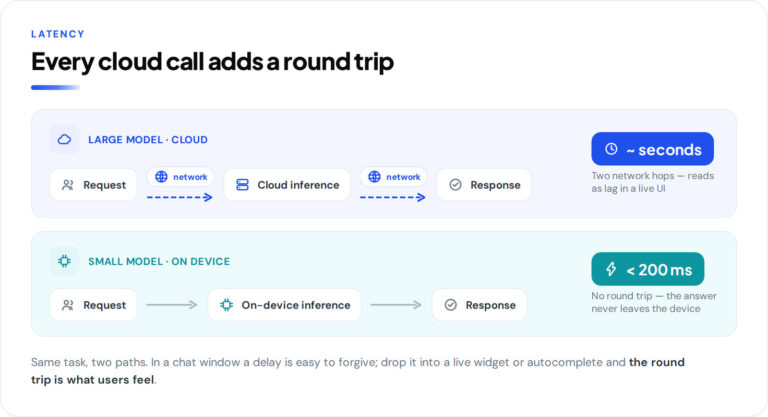
Every cloud-hosted large model adds a network round trip to inference. You might not feel it at first. A two-second delay is easy to forgive in a chat window. Drop those same two seconds into a live support widget or a code-autocomplete feature, and it reads as broken software.
Small models running locally skip the round trip. Many answer in well under 200 milliseconds. For anything interactive, that gap decides whether people keep using a feature or quietly drop it. LLM latency and cost tend to move together here, which leads straight into the other half of the tradeoff.
What the Cost Math Looks Like at Scale
The economics push the same way, and they move fast once volume climbs.
Run the numbers on a million routine chats a month, the sort of monthly volume plenty of enterprise AI teams already handle. Handled by a frontier cloud LLM, that workload sits somewhere in the low tens of thousands of dollars, and it climbs as each exchange gets longer. Move the same predictable work onto a small, task-tuned model you host yourself, and the monthly compute can fall to the low hundreds. Treat those figures as an order-of-magnitude picture rather than a quote, but the shape holds: you’re often looking at a 10x to 50x swing on traffic that looks identical to whoever’s on the other end.
That swing is what sits behind Gartner’s forecast. By 2027, Gartner expects organizations to deploy small, task-specific models about three times as often as general-purpose LLMs. It ties the shift to cost and speed, plus the better accuracy these models show on the narrow, repeatable work they’re tuned for.
Where Specialization Beats Scale
How Small the Accuracy Gap Has Gotten
The old assumption was that a small model trades accuracy for speed. On the tasks a model was built or tuned for, that trade has mostly closed. The gap against a general-purpose LLM has gone from around 20 percent a couple of years ago to single digits today, and on some domain-specific benchmarks it’s hard to find at all.
Gartner went further and named IBM the company to beat in domain-specific language model enablement, pointing at the same pattern: right-sized models, tuned on relevant data, closing the accuracy gap while cutting cost and compute. The tradeoff didn’t vanish. It moved. A specialized small model gives up broad, general reasoning and gets back steady, calibrated performance on the exact work it was built for. On that work, domain-specific AI models tend to win outright.
Privacy and Edge Deployment Point the Same Way
Why Regulated Industries Moved First
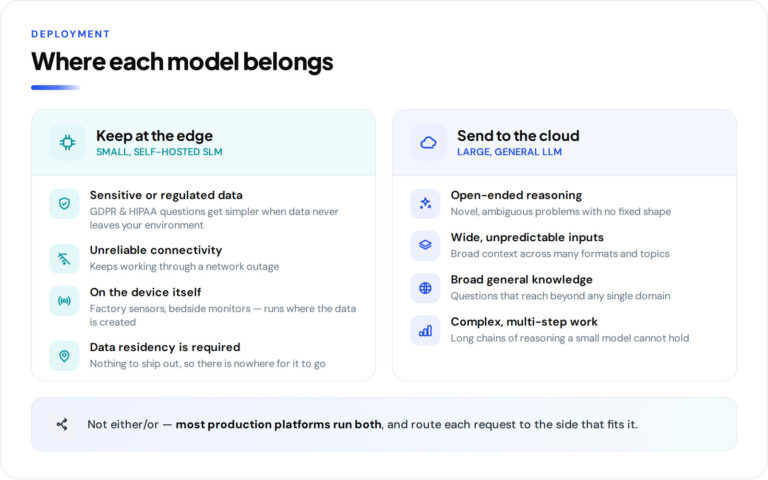
Sending a customer’s financial record or medical history to a third-party API is a compliance conversation before it’s a technical one.
Regulated sectors have moved toward small, self-hosted models faster than most, and the logic is simple. A model running inside your own environment never ships sensitive data anywhere to begin with. For a GDPR or HIPAA data-handling question, that beats layering contractual language on top of a cloud API call. It also fits the kind of documented governance NIST’s AI Risk Management Framework expects organizations to show, the same governance work Deloitte finds separating the enterprises that scale AI from the ones that stall.
What Belongs at the Edge, and What Still Needs the Cloud
Edge and privacy travel together for a reason. A small model on a factory sensor or a bedside monitor keeps working through a network outage and has no reason to send the data it handles anywhere else. That’s real operational value wherever connectivity isn’t guaranteed and data residency isn’t optional. Done right, edge AI deployment turns on-device AI privacy from a policy promise into a physical fact: the data stays put because there’s nowhere for it to go.
None of this makes large models obsolete. Open-ended reasoning across a wide, unpredictable range of inputs is still where large models earn their spot, and no amount of fine-tuning turns a small model into a replacement for it.
Most Platforms Run Both: The Case for Model Routing Architecture
Routing, Guardrails, and Drafting
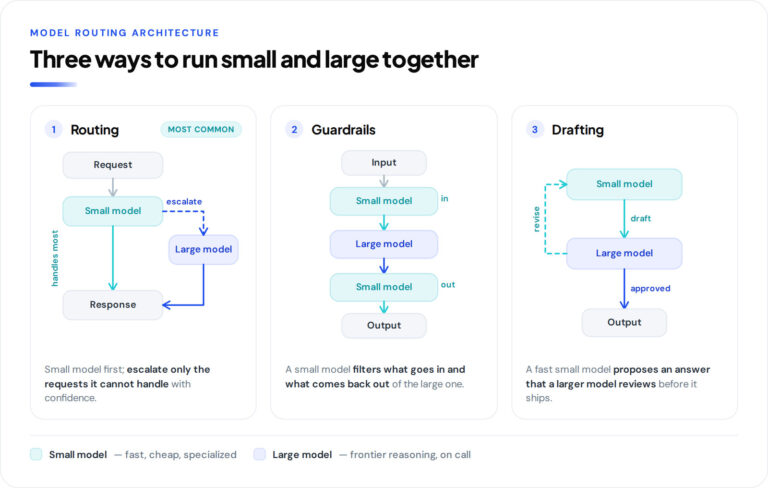
Most production systems don’t standardize on one model type. They compose both, and a few patterns show up again and again.
Routing sends a request to a small model first and escalates to a large one only when the task runs past what the small model can handle with confidence.
Guardrails put a small model in front of or behind the large one, checking and filtering what goes in and what comes back out.
Drafting lets a fast small model propose an answer that a larger model reviews before it ships.
Routing is the most common by a wide margin, and it’s easy to see why. It clears the bulk of predictable, repetitive work cheaply and saves expensive frontier reasoning for the requests that need it. Google Cloud’s guidance on combining fine-tuning and retrieval lands in a similar place from another direction: the useful question is usually which technique should own which part of the problem, rather than which single one wins outright.
Where Arivonix Fits
This is the question Arivonix’s Agentic AI Designer is built around. It doesn’t default every workflow to the biggest model on hand. It matches each task to the model that fits it: small and specialized where the work is narrow and repeatable, larger and more general where the reasoning calls for it.
That routing decision runs through the same governance layer as everything else on the platform. A small model handling sensitive data at the edge gets the same confidence scoring and output lineage as a large model doing complex reasoning in the cloud.
The approach traces back to what our guide to specialized intelligence lays out as the platform’s foundation. For teams that want the mechanics of how a model learns to specialize, our companion piece on how specialized AI learns from your data goes deeper into the fine-tuning and feedback loops that make a small model trustworthy enough to run unsupervised.
Most teams building an agentic AI platform already suspect their model mix is off somewhere. Looking at the actual traffic is usually where that hunch gets settled.