
EU AI Act Timeline: Why December 2027 Is Closer Than It Looks for Insurers

For most of the past two years, every EU AI Act timeline that compliance teams planned around pointed to one date: August 2, 2026. That’s when the rules for high-risk AI systems were due to start.
Then the date moved. The Digital Omnibus on AI, Regulation (EU) 2026/1744, came into force on July 27, 2026. It pushed the Annex III high-risk obligations back 16 months, to December 2, 2027.
It’s tempting to treat that as breathing room and quietly move budget elsewhere. We think that would be a mistake, especially for insurers.
The EU delayed the rules because regulators weren’t ready. Standards and guidance were running late, and so were national supervisors. The requirements themselves didn’t get any lighter. Life and health insurance pricing models are still high-risk, and the logging and data work behind them still takes months to build.
For an insurer, the more useful planning question is what you’ll need to show a supervisor on December 2, 2027, and how much of that can only come from months of operating history.
EU AI Act Implementation Timeline (2026 Update)
Here’s the full EU AI Act timeline as it stands after the Omnibus, based on the European Commission’s AI Act Service Desk.
The Omnibus is the EU’s simplification package for the Act. Alongside the date changes, it extends some SME relief to small mid-cap companies and adds two new prohibitions. The core high-risk framework stays as it was.
| Date | What applies | Status |
|---|---|---|
| Aug 1, 2024 | AI Act enters into force | In effect |
| Feb 2, 2025 | Prohibited AI practices (Article 5) and the AI literacy duty (Article 4) apply | In effect |
| Aug 2, 2025 | Obligations for general-purpose AI (GPAI) model providers begin; member states due to name national authorities and set penalty rules | In effect |
| Jul 27, 2026 | Digital Omnibus on AI (Regulation (EU) 2026/1744) enters into force | In effect |
| Aug 2, 2026 | Article 50 transparency duties apply; Commission can start fining GPAI model providers | In effect |
| Dec 2, 2026 | New prohibitions on AI-generated non-consensual intimate imagery and child sexual abuse material; Article 50(2) content-marking deadline for generative AI systems already on the market before Aug 2, 2026 | Upcoming |
| Aug 2, 2027 | GPAI models placed on the market before Aug 2, 2025 must comply; each member state needs at least one AI regulatory sandbox | Upcoming |
| Dec 2, 2027 | Annex III high-risk obligations apply, including life and health insurance risk assessment and pricing | Moved from Aug 2, 2026 |
| Aug 2, 2028 | Annex I high-risk obligations apply to AI built into regulated products | Moved from Aug 2, 2027 |
What Already Applies Today
Article 50 transparency duties have applied since August 2, 2026. If a customer is chatting with an AI assistant, the system has to make that clear unless it’s already obvious. Deployers also have to label deepfakes.
The Commission’s final Article 50 guidelines, published July 20, 2026, add a detail insurers should note. An AI agent that acts on its own has to disclose whose behalf it’s acting on. If you run a claims or service agent that talks to policyholders, this is a current obligation.
The original prohibitions and the AI literacy duty have applied since February 2025. The Commission’s power to fine providers of general-purpose AI models started on August 2, 2026.
What the Digital Omnibus Moved
Annex III high-risk systems, which include life and health insurance pricing, now face their obligations from December 2, 2027. AI built into products covered by EU product safety law (Annex I) follows on August 2, 2028.
The new prohibitions cover AI that generates non-consensual intimate imagery or child sexual abuse material. They apply from December 2, 2026, and are unlikely to affect an insurer’s core models.
One more detail matters for model owners. Under Article 111(2), high-risk systems already on the market before the new date only fall under the rules if their design changes significantly after it. Pricing models get retrained and re-tuned often, so treat that carve-out with caution. Decide now how you’ll judge whether a change counts as significant, and write the reasoning down.
Why the EU AI Act Delay Leaves Less Time Than It Seems
The reasons for the delay are also a good map of the risk that’s left.
The first harmonized standard, EN 18286 on quality management systems, was approved by CEN and CENELEC in June 2026. It was cited in the Official Journal only in October, which is when it started to carry a presumption of conformity for the requirements it covers. Most of the other standards the Commission asked for are still being finalized.
The Commission’s guidance on classifying high-risk systems was due in February 2026. It arrived as a draft on May 19, and the final version isn’t expected before the end of the year.
National supervision is uneven, too. A September 2026 mapping by Ireland’s ADAPT Centre found most of the 30 EU and EEA countries spreading AI Act enforcement across existing sector regulators. Two, Bulgaria and Iceland, still had no defined national governance structure.
As of October 2026, December 2, 2027 is about 13 months away. With the first standard only just cited, that’s roughly a year to build against an official route to conformity. Teams that start in 2027 will spend that year interpreting standards. Teams that start now can spend it testing against them.
EU AI Act High-Risk Rules for Insurers: Underwriting and Pricing Stay in Scope
The Omnibus moved the deadline for these models. Their classification stayed exactly where it was.
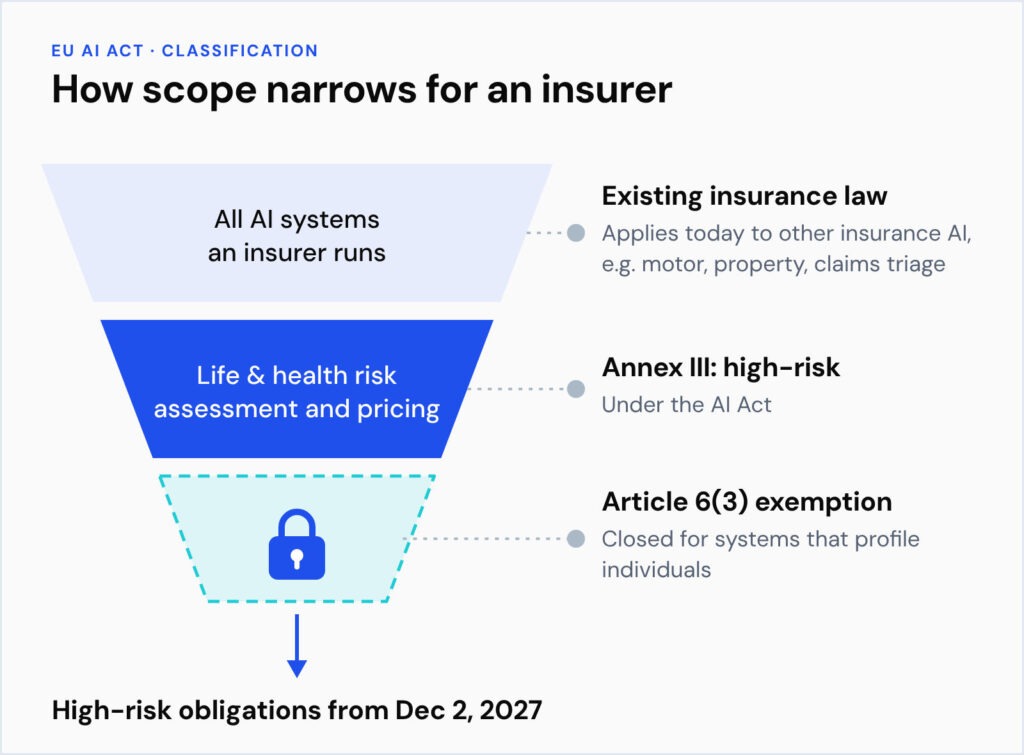
Classification. Annex III lists risk assessment and pricing for individuals in life and health insurance as high-risk. Article 6(3) lets a provider argue that a system doesn’t materially influence decisions. That route closes for any system that profiles individuals, and individual-level underwriting and pricing models generally do. If you do claim the exemption, Article 6(4) still requires you to document the assessment and register the system.
Two regimes. Life and health pricing models answer to the AI Act. Other insurance AI, such as motor or property pricing and claims triage, answers to existing insurance law, which applies today. EIOPA’s August 2025 opinion sets out what supervisors expect for those systems, including data governance, record keeping, fairness, explainability and human oversight. It leaves out systems that are high-risk under the Act.
Enforcement and penalties. For insurers, the market surveillance authority will generally be your own financial supervisor, under Article 74(6). Under Article 99, breaching the prohibitions can cost up to €35 million or 7% of worldwide annual turnover, whichever is higher. Most other obligations, including the high-risk requirements, carry fines of up to €15 million or 3%.
EU AI Act Compliance Work That Can’t Be Rushed
You can write a policy in a quarter. An operating record takes much longer to build.
That’s why the stronger EU AI Act compliance programs work backward from the evidence the Act expects. That evidence only exists if systems start producing it well before the deadline.
Logging That Reaches the Decision
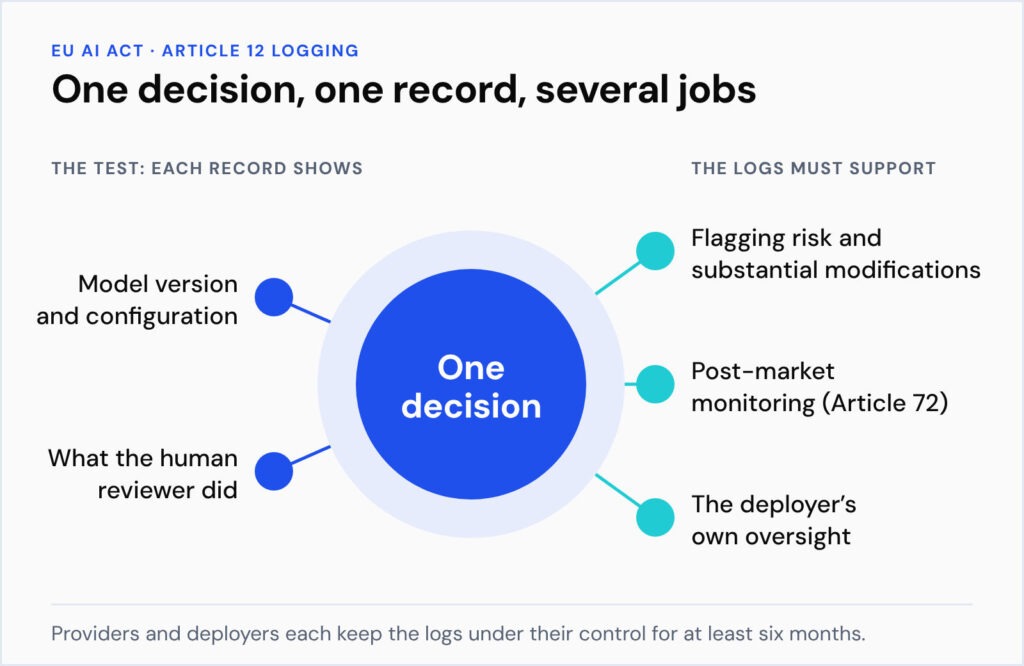
Article 12 requires high-risk systems to record events automatically over their lifetime. Those logs have to support post-market monitoring under Article 72 and the deployer’s own oversight. They also need to flag situations that could create risk or amount to a substantial modification.
Providers and deployers each keep the logs under their control for at least six months. Financial institutions can fold them into the documentation they already keep under financial services law.
The practical test is easy to state. For any single decision, can your logs show which model version and configuration produced it, and what the human reviewer did with it?
Data Governance as a Dated Record
Article 10 expects documented practices for where the data came from, how it was prepared, how it was checked for bias and where the gaps are. These choices are easy to record when a model version is built and painful to reconstruct later.
A record frozen for each model version in 2026 shows decisions made at the time. A reconstruction in 2027 reads like a story written after the fact.
Agent Boundaries and Baselines
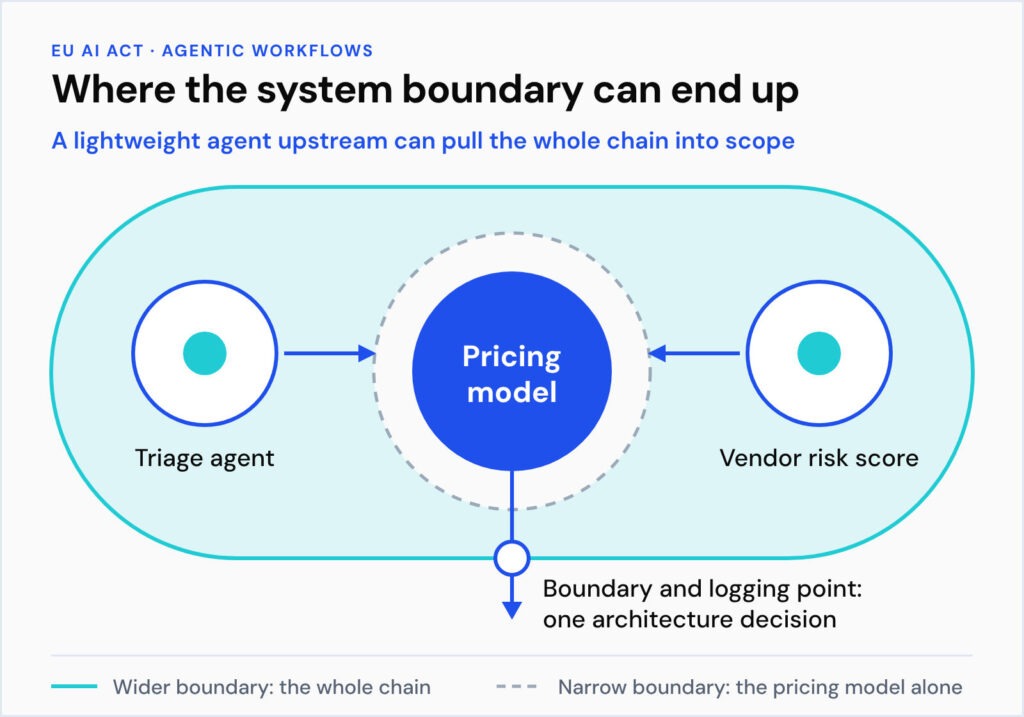
In an agentic workflow, a lightweight triage agent feeding a pricing model can pull the whole chain into scope. That risk grows as teams stack agents on fast-moving frameworks. Where you draw the system boundary, and where you log, is an architecture decision. It’s far cheaper to make early.
Baselines work the same way. Article 72 requires providers to collect and analyze performance data throughout a system’s life, and that data only means something against a documented starting point. Running shadow compliance now, which means generating the records a system would need while nothing is at stake, is how teams capture that baseline.
Two Procurement Moves for the Next Contract Cycle
First, build to the Act’s text and ISO/IEC 42001, then map your controls to EN 18286 now that it’s cited.
Second, if you buy a pricing model instead of building it, you’re still the deployer. You’ll need the provider’s instructions for use and access to the logs it holds. Upcoming contract renewals are the right time to negotiate those terms.
Where Arivonix Fits
Everything above depends on evidence that exists before anyone asks for it. That’s the problem our approach to data-centric AI assurance is built around. It keeps a running record of data lineage and agent decisions as systems operate, so there’s an operating history ready when a supervisor asks.
Our guide to specialized intelligence in agentic AI platforms covers the build side. You can also see how this works in underwriting and claims workflows for insurers.
Picture a life insurer with a pricing model, a triage agent that feeds it and a vendor-supplied risk score. (This is a hypothetical example.) Its readiness comes down to a few questions:
- Can it show how the system behaved over the past 12 months?
- Where does the high-risk boundary sit across the chain?
- Which logs does the insurer control, and which sit with the vendor?
Documented decision trails answer the first question. The other two are scoping calls that are much easier to settle in 2026 than in late 2027.
The revised EU AI Act timeline gives insurers two ways to use the extra 16 months. Some will treat it as a pause and arrive at December 2027 with a policy deck. Others will use it to build, and arrive with a year of operating evidence. Only the second group will have a clear answer when a supervisor asks how a model behaved last spring.
This article is for general information and is not legal advice. Confirm how the AI Act applies to your systems with qualified counsel.

Karthik Subramanian
Karthik Subramanian is the Chief Growth Officer at Arivonix AI, where he leads product and growth strategy. He brings over 20+ years of experience across information services and consulting, with expertise spanning product management, consulting, product development, and strategic AI initiatives. At Arivonix, he focuses on building product and service portfolios and translating evolving customer and market needs into practical technology solutions.