Where No-Code AI Limitations at Scale Show Up
The trouble tends to start in three predictable places, and none of them trace back to a flaw in the original idea.
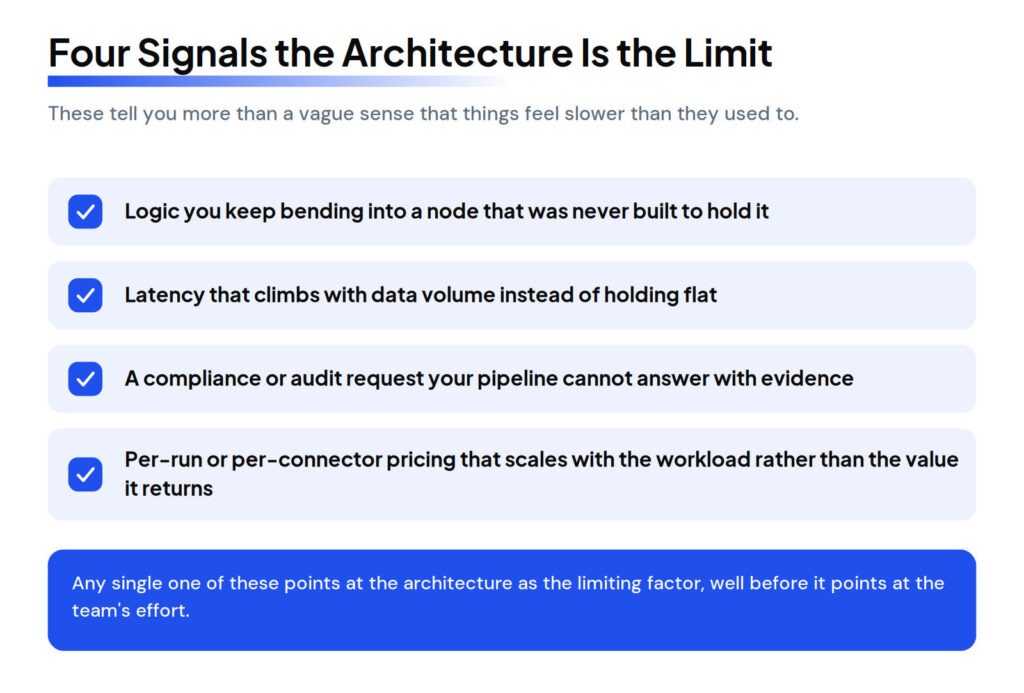
Customization runs out of room first. No-code platforms are built around a fixed set of components, so the moment a workflow needs logic the platform’s designers never anticipated, a team either forces an awkward workaround or gives up on the feature.
Performance is the next wall. A pipeline assembled by chaining nodes in a visual builder usually runs slower than a purpose-built process that executes the same steps in parallel, and the gap widens as data volume climbs.
Portability is the one teams underestimate. A pipeline living inside one platform’s node system, credential store, and execution environment usually has to be rebuilt to move elsewhere, so what looks like a movable asset is closer to a rental.
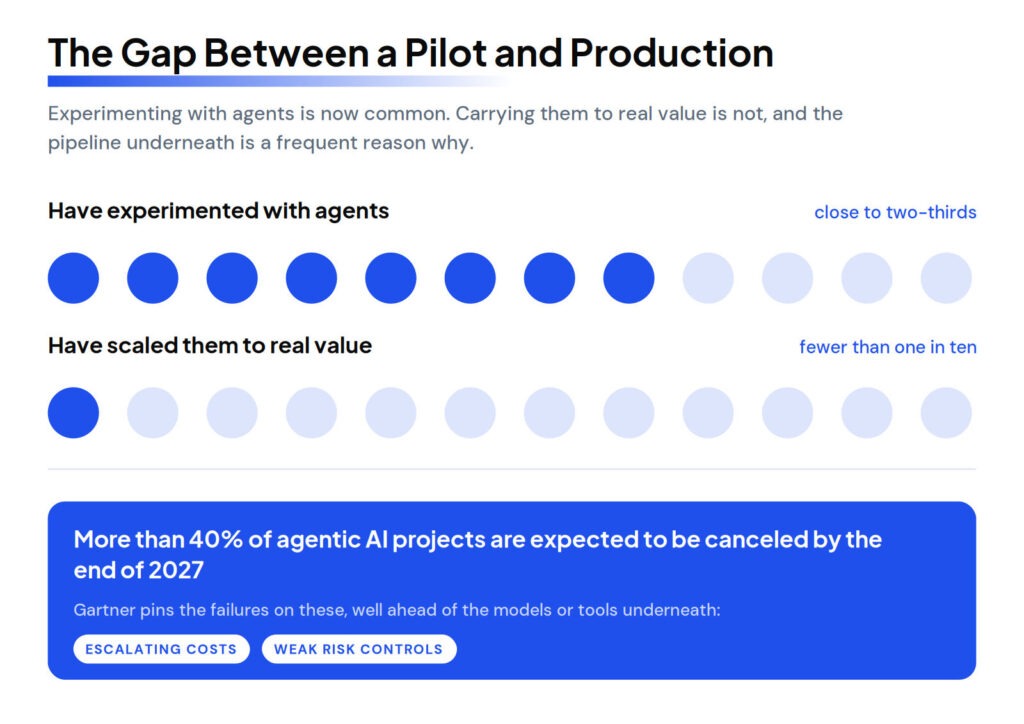
This pattern is showing up across agentic AI, not only in pipelines. Gartner expects more than 40% of agentic AI projects to be canceled by the end of 2027, and pins the failures on escalating costs and weak risk controls well ahead of the models or tools underneath. A no-code AI platform that looked cheap in a pilot can turn expensive once usage climbs past the tier the demo was priced for, and a pipeline that was never designed for governance is the kind of project that lands in that cancellation count.
What a Real Data Pipeline Architecture Requires at Scale
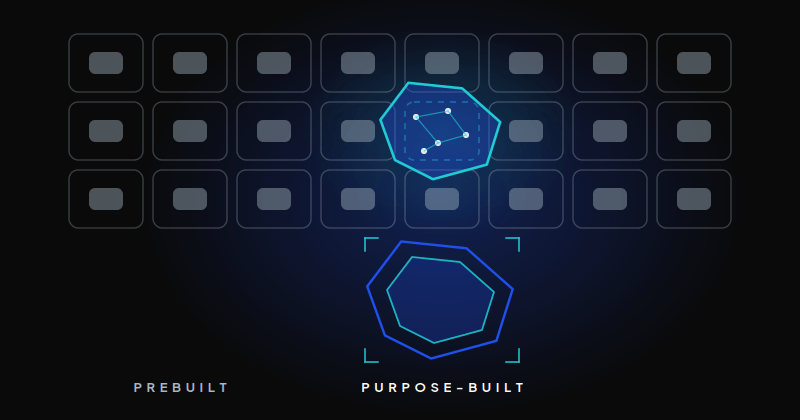
A pipeline built for production volume rather than a proof of concept asks for a few things most no-code builders were never designed to give: custom business logic that does not fit a pre-built node, integration depth with systems that ship no off-the-shelf connector, parallel execution in place of sequential node-chaining, and a monitoring and audit layer that can show what happened to a given record and why.
Integration depth is usually the first of those to bite. A modern data estate still runs on a mainframe export, a rate-limited partner API, and a warehouse with its own access rules, and none of them arrive as a clean drag-and-drop node. Getting them to cooperate takes retry logic, backfills, and schema handling that a fixed component library rarely covers.
That last requirement carries more weight than it first appears. A pipeline feeding decisions that touch customers or compliance needs the same traceability we have argued AI oversight itself needs: evidence someone can audit, down to the individual record. Our piece on human-in-the-loop AI governance makes that case at the decision layer, and it holds just as firmly for the pipeline sitting underneath the decision.
McKinsey’s work on scaling agentic AI found that close to two-thirds of organizations have experimented with agents, while fewer than 10% have scaled them to real value. A no-code pipeline that never had to carry production load is a common reason that gap holds. Pilots and production run on different requirements, and no-code process automation tools are built to satisfy the first set well before the second.



 Arivonix AI
  Arivonix AI
  Arivonix AI