
AI Data Licensing: AI Labs Are Paying for Proprietary Data. Should You Sell Yours?

For most of the generative AI boom, data licensing was something publishers did. News archives and image libraries changed hands for flat annual fees, and most enterprises watched from the sidelines.
That has changed over the past year, largely because of two court decisions. In July 2026, a federal court gave final approval to Anthropic’s $1.5 billion settlement with authors. That works out to about $3,000 for each of more than 400,000 books, and it followed an earlier ruling that training on pirated copies wasn’t protected.
In September, the Third Circuit affirmed that ROSS Intelligence’s use of Westlaw headnotes to train its system wasn’t fair use. It’s the first federal appeals court decision on fair use in AI training.
Buyers have responded by paying for data they can defend, and they’re looking well beyond publishers. On October 9, micro1 committed $1 billion over 12 months to acquire and license enterprise operational data, with financing from Citi and Hercules Capital.
So someone will pay for your proprietary data. The harder question is which kind of deal still leaves your company better off a few years from now, once a model has learned everything your data can teach it.
Our view at Arivonix is that most enterprises should start by licensing governed access to their data and treat a one-time training sale as the exception. The rest of this piece explains why.
How the Data Licensing Market Changed in 2026
The first wave of AI data deals was about volume. A lab paid a fixed fee, received a corpus and trained on it. The deals being signed now differ on almost every dimension.
| Dimension | Early AI data deals (2023 and 2024) | Emerging in 2026 | Examples |
|---|---|---|---|
| What's licensed | Archives of public text, images and forum posts | Specialized, expert and operational data | micro1's enterprise data program; Mercor's expert data |
| How it's delivered | Bulk transfer of a corpus | Governed access at the moment of use | LSEG and Verisk MCP connectors |
| How it's priced | Flat annual fee | Usage-based or per-use fees | Microsoft Publisher Content Marketplace; Cloudflare Pay Per Use |
| Who's selling | Publishers and social platforms | Enterprises in pharma, finance and insurance | Incyte, Noetik, LSEG, Verisk |
| What buyers verify | Little beyond the contract | Documented rights and provenance | EU training-content summary template |
Legal Risk Has Put a Price on Clean Data
The Anthropic settlement put a per-work figure on unlicensed training data. The ROSS decision showed an appeals court rejecting fair use where the training fed a competing product.
Neither outcome settles the broader copyright questions, and ROSS involved a non-generative system. Both still make it more expensive for a buyer to rely on data it can’t account for.
Regulation is pushing the same way. Under the EU AI Act, providers of general-purpose AI models placed on the EU market since August 2, 2025, must publish a summary of their training content using a Commission template.
The template asks whether they used commercially licensed content and requires a list of the top 10% of web domains they scraped. A buyer that can name its sources has a much easier time filling it in.
For sellers, data provenance is now part of the product. A dataset with a clear record of where it came from and what consent covers it is worth more than a larger one nobody can vouch for.
AI Buyers Now Want Workflow and Expert Data
What buyers want has shifted too. Mercor, which supplies domain experts who create training data for AI developers, passed $2 billion in gross annualized revenue in June 2026, double its pace at the start of the year.
micro1 says it uses de-identified company data to build reinforcement learning environments. These teach AI models and agents how real business workflows run.
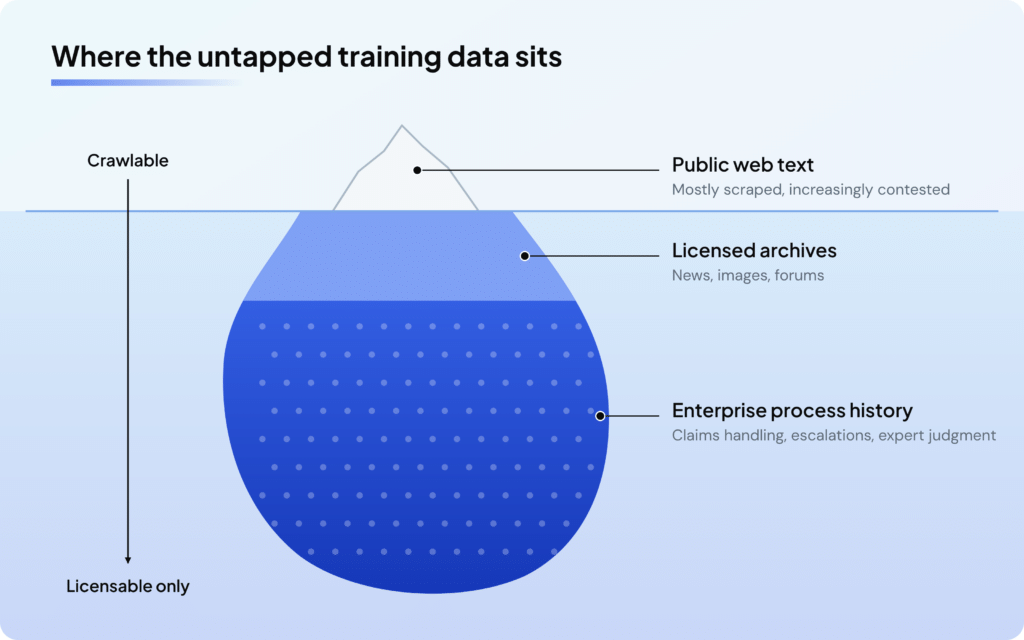
That’s a different asset from a content archive. Agent builders need to see how work gets done, such as how a claim moves from first notice to settlement and when an adjuster decides to escalate. Most enterprises hold years of this process history and have never put a price on it.
Why Flat-Fee Data Deals Are Giving Way to Usage-Based Pricing
Reddit shows the shift most clearly. Since at least September 2025, the company has been trying to move past what Bloomberg described as a “dollars-for-data” model.
In July 2026, the Wall Street Journal reported that Reddit had discussed cutting off Google’s access to its content for AI training. That deal, reported at about $60 million a year, is nearing its end.
The infrastructure for usage-based pricing is arriving at the same time. Microsoft launched its Publisher Content Marketplace in February 2026. Publishers set their own license terms and get usage reporting. Copilot was the pilot use case, and Yahoo is among the first outside buyers being onboarded.
In July, Cloudflare began moving away from charging AI crawlers per crawl. Its new Pay Per Use model is meant to pay publishers when their content appears in AI results and to let agents pay on demand for premium content.
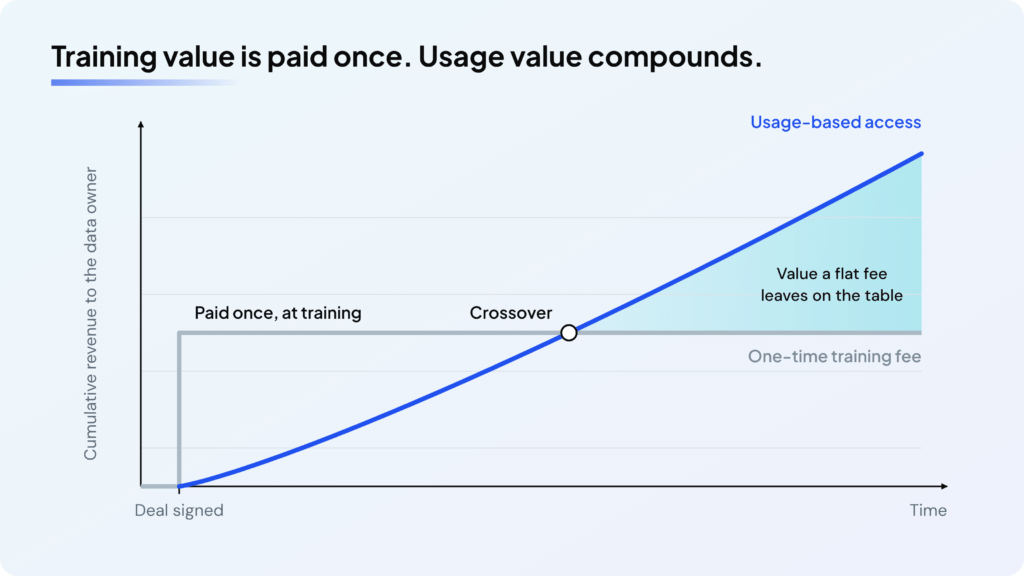
Enterprise data follows the same logic. Training value is collected once. After a model learns from a dataset, the buyer has little reason to pay for it again.
Inference value recurs. Data that grounds an answer or informs an agent’s next step gets used every day, and each use can be counted.
How to Price Data for AI Buyers
There’s no public rate card, and most terms stay confidential. Still, the deals disclosed so far point to a few factors that consistently move the price.
When you work out how to price data, start with what the buyer will do with it. A training license is close to a permanent transfer, so price it like a sale. Access for grounding, retrieval or agent workflows can be priced per query or against reported usage.
From there, these factors push the number up or down:
- Rights you can document. Clean consent and provenance lower the buyer’s legal risk, and buyers pay for that.
- Freshness. A steady stream of current data keeps earning after the first training run. A static archive usually doesn’t.
- Decision relevance. Data tied to a decision the buyer’s product makes, such as an underwriting call or a claims payout, is worth more than general background text.
- How easy it is to replace. If a buyer can get something close from another vendor or generate it synthetically, your price falls.
- Exclusivity. It raises the headline fee, though it carries costs we cover below.
One more point belongs in the negotiation from day one. You can’t price usage you can’t see, so usage reporting and audit rights should be in the term sheet.
What Enterprises Are Doing Differently in AI Data Deals
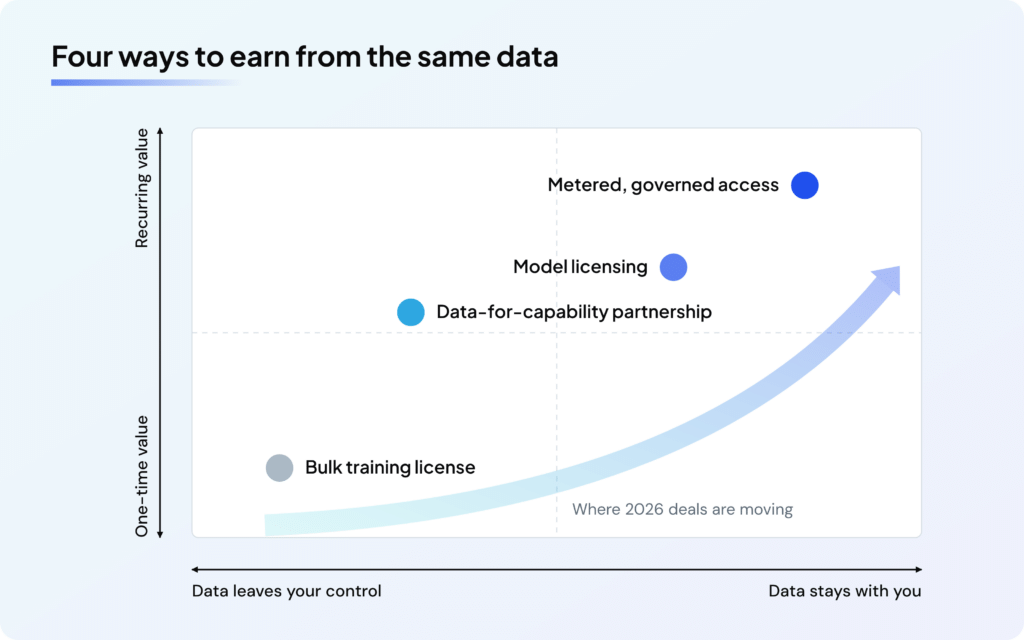
Several of the most instructive deals of 2026 don’t involve selling data at all. Four patterns stand out.
Licensing access instead of handing over copies. In May 2026, LSEG connected its data to Gemini Enterprise through a Model Context Protocol (MCP) connector. It already had partnerships covering ChatGPT and Claude.
The same month, Verisk made its ISO underwriting intelligence available in Claude through MCP connectors governed by Verisk’s own data governance framework. In both cases, the data stays with its owner and under the owner’s controls.
Trading data for capability. Incyte is sharing its experimental data with Genesis Therapeutics in return for better models. Under an expanded collaboration announced May 20, 2026, Incyte’s proprietary data will train Genesis’s AI platform.
Incyte is also paying $80 million in cash and making a $40 million equity investment, and it keeps exclusive rights to the resulting products. Here the data works as an input to Incyte’s own drug pipeline.
Licensing a model built on the data. In January 2026, GSK took a non-exclusive license to Noetik’s oncology foundation models, which are built on Noetik’s spatial biology datasets. The five-year deal includes $50 million upfront and annual licensing fees.
Noetik earns from its data while the raw data stays in-house.
Treating exclusivity as a cost. An exclusive license raises the headline price. It also caps the number of buyers and ties the seller to one company’s roadmap. Non-exclusive terms keep the option to license the same asset again as the market reprices it.
In each pattern, more of the value sits in the data licensing agreement itself. Field-of-use limits, refresh obligations, audit rights and whether model weights trained on the data survive termination can matter as much as the headline fee.
When Not to Sell Proprietary Data: The Data Moat Question
Every one of these deals assumes the data is worth more outside the company than inside it. Before you sell data to AI companies, test that assumption against four situations.
When the Buyer Could Become a Competitor
In the ROSS case, the trial court found that ROSS built its product to compete directly with Thomson Reuters, and the Third Circuit upheld the ruling against fair use. Commercial licensing carries the same risk, minus the lawsuit.
An AI company that trains on your data to build a vertical product may end up selling that product to your customers or your competitors.
Insurance offers a live example. Verisk’s shares were cut nearly in half over the year to May 2026, as investors worried that AI could commoditize its core data assets.
A data moat holds only as long as what your data enables can’t be learned once and reproduced. Scarcity alone won’t protect it.
When You Don’t Hold All the Rights
Much enterprise data comes with strings attached. Think customer contracts, partner agreements, consent collected for a narrower purpose, or bureau data blended into your own records.
Buyers who have followed the Anthropic case will ask for warranties and indemnities on exactly these points. If the rights chain has gaps, the liability comes back to the seller.
When the Deal Can’t Be Unwound
A one-time training license is close to permanent in practice. Ending the contract doesn’t remove what a model has already learned.
If the data underpins your advantage, price a training license as a sale. Or choose an access-based model you can switch off.
When the Market Hasn’t Priced Your Data Yet
Early flat-fee deals may have undervalued what buyers were getting. In June 2026, Wells Fargo estimated that renegotiated terms could lift Reddit’s combined AI licensing revenue from Google and OpenAI to $550 million a year.
That’s more than four times the roughly $130 million run rate reported for its current deals. A long, fixed-price commitment signed today locks in today’s price.
Where Arivonix Fits
Enterprises considering a data deal rarely lack interested buyers. The harder part is offering data in a form that can be metered and switched off without handing over the underlying records.
Our Data Products Hub is built for this. It packages governed data into products that partners analyze in a clean room, with masking and a full audit trail, so raw data is never exposed.
Our AI-ready distribution channels add secure APIs and SQL clean rooms, so partners query governed endpoints instead of receiving a copy.
For teams that decide their data is worth more inside the business, our guide to specialized intelligence in agentic AI platforms covers how to build domain-specific AI on it.
Example: A Carrier Weighs a Training Offer
Picture a commercial P&C carrier approached by an AI startup that’s building an underwriting agent. The startup wants ten years of claims notes and loss runs for training. (This is a hypothetical example.)
Before anyone discusses price, the carrier needs answers to a few questions:
- Which parts of the dataset does it own outright, and which came from brokers, bureaus or policyholders under narrower terms?
- Would metered, governed access earn more over three years than a one-time training fee?
- Is the startup building something it will eventually sell to the carrier’s distribution partners or competitors?
- If the contract ends, does the startup have to retire models trained on the data?
The first is a rights question, and the last is a contract term. The middle two are strategy calls, and they’re the same calls we help carriers work through in AI for underwriting and claims.
A one-time sale at today’s price still makes sense for some datasets. For the data that shapes how you compete, keep control of access, so you still have something to offer when the next round of AI data licensing renewals comes up.
This article is for general information and is not legal or financial advice. Confirm the terms of any data licensing agreement with qualified counsel.

Ramesh Ilangovan
Ramesh heads marketing at Arivonix AI, where he leads product marketing and growth strategy. He brings over a decade of experience across B2B SaaS and technology, with expertise spanning go-to-market strategy, positioning and messaging, and demand generation. At Arivonix, he focuses on taking AI products to market and translating complex capabilities across data, agentic AI, and specialized intelligence into clear business value.