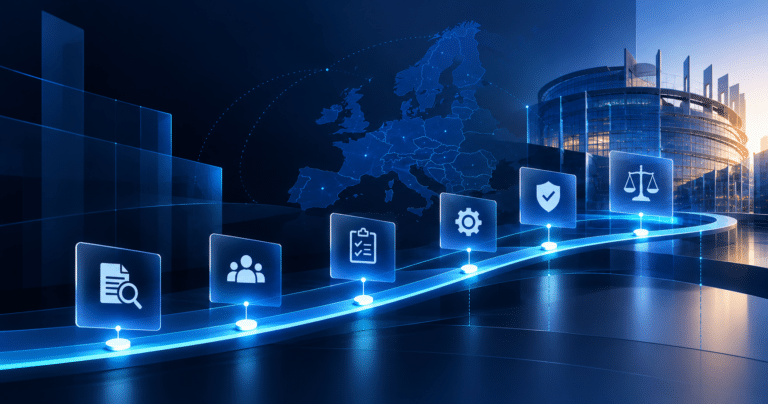
AI Agent Identity Has a Credential Answer. Data Access Still Needs One.

A year ago, the idea that every AI agent should carry its own identity mostly lived in research papers and conference talks. Today, AI agent identity is a product category with budgets behind it.
Microsoft lists Entra Agent ID as generally available, and Gartner put IAM for AI agents on its list of cybersecurity trends CISOs need to act on in 2026. Standards bodies have moved too: NIST’s National Cybersecurity Center of Excellence now runs a project on software and AI agent identity and authorization.
So the first question is settled. Agents get an identity of their own.
The harder question is what that identity should be allowed to reach when an agent acts for a specific person. Most enterprise access models still answer it with a service account, and that’s where we think the real work begins.
How Enterprises Are Rebuilding IAM Around Non-Human Identity
AI agent identity is the distinct, governed identity an agent uses inside enterprise systems. In practice, it has four parts: a named human owner, a declared purpose, credentials of its own, and a record of whom the agent is acting for.
Each of those parts now has dedicated tooling, and IAM programs are changing in a fairly consistent way.
Agents are being registered up front instead of discovered after the fact. Microsoft’s implementation adds sponsor lifecycle workflows that hand an agent to a new sponsor when the original one changes roles or leaves the company. It’s a direct answer to orphaned agents, the ones that keep running long after anyone remembers launching them.
Static API keys are giving way to short-lived, scoped tokens. Access policies can now tell an agent working on its own apart from one working on behalf of a signed-in user.
Gartner’s guidance points the same way. Its 2026 trends analysis says CISOs “must extend IAM to machine actors, automate credential life cycles and define policy-driven authorization.” It also warns that “no-code and low-code tools are enabling ‘rogue’ automations,” which is why registration has become the starting point.
The net effect is that agents are leaving the gray zone between applications and users. They’re joining the same non-human identity inventory that already holds service accounts and workloads, with a lifecycle and an accountable owner of their own.
Why AI Agent Authorization Is Now Harder Than Authentication
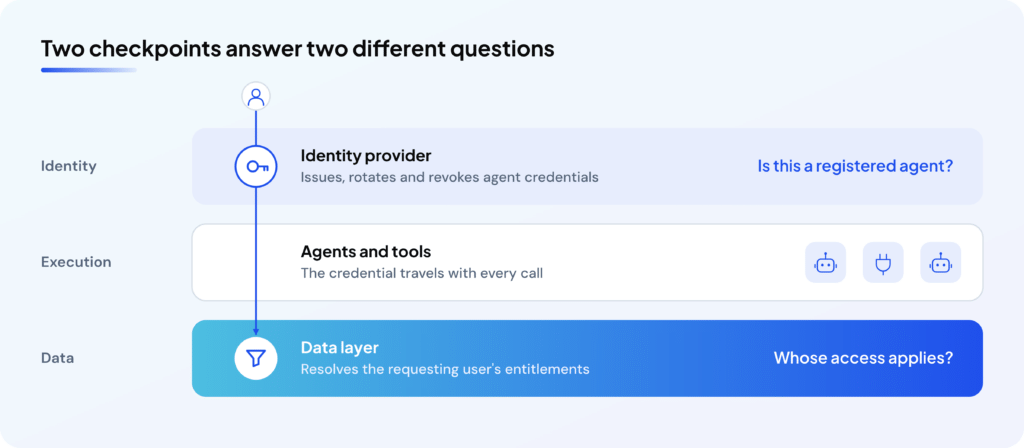
Most of that progress lands on AI agent authentication. On the mainstream identity platforms, proving that a request came from a specific, registered agent is close to a solved problem.
The difficulty has moved one step later. Once the agent is inside, what is it allowed to do, and on whose behalf?
The OpenID Foundation’s October 2025 whitepaper on identity management for agentic AI is blunt about the limits. It found that current frameworks secure today’s deployments “only because today’s agents remain relatively simple,” and that they “weren’t designed for recursive delegation chains.”
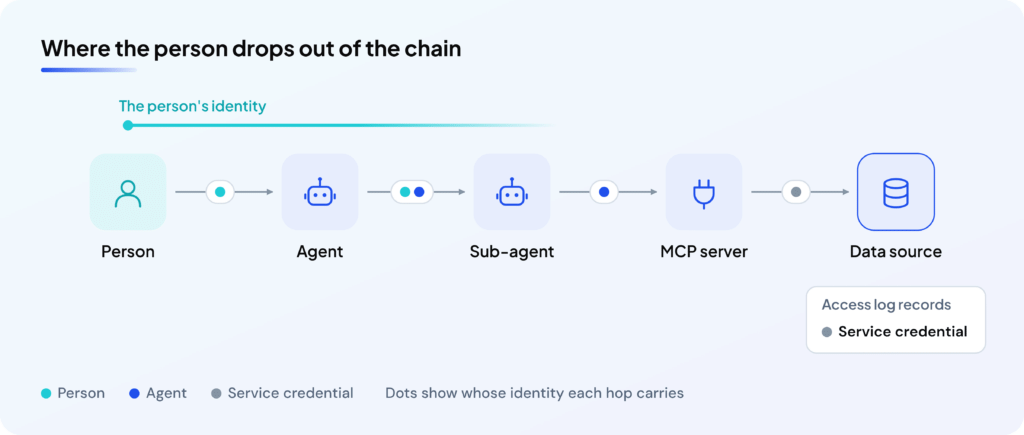
Picture an agent that calls a second agent, which calls a tool, which queries a database. The request that reaches the data is three hops away from the person who asked the question. By then, the credential in play usually names the last service in the chain, and the human who started it is nowhere in it.
The Model Context Protocol makes this concrete. MCP gives agents a common way to reach tools and data. Its current authorization specification makes authorization optional, and its security requirements forbid an MCP server from passing the token it received on to the systems behind it.
That’s sound security practice. It also means every hop starts with a fresh credential. Unless someone deliberately carries the user’s identity forward, the server reaches downstream data under its own credentials, and the person drops out of the chain right where the data gets read.
This is where the visibility gap in agent deployments comes from. Access logs record the identity behind each call accurately. In a delegated chain, that identity just isn’t the person who asked.
What AI Agent Access Control Requires When Agents Act for People
The most common shortcut in production today is to give an agent a broad service identity and let it retrieve whatever that identity can read.
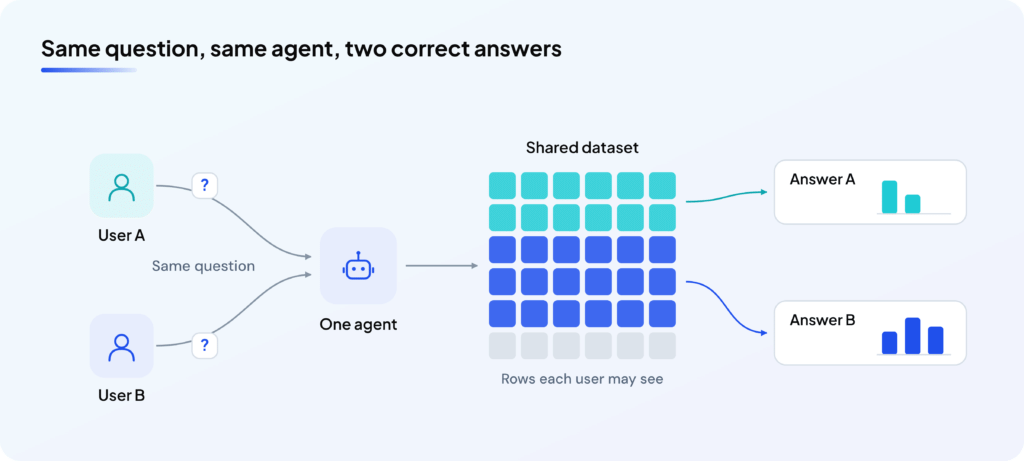
It holds up in a pilot, because the pilot’s users are usually the people who built it. At scale, it means an analyst can ask an assistant a question and get back figures from a dataset they could never open directly.
Nothing was breached. The agent answered with its own permissions, and the analyst’s permissions never came into it.
Fixing this takes a tighter definition of AI agent authorization. We call it the intersection rule:
An AI agent acting for a person should reach only data that the requesting user is entitled to see and that the agent is scoped to use, checked at the moment of the request.
You need both halves. User entitlements without an agent scope let a narrowly built agent reach everything its user can. Agent scope without user entitlements brings back the service-account problem.
Timing matters just as much. A check frozen into a token at sign-in goes stale, because entitlements change during the day and a delegated chain can run for hours.
A Simple Test for AI Agent Access Control
Have two users with different access ask the same agent the same question. If they get the same answer, the agent isn’t honoring identity, however well its credentials are managed.
NIST’s concept paper on agent identity and authorization raises the same issue in standards language. One of its open questions asks, “How do we bind agent identity with human identity to support ‘human-in-the-loop’ authorizations?”
Our answer is that entitlement-aware access only works when the data layer knows whose identity it’s evaluating. That depends on governance and lineage being built into the platform underneath the agents, a point we cover in our guide to specialized intelligence platforms.
Signals Your AI Agent Identity Management Is Falling Behind
A general feeling that agents are under control doesn’t tell you much. These four signals tell you more:
- No named owner. If nobody can name an agent’s owner, nobody is accountable for what it does.
- Borrowed human credentials. A person’s credential pasted into an agent’s configuration is exactly the habit agent identity programs exist to end.
- Service accounts in the access logs. If a service account shows up where a requesting user should, the data layer is evaluating the agent’s identity instead of the person’s.
- Access that survives offboarding. If removing an employee doesn’t change what their agents can reach that same afternoon, the access was never tied to the person.
Each of these comes back to accountability, the argument we made in our piece on human-in-the-loop AI governance. Oversight only works when every action traces back to someone who can answer for it.
If you’re evaluating agent platforms now, our vendor evaluation checklist covers the identity and delegation questions worth asking every vendor before a pilot turns into production.
Where Arivonix Fits
Identity providers are taking on the work of issuing agent credentials and revoking them when they’re no longer needed. That work matters, and we don’t try to duplicate it.
Arivonix focuses on the step after it: entitlement-aware access through the governed data layer. When an agent built in the Agentic AI Designer retrieves data for a user, the request is resolved against that user’s own entitlements at the moment it runs.
Our approach to data-centric AI assurance keeps that resolution traceable. Every answer can be tied back to the person it was produced for and the access they held when they asked.
Agent identity went from an open debate to a product category in about a year. The teams that get the most out of it will treat the credential as the starting point and plan for the moment it reaches the data.
Ramesh Ilangovan
Ramesh heads marketing at Arivonix AI, where he leads product marketing and growth strategy. He brings over a decade of experience across B2B SaaS and technology, with expertise spanning go-to-market strategy, positioning and messaging, and demand generation. At Arivonix, he focuses on taking AI products to market and translating complex capabilities across data, agentic AI, and specialized intelligence into clear business value.