
Arivonix AI

Introducing Agent Arivon. Your AI Data Engineer.

Arivonix AI

Agentic AI Frameworks: The Case for Specialized Intelligence Over No-Code AI
Two years ago, the question every C-suite asked about AI was how fast a team could ship something. No-code tooling answered it well. A business analyst could drag together a workflow, wire it to a language model, and have a working assistant by the…

Link copied
banner

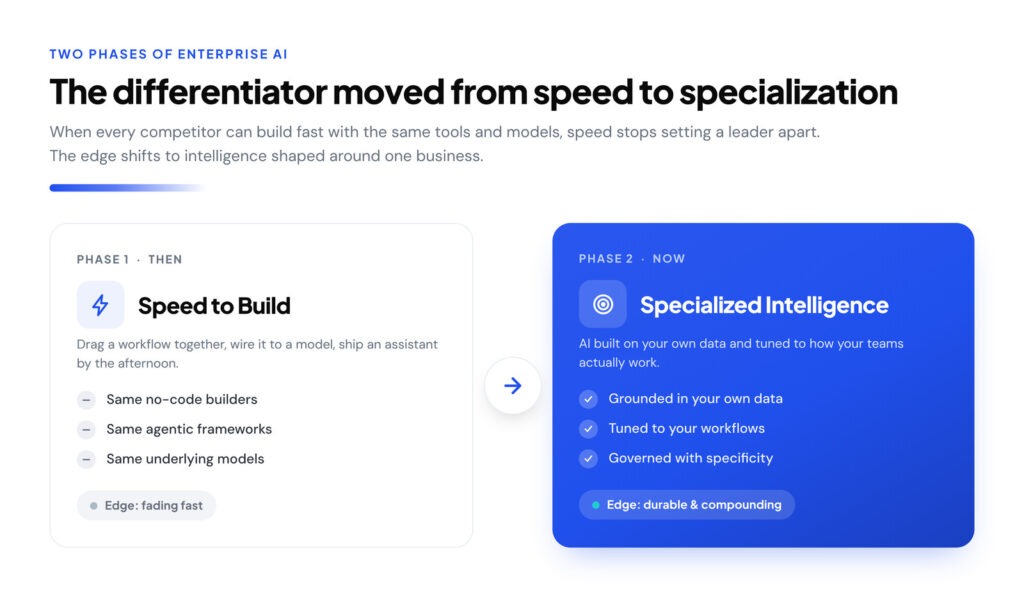
Two years ago, the question every C-suite asked about AI was how fast a team could ship something. No-code tooling answered it well. A business analyst could drag together a workflow, wire it to a language model, and have a working assistant by the end of the afternoon. That was Phase 1, and for a while, speed alone gave you a real edge. 

Speed doesn’t do that job anymore. Every competitor now has the same no-code builders, the same agentic AI frameworks, and mostly the same underlying models. Once everyone can build fast, building fast stops telling a leader apart from the pack. 

The conversation inside most organizations has already moved on. It went from “how do we build an AI agent” to “how do we make ours better than the one our competitor just shipped.” No-code tooling has no answer to that second question. 

That is where specialized intelligence comes in. The idea is simple enough: AI built on your own data and tuned to how your teams work, governed with a level of specificity that generic tooling was never meant to handle. It doesn’t take a bigger model or a slicker canvas to get there. 

Agentic AI Frameworks

What No-Code AI Got Right 

Credit where it’s due. No-code process automation solved a real problem. It took AI out of the hands of a small engineering team and put it in front of the people who understood the workflow being automated. 

For routine, well-defined work like ticket routing or data entry, trading some flexibility for speed still makes sense. Nothing that follows says no-code tooling was a mistake. 

Where No-Code AI Runs Out of Room 

The trouble starts when a workflow stops being routine. The no-code AI limitations most teams run into tend to cluster in a few familiar spots. 

The first is a configuration ceiling: the tool can’t express the one piece of business logic that matters most. The next is pricing that climbs in ways you can’t predict once real usage moves past the demo tier. The last one is quieter. It’s a governance gap you don’t notice until an agent starts making decisions that carry consequences. 

None of this is a reason to tear out a no-code tool that’s doing its job. It’s a reason to accept that a platform built for speed of assembly was never built for depth of judgment. Ask it to do both, and it usually does neither well. 

AI Maturity: From Speed to Specialization 

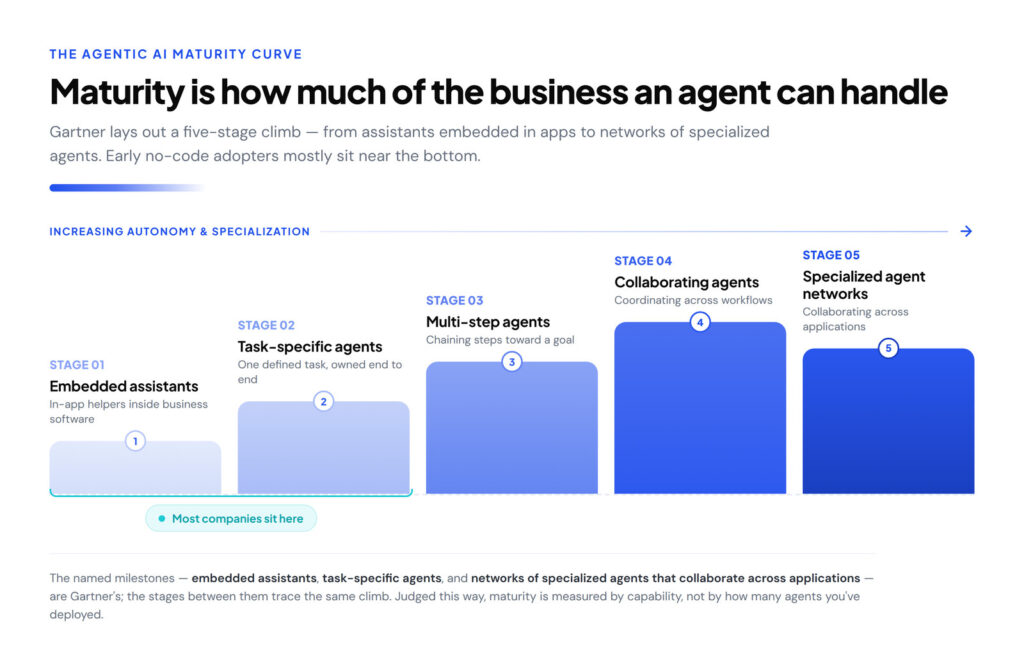
Gartner’s framework for how organizations progress with AI agents maps this shift well. The firm lays out a five-stage path that runs from assistants embedded in business apps, to task-specific agents, to networks of specialized agents that collaborate across applications. Most companies that adopted no-code tooling early sit at the first stage, or are edging into the second. Few have built the specialization the later stages call for. 

AI Maturity: From Speed to Specialization

Gartner also names a related trap. Plenty of what gets sold as an AI agent doesn’t fit the definition. The firm calls this “agentwashing,” where a basic assistant gets relabeled as an agent, and it muddies how far along the maturity curve a company sits. When an AI maturity model rests on marketing labels, it stops measuring anything. 

Agentic AI maturity is better judged by how much of your business an agent can handle than by how many agents you’ve deployed. 

What Specialized Intelligence Looks Like in Practice 

This is the part most specialized AI vs no-code AI comparisons skip. Specialization doesn’t win on its own, just because a vendor stuck the word on a model. 

A 2026 Nature Medicine study tested purpose-built clinical AI tools against frontier general-purpose models, on medical benchmarks and on physicians’ real-world questions. The general-purpose models came out ahead. That result is easy to misread. It doesn’t mean specialization has no value. It means a label on its own buys you nothing. 

Specialization counts when it’s grounded in real domain data, tested against the work your teams do, and shaped by the rules your domain runs on. Skip those, and what you’ve got is a generic tool with a domain sticker on it. 

That gap explains a forecast Gartner put out last year: more than half of the generative AI models enterprises use will be domain-specific by 2027, up from about 1 percent in 2024. The point of that shift has little to do with model size. What drives it is demand for models and agentic workflows shaped around a specific business, rather than a general-purpose system with a company’s name stuck on it. 

Why Speed-to-Build Stopped Being the Differentiator 

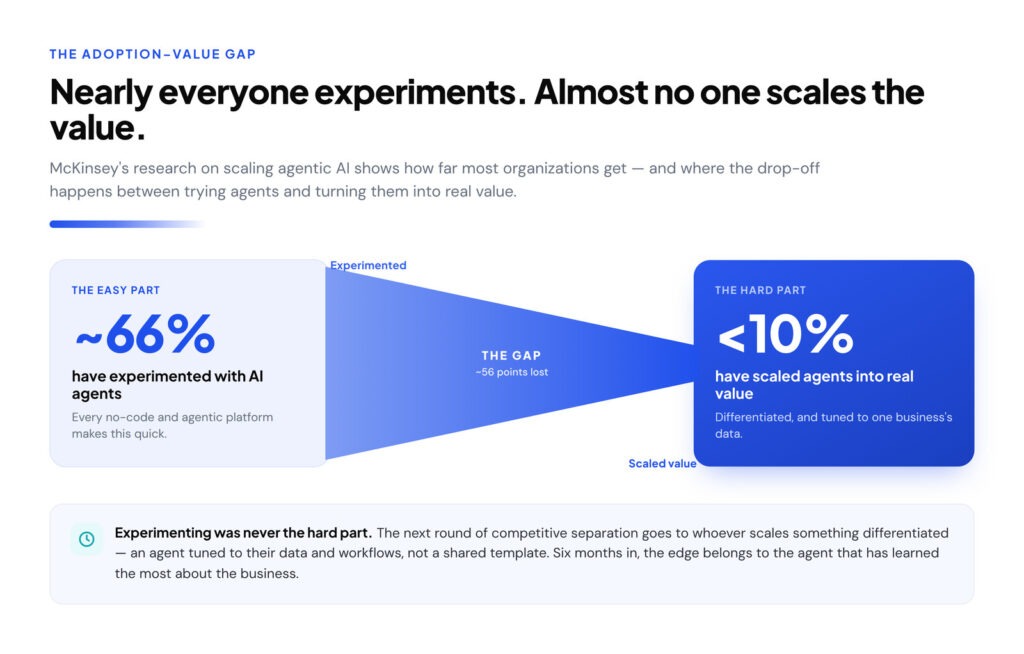
The distance between adoption and payoff backs this up. McKinsey’s research on scaling agentic AI found that close to two-thirds of organizations have experimented with agents, while fewer than 10 percent have scaled them into real value. 

ai agent adoption value gap 1 Agentic AI Frameworks: The Case for Specialized Intelligence Over No-Code AI
Experimenting was never the hard part. Every no-code platform and every agentic AI platform on the market makes that easy. The hard part is scaling something differentiated, tuned to one business’s data and workflows instead of a shared template. Almost nobody has cracked it. 

That’s where the next round of competitive separation happens, and it won’t come down to who shipped an agent first. Six months in, the edge belongs to whoever’s agent has learned the most about their business. 

Where Agentic AI Frameworks Pull Ahead of Platforms 

The difference between a framework and a platform matters more than the words suggest. A platform hands a team a fixed set of building blocks and asks them to stay inside its walls. A framework gives them a structured way to keep specializing an agent as they go, folding in more of the company’s data, its governance rules, and the edge cases that surface as the system matures. 

A platform is built for a fast first deployment. A framework is built for the fifth deployment and the fiftieth, each one sharper than the last. 

Teams already deep in vendor evaluation may find our CIO’s checklist for evaluating an AI agent platform a useful companion to this piece. A few of its criteria, governance capability and customization depth especially, are the same ones that tell a real framework apart from a relabeled no-code tool. 

Where Arivonix Fits 

This is the case Arivonix has been building toward in its own architecture. Our guide to specialized intelligence in agentic AI platforms gets into how that specialization gets built layer by layer instead of bolted on as a feature. 

The Agentic AI Designer starts from a simple premise: speed and specialization stop being a trade-off when the framework was designed for both from day one. And because specialization without accountability just gives you a faster way to be wrong at scale, the governance approach from our piece on human-in-the-loop AI governance runs through how that specialization ships, not around it. 

The companies that treated Phase 1 as the destination are about to learn it was only the start. The ones already building toward what comes next are the ones to watch. 

Start Your Free Trial   |   Book a Consultation 

PS

Written by Pujitha S

Product Manager

Back to all articles

Keep reading

banner Arivonix AI

How to Evaluate an Enterprise AI Agent Platform: A CIO’s 12-Point Checklist

Most of the vendor decks landing on a CIO’s desk right now use the word “agentic” the way software once used “cloud-native”: a label…

Pujitha S Aug 19, 2026 Read
banner Arivonix AI

Human-in-the-Loop AI Governance: Where Human Oversight Belongs When AI Agents Act

Ask a compliance officer in 2024 what worried them about AI, and the answer usually came back to a single bad output. Maybe a wrong figure…

Pujitha S Aug 14, 2026 Read
banner Arivonix AI

SLM vs LLM: Model Selection for Agentic AI Platforms

Ask an engineering team in 2024 which model to use, and the answer was almost always the biggest one available. Ask them today, and the same…

Pujitha S Aug 11, 2026 Read
START YOUR FREE TRIAL

Try our Agentic AI Platform and build your Agentic AI workflows in less than a day to unlock your data insights.

Start Free Trial
No credit card required