
How Specialized AI Learns From Your Data: A Technical Deep-Dive
Ask ten vendors what specialized AI means and you’ll get ten confident answers. Ask what it takes to actually build one, and you’ll hear a lot less.
Our guide to specialized intelligence handles the big picture, from what it is to how to evaluate a platform. This piece goes below that, into the engineering it sits on: what actually happens when a model learns from a company’s own data, and where that process tends to break in practice.
It matters because a well-prompted generic model and a genuinely specialized one can pass the same demo and then behave nothing alike once real traffic arrives. Specialization isn’t a switch a vendor flips on. It’s an engineering tradeoff with real costs, and understanding those costs is usually what separates an AI agent platform that keeps improving after launch from one that stalls the day it ships.
Why prompting a generic model isn’t the same as specializing one
A good system prompt can make a general-purpose model sound like a specialist. Getting it to behave like one when the inputs get messy is a different problem entirely.
What actually changes when your data meets a model
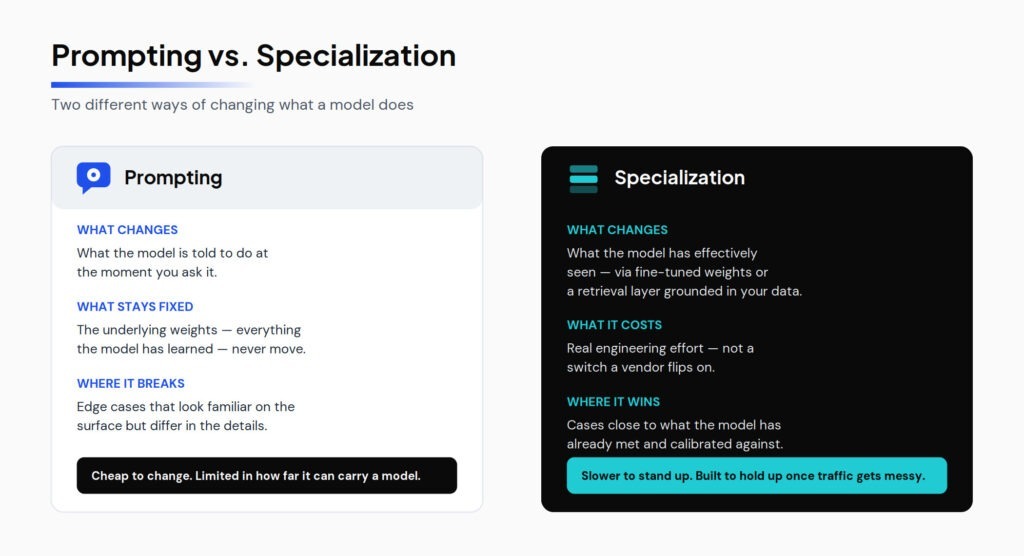
Prompting changes what a model is told to do at the moment you ask it. The underlying weights, which hold everything the model has learned about language and reasoning, stay exactly where they were.
Specialization changes that. Whether you fine-tune the weights or wrap the model in a retrieval layer grounded in your own data, you’re changing what the model has effectively seen.
The gap shows up most in edge cases. Hand a prompted generic model a scenario that looks like its training data on the surface but differs in the details, and it will often produce a confident answer that happens to be wrong. A specialized AI model trained on a company’s own historical cases has met something close to that edge case already, and it has calibrated against it.
The ceiling every prompted platform runs into
There’s a limit to how far instructions alone can carry a general-purpose model, and most engineering teams reach it sooner than they expect. Prompts are cheap to change, so teams keep tweaking them well past the point of diminishing returns before admitting the model itself has to change.
Sequencing the work that way is reasonable. Start with prompting and retrieval, then reach for deeper specialization once accuracy has clearly plateaued despite better prompts and better context. The catch is that most organizations only discover what specialization really involves after they’ve used up the cheaper options.
Specialization has its own boundary, and vendor material rarely mentions it. A model tuned on a company’s underwriting cases won’t automatically get better at claims correspondence just because both sit inside the same industry. Push a specialized model past the task it was trained for and its performance tends to slide back toward a generic baseline, sometimes worse, because narrow tuning can crowd out general ability the model still needs.
That pressure isn’t spread evenly across sectors. Health care, financial services, and other data-rich, regulation-heavy industries are among the fastest movers here, since a confidently wrong answer costs the most exactly where the stakes are highest.
What “learning from your data” actually takes
The training data nobody budgets for
Fine-tuning doesn’t need a company’s entire data warehouse. It needs a few hundred to a few thousand well-labeled examples that genuinely represent the task you want the model to handle, fewer for narrow structured work and more for anything that calls for judgment.
What most teams underestimate is how much of that data has to be cleaned by hand first. Historical support tickets, underwriting notes, and claims files are full of exactly the patterns a specialized model needs to learn.
They’re also messy in the ways that break training. Formatting drifts from one year to the next. Policy references go stale. Plenty of tickets get marked resolved while carrying the wrong label, and a model will happily learn from that wrong label if nobody catches it first.
Why more data isn’t automatically better data
The instinct is to throw more data at the problem, but volume is rarely the real constraint. What matters far more is whether the data represents the cases you actually care about.
A training set that’s heavy on routine cases and thin on the hard ones produces a model that’s confidently mediocre in exactly the situations that matter most. This is also where catastrophic forgetting stops being a theoretical worry and turns into an operational one. Push a model too hard on a narrow slice of specialized data and it can lose general ability it still needs for the parts of the job that were never the point of the tuning.
Fine-tuning, retrieval, or both: how the learning happens
“Learning from your data” isn’t one technique. Treating it as if it were is where a lot of specialization projects go wrong before they’ve really begun.
Two ways to encode company knowledge
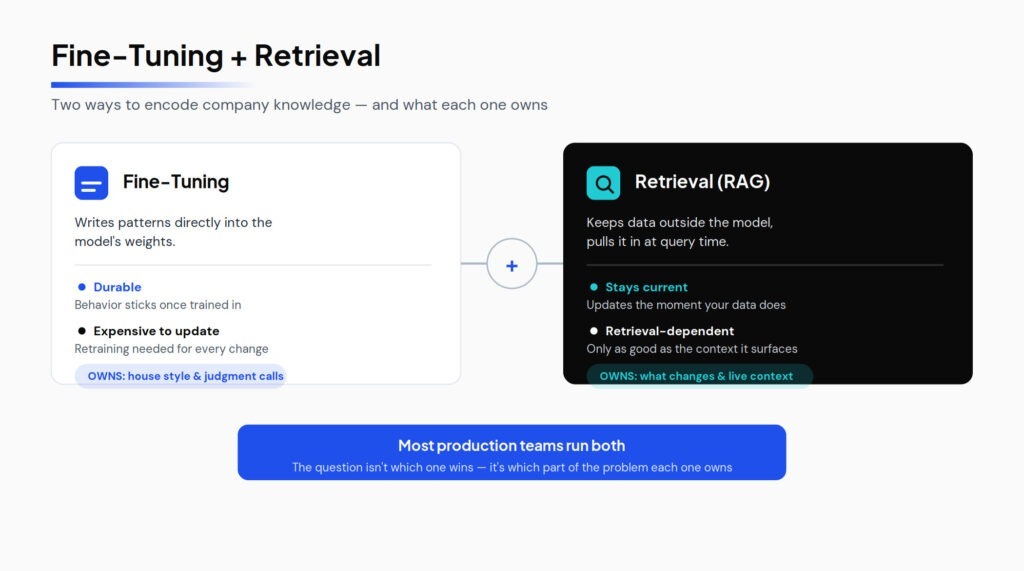
Fine-tuning writes patterns directly into a model’s weights. That makes them durable, but also expensive to update, and they go stale the moment the underlying facts change.
Retrieval-augmented generation, or RAG, takes the opposite approach. It keeps your data outside the model and pulls the relevant pieces in at query time. That stays current on its own, but it adds a retrieval step, and the result is only as good as retrieval’s ability to surface the right context.
Teams who run both in production tend not to treat this as an either-or. Google Cloud makes the same point in its own guidance: you can combine the two freely. Retrieval covers what changes. Fine-tuning covers what shouldn’t, like house style and the judgment calls a business has already made thousands of times and has no interest in relitigating on every request.
Why the combination beats either one alone
A well-built specialized platform usually leans on retrieval to ground each answer in the customer’s live account and current policy, and on fine-tuning to keep the model’s behavior and format consistent with how the business actually works.
Take either piece away and the seams show. Retrieval on its own still leaves a generic model reading your context through generic instincts. Fine-tuning on its own locks in knowledge that your own data will outdate within a quarter. Which is why framing the decision as fine-tuning versus retrieval misses the point. The question worth asking is which part of the problem each one should own.
The feedback loop that keeps a specialized model improving
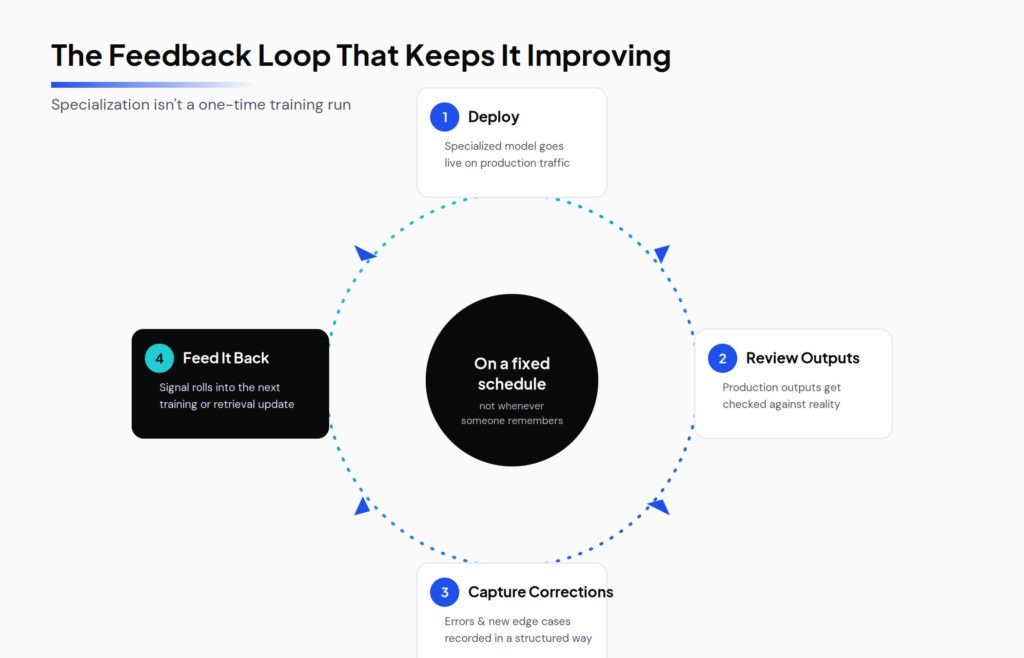
Specialization isn’t a one-time training run. Tune a model once on a snapshot of historical data and it starts drifting out of date the moment the business moves. New products launch. Regulations shift. Edge cases turn up that nobody had seen when the training set was assembled.
Where feedback loops quietly break down
That loop is the machinery behind the compounding advantage the guide describes. A specialized model only gets better with use if something actually carries each correction back into it.
The teams we’ve seen get lasting value from a specialized platform have built exactly that. Production outputs get reviewed. Corrections and new edge cases get captured in a structured way. That signal feeds back into the next training or retrieval update on a set schedule instead of whenever someone happens to remember.
Most feedback loops don’t fail loudly. They fail quietly. A team collects the data but never routes it back into the model, or routes it so rarely that the model stays a full quarter behind the business it’s meant to understand.
A feedback loop on a slide and a feedback loop that runs on a schedule are very different things. The distance between them is usually where a specialized model’s edge over a generic one wears away.
Confidence calibration: the metric nobody benchmarks
Why a confident wrong answer is the expensive one
Research on how well language models judge their own confidence keeps landing on the same uncomfortable result: models tend to report high confidence whether or not the answer underneath is correct. On average, stated confidence runs ahead of real accuracy.
A model that says it’s 95 percent sure and is wrong one time in four does real damage in a production workflow. Sooner or later it pushes a costly decision through on false certainty, and a standard accuracy benchmark won’t flag it, because accuracy and calibration measure two different things. A model can post near-perfect accuracy on a task and still be badly miscalibrated about when it’s actually right.
What calibration looks like in production
The standard way researchers score this is expected calibration error, which compares how confident a model claims to be against how often it’s right at that confidence level. A well-calibrated model that reports 80 percent confidence should be correct about eight times out of ten.
Most production deployments have never measured that number for their own workflows, which means most teams don’t really know how miscalibrated their agent is until a confident, wrong answer causes a visible problem.
The more mature pattern is confidence-gated routing. A fast specialized model handles the cases it’s confident about, and anything below a set confidence threshold gets escalated to a larger model or to a person rather than answered anyway.
Done well, that keeps precision high on the answers the model does return while still automating most of the workload. The rest get held back rather than guessed at, which is the entire point on the cases where a wrong answer would cost the most.
How specialized models close the calibration gap
Specialized models close part of this gap for a straightforward reason. They’re calibrated against outcomes that resemble the real production distribution, rather than a broad generic training mix that has no particular reason to reflect how sure a model should be about one company’s edge cases.
The rigorous version of this treats calibration as its own measured dimension, tracked separately from raw accuracy, with a threshold below which the model has to flag uncertainty and hand off to a person instead of answering.
Very few platform vendors publish calibration metrics at all. Fewer still treat abstention, a model correctly choosing not to answer, as a deliberate design decision rather than an afterthought.
This is the layer Arivonix’s Agentic AI Designer is built around. It tunes models against a company’s own data and outcomes instead of shipping a generic model behind a longer system prompt.
The unglamorous parts, from curating the data to keeping feedback and calibration on a fixed cadence, get handled as ongoing operational work rather than a one-off project that goes stale the day it launches. Confidence scoring and output lineage run through Data-Centric AI Assurance by default, so a low-confidence output gets flagged and routed rather than delivered with the same certainty as everything else.
Most engineering teams evaluating an AI agent platform can already feel the difference between a model that was prompted into sounding specialized and one that genuinely learned from their data. This is usually a good place to test that instinct.