
AI Agent Development Platforms: A Comparison for Engineering Teams
The way engineering teams pick an AI agent development platform changed this year. Twelve months ago the decision was which framework to standardize on. Now it is which layer of the market to buy into, and most teams commit to one without noticing there are three.
Adoption ran well ahead of the tooling. LangChain’s 2026 State of Agent Engineering report, based on more than 1,300 engineers and technical leaders, found 57.3 percent of the organizations surveyed already running agents in production and another 30.4 percent building toward it. A year earlier the first figure was 51 percent.
Set that next to Gartner’s 2026 Hype Cycle for Agentic AI and the read gets more honest. Gartner places the category at the peak of inflated expectations and puts broad enterprise deployment closer to 17 percent, with most organizations still planning rather than shipping. The two numbers do not fight each other. LangChain surveyed people who build agents for a living, and Gartner surveyed everyone. That distance is roughly the distance between the teams reading this and the market average.
Three Layers Now Hide Inside One Platform Decision
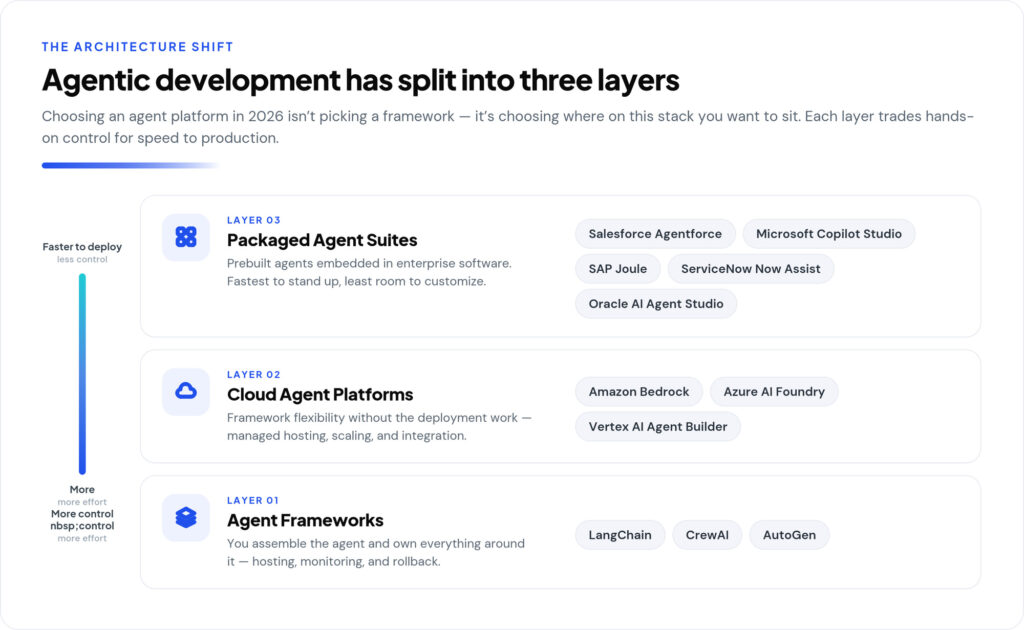
The shift sits underneath the adoption curve. A year ago, choosing an agentic AI development platform meant choosing a framework. You picked LangChain, CrewAI, or AutoGen and called it a stack.
That framing came apart in 2026. The packaged end of the market pulled away on its own. Salesforce Agentforce, Microsoft Copilot Studio, SAP Joule, ServiceNow Now Assist, and Oracle AI Agent Studio now sell finished agents instead of building blocks. In the middle sit Amazon Bedrock AgentCore, Azure AI Foundry, and Vertex AI Agent Builder, which keep framework flexibility while absorbing most of the deployment work.
So the category settled into three layers stacked on each other: raw frameworks at the bottom, managed cloud services in the middle, packaged applications on top. A team comparing options today is choosing across all three at once, whether the sales deck says so or not.
What “Production-Ready” Actually Means
Production-ready is the phrase that gets used the most and defined the least. Pinning it down matters, because the space between its two readings is where budgets tend to disappear.
A development platform gets an agent built and running somewhere it can be called. A production platform keeps that agent safe once real traffic arrives. That second job comes down to a handful of concrete capabilities:
- Staged promotion, so a change is tested in a lower environment before it reaches a customer.
- Versioned rollback for the times a change makes an agent worse instead of better.
- Behavioral monitoring that tracks what an agent does, not only whether it responds.
An agent can pass every uptime check and still be wrong in a way that check was never built to see. The two tiers get marketed in almost identical language, which is why teams tend to learn which one they bought only after something breaks.
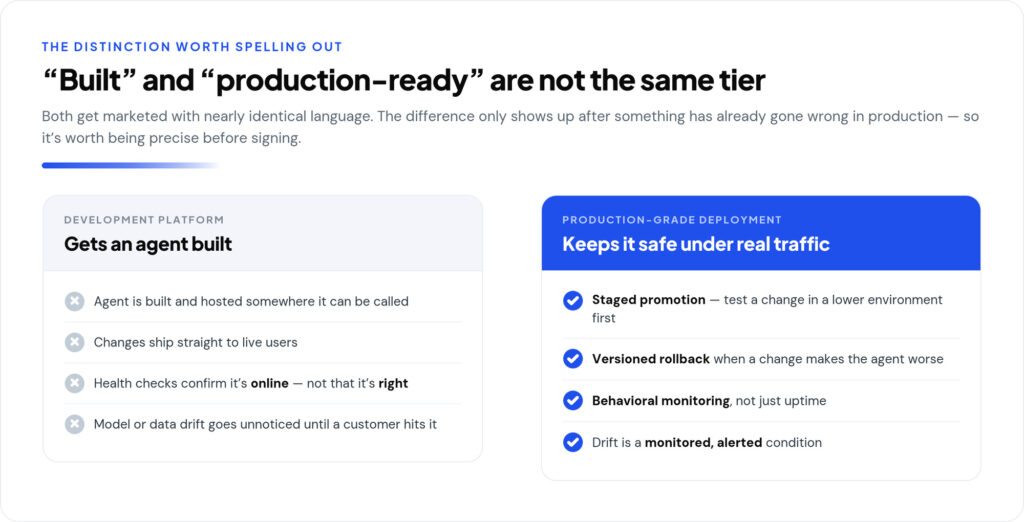
The failure that exposes the difference fastest is model drift. An agent’s behavior can change when nobody on the team touched the code, because the model provider shipped an update or a connected data source changed shape. Development-first tools rarely catch that before a customer does. Production-grade platforms treat drift as a monitored condition with an alert attached, the way an infrastructure team treats latency creeping past a threshold.
The timing is the hard part. A team that took the fastest route to a live prototype often finds the gap months later, once an agent has been running unsupervised on work nobody scoped for it. Adding staged promotion and drift monitoring after the fact, to an agent already wired into a live workflow, is a far bigger job than building those controls in from day one.
Agent Identity Is Turning Into Its Own Control Plane
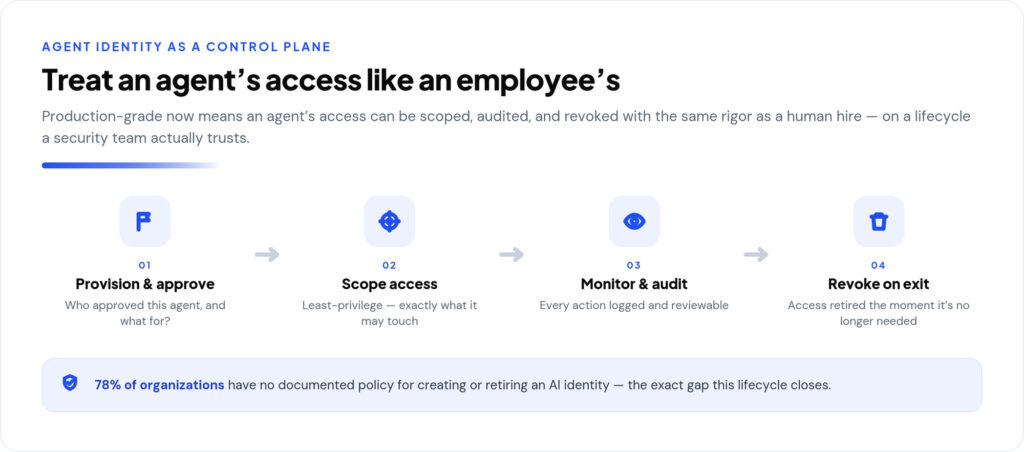
The same gap reappears the moment agents start acting instead of answering. A framework will hand an agent a set of API credentials and step aside. Whether those credentials are scoped correctly and revocable the day the person who created them leaves is a separate question, and it is usually the one a security review raises months into a deployment.
Security teams have moved this from a footnote to a headline. Microsoft’s January 2026 identity research found the average enterprise already runs five separate identity systems and four network access systems before a single agent joins, each enforcing policy its own way. Stacking autonomous, non-human identities on top of that is what pushed agent identity onto Gartner’s list of top cybersecurity trends for the year.
The scale is the uncomfortable part. The Cloud Security Alliance’s 2026 research on non-human identity puts these accounts at roughly 45 to 1 against human staff in the average enterprise, and the same work found 78 percent of organizations have no documented policy for creating or retiring an AI identity. Gravitee’s 2026 survey of technology leaders saw enterprise agent counts roughly double in a single quarter, with close to 38 percent of organizations already running more than a hundred agents.
A platform that treats an agent’s credentials as a one-time setup step, configured once and never revisited, is building on the weakness security teams now rank as the most urgent to close.
This is rewriting what production-grade means for an AI agent development platform. The old definition was uptime and latency. The working definition now includes whether an agent’s access can be audited and revoked with the same discipline a company applies to an employee account.
Identity vendors are already moving into that space, treating an agent as a first-class identity with its own lifecycle rather than an appendage of whoever configured it. Procurement teams are starting to ask platform vendors the questions a CISO asks about a new hire: who approved this access, and how does it get revoked once the agent is retired.
Build vs Buy Usually Settles Into a Hybrid
Framed as build versus buy, the choice sounds binary. It rarely stays that way. A packaged or cloud platform tends to cover the common workflows, while a custom stack handles the few that set the business apart. The economics start favoring build somewhere north of a million agent conversations a year, where per-call pricing on a managed platform overtakes the cost of running your own.
The factors that decide how far either path can go are governance and integration depth, far more than the choice of model.
Governance and the Regulatory Clock
The regulatory clock is real. The EU AI Act reaches its next enforcement milestone on 2 August 2026, when its transparency obligations apply, though the heavier high-risk obligations were deferred to late 2027 under the Digital Omnibus. Gartner expects more than 40 percent of agentic AI projects to be canceled by the end of 2027, and the reasons it names are unclear business value and weak risk controls, well ahead of anything about the model.
That matches what security researchers keep finding on the identity side. Canceled projects and identity gaps usually trace back to one root cause: governance debt that shows up in different parts of the same audit.
Integration Depth
On integration, Deloitte’s Tech Trends 2026 research points to legacy system integration and data architecture as the obstacles that stall agentic projects, again ahead of model choice. A long connector list looks great in a demo. Whether an agent can work reliably against the systems a company already runs is the question that surfaces later, usually after the contract is signed.
Integration Depth: The Number Comparison Charts Leave Out
That point deserves more room, because integration is where vendor comparisons and daily reality drift furthest apart.
Comparison tables lean on connector marketplace size because it fits neatly in a cell. It is a weak stand-in for what actually matters: whether an agent can read and write against the specific, often unglamorous systems a given company runs on. Two hundred prebuilt connectors count for little if the one system holding a company’s workflow together, a homegrown ERP or an on-premises database nobody wants to touch, is missing from the list.
Real integration depth lives in the details a demo skips. Does data sync in real time, or on a batch delay that breaks anything time-sensitive? And when a schema changes upstream, does the connection raise an alert or fail without a sound? The other tell is what happens with a system that is not in the marketplace at all. On shallow platforms it becomes a custom engineering project. On deeper ones it is a configuration setting.
Teams that get burned here made the same call. They checked integration breadth during the sales process and tested integration depth only after signing. Asking a vendor to prove a connection against your messiest real system before you commit is a small request, and it saves months.
The stakes climb again once an agent needs write access. Reading from a legacy system safely is one problem. Writing back to it, updating a record or triggering a downstream process without corrupting data the rest of the business depends on, is a much harder one, and it is where plenty of polished demos stop.
This is close to the problem Arivonix’s Agentic AI Designer is built around. On Arivonix, governance and enterprise integration are part of how an agent gets built rather than controls added after the framework is chosen, with audit logging and drift monitoring in the same layer. Its specialized intelligence is tuned to a company’s own data instead of a generic model sitting under every agent.
Most engineering teams already sense which layer they are short on. The step worth taking is checking that instinct against the agentic orchestration layer sitting under whatever AI agent development platform they run today.