GraphRAG vs Standard RAG: Which Retrieval Architecture Is Right for Enterprise AI?
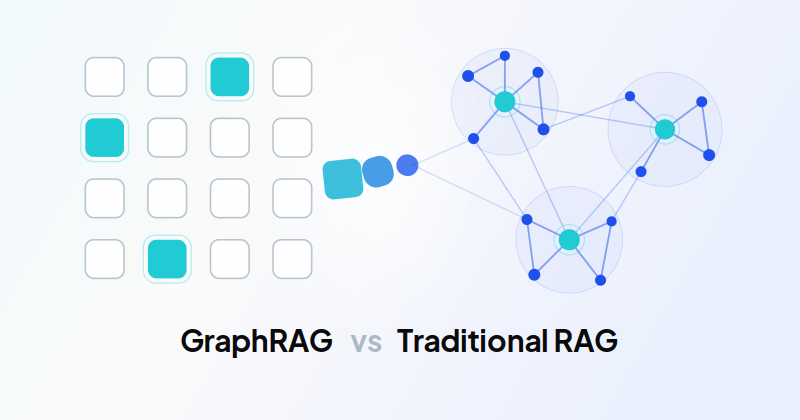
Ask a standard RAG system “what was our Q3 refund policy” and it answers well. Ask it “what are the recurring themes across two years of customer complaints” and it falls apart, because no single retrieved chunk holds that answer. Closing that gap is the whole reason GraphRAG exists.
Microsoft Research introduced GraphRAG in 2024 as a graph-based approach to retrieval-augmented generation, aimed at the kind of question plain vector retrieval structurally cannot answer. It has since become one of the busiest debates in enterprise AI architecture. Most of that debate asks the wrong thing. Whether GraphRAG beats standard RAG across the board matters far less than knowing which questions need a graph and which ones never will.
How Standard RAG Works, and Where It Breaks
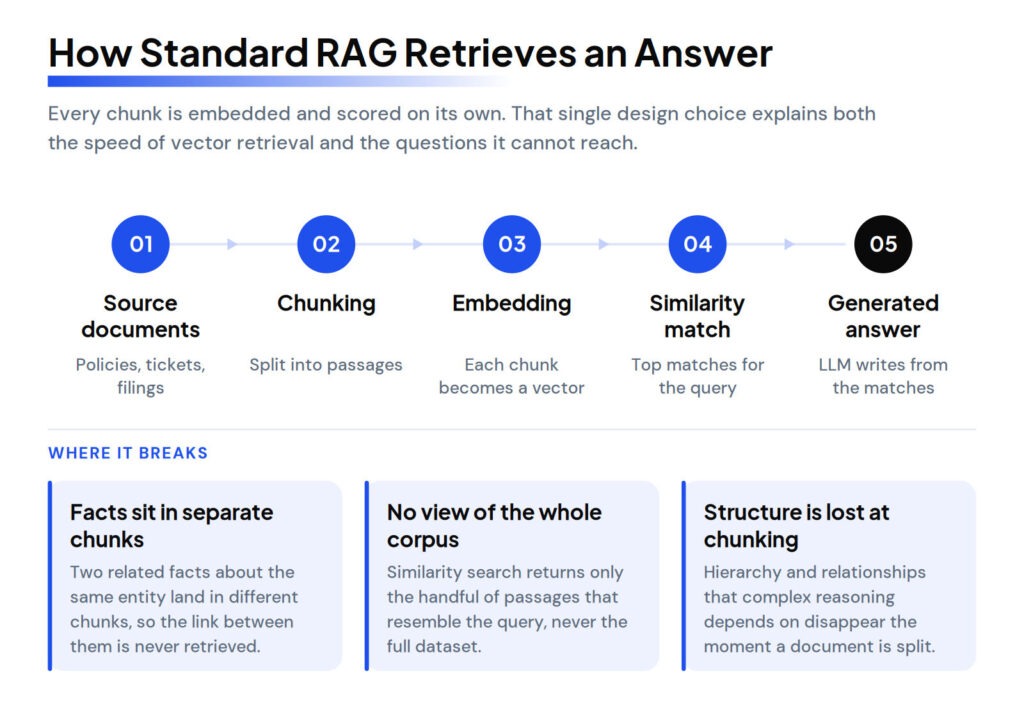
Standard vector RAG retrieves the passages most similar to a query. Documents get split into chunks, each chunk becomes a numerical embedding, and the query is matched against those embeddings by similarity. That match runs on meaning rather than exact keywords, which is why people use vector search and semantic search to describe the same retrieval step. RAG then goes one step past semantic search alone: it hands those retrieved passages to a language model that writes the answer.
That design has a few blind spots. Because each chunk is embedded on its own, the system cannot connect facts that sit in different chunks but share an entity. It also struggles with questions about a whole dataset, since similarity search only pulls back the handful of chunks that resemble the query, never the full picture. And the moment a document gets chopped into pieces, the relationships and hierarchy that complex reasoning leans on are gone.
What GraphRAG Does Differently
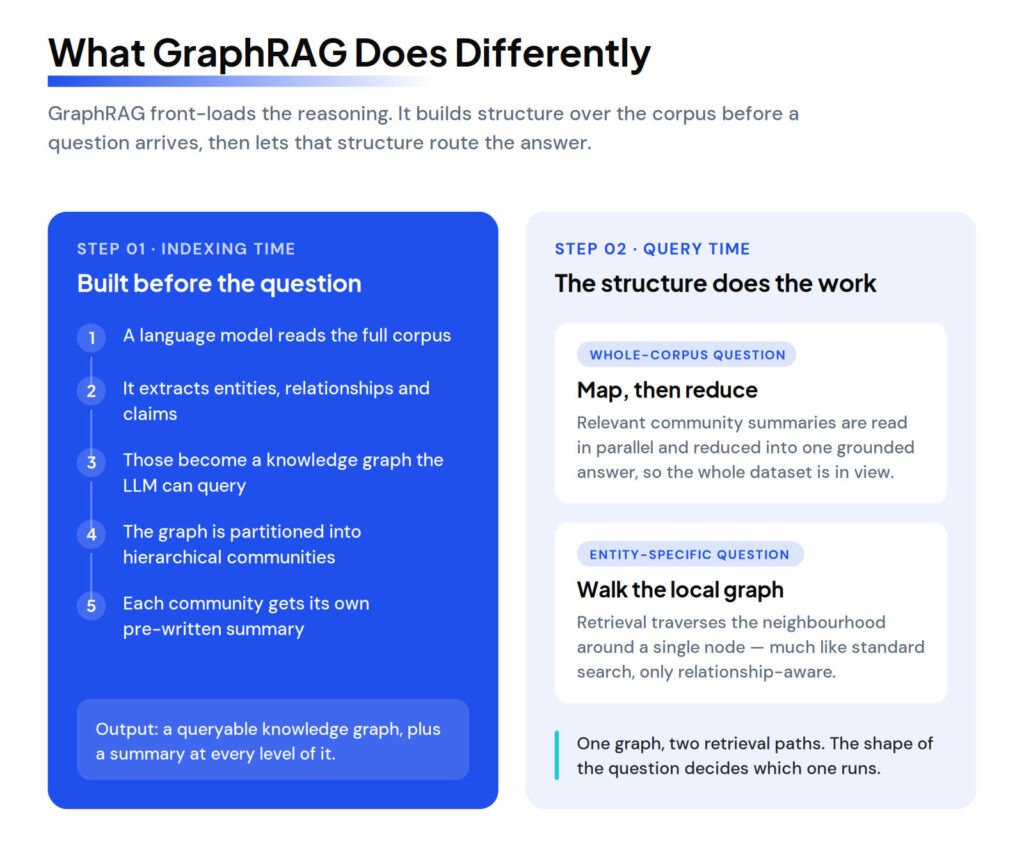
GraphRAG does its work before anyone asks a question. During indexing, a language model reads through the corpus and pulls out entities, relationships, and claims, then assembles them into a knowledge graph the LLM can query directly. The graph gets partitioned into hierarchical communities of densely connected topics, and each community gets its own pre-written summary, from high-level themes down to narrow subtopics.
At query time, that structure does the work. For broad questions that span a whole dataset, GraphRAG maps the relevant community summaries in parallel and reduces them into one grounded answer. Microsoft Research argues this step is necessary because naive RAG will always return misleading answers to questions that need the entire dataset in view rather than a few matched chunks. For narrower, entity-specific questions, GraphRAG can walk the graph around a single node, which behaves much like standard retrieval, only relationship-aware.
What the Benchmarks Show
Marketing copy has run ahead of the data on GraphRAG. A clearer read comes from an August 2026 VentureBeat analysis that pulled together Microsoft’s original research and four independent benchmark studies. Three findings stand out.
Global sensemaking is the clearest win
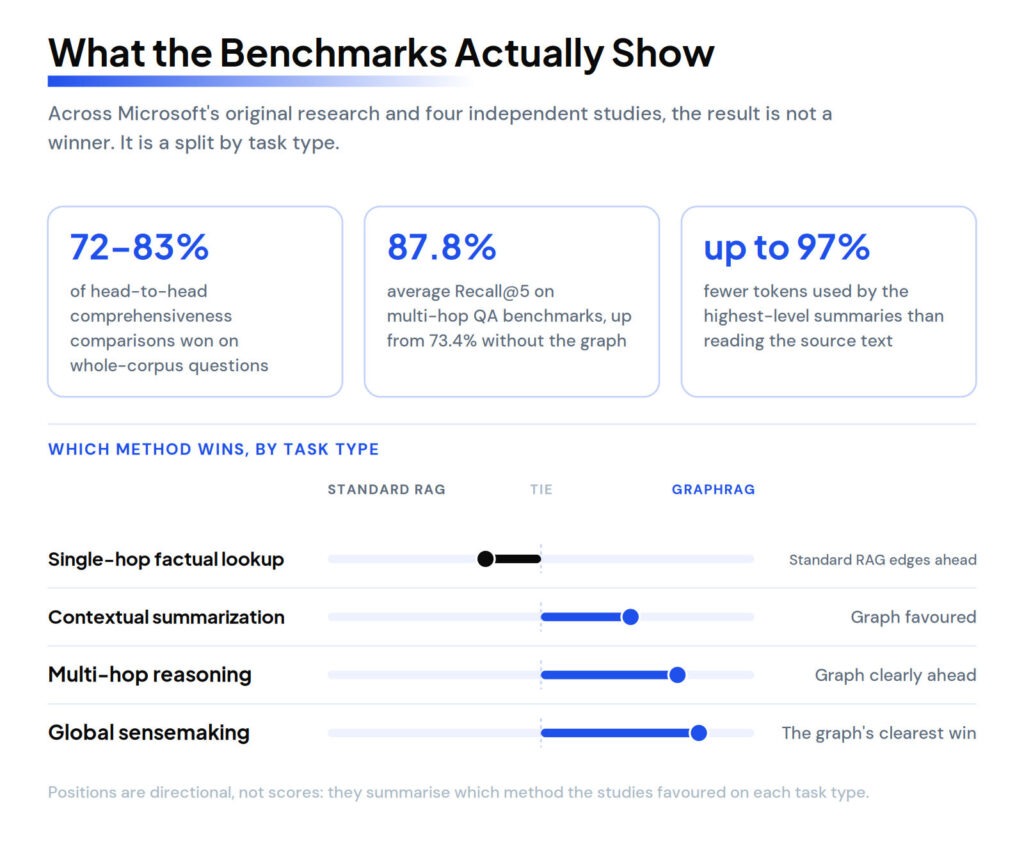
On questions that call for making sense of an entire corpus rather than a single passage, GraphRAG won 72 to 83 percent of head-to-head comprehensiveness comparisons against standard RAG. Its highest-level summaries did that while using up to 97 percent fewer tokens than feeding the source text through directly.
Multi-hop retrieval shows the biggest quality gains
On standard multi-hop QA benchmarks like MuSiQue, HotpotQA, and 2WikiMultiHopQA, graph-guided retrieval lifted average Recall@5 from 73.4 percent to 87.8 percent. That is close to a 20-point jump, and the largest gains landed on the hardest cross-document question sets.
The honest read is that it depends on the question
A 2025 controlled study from Michigan State and Meta ran standard RAG against four GraphRAG variants under one protocol and found no universal winner. On single-hop factual lookups, plain RAG edged ahead. On multi-hop reasoning, graph-guided retrieval pulled ahead. GraphRAG-Bench, presented at ICLR 2026, saw the same split by task: simple fact retrieval was close to a tie, while complex reasoning and contextual summarization both favored the graph by a solid margin.
The Real Costs: Indexing Price and Evaluation Bias
Two caveats keep GraphRAG from being a drop-in upgrade. The first is money. Having an LLM extract entities and relationships across a full corpus costs far more than building a plain vector index. Microsoft’s own follow-up, LazyGraphRAG, defers that extraction to query time to bring the cost down, which tells you the original indexing budget is impractical for a lot of real deployments.
The second caveat is evaluation. Many reported wins come from an LLM acting as judge, and independent audits show that setup carries real bias. Position alone can swing a win rate by more than 30 points, depending only on which answer appears first. The research still holds. The takeaway is just narrower: the biggest, most consistent gains, the multi-hop accuracy and recall lifts, deserve more trust than the comprehensiveness margins that rest entirely on LLM judgment.
Matching the Architecture to the Question
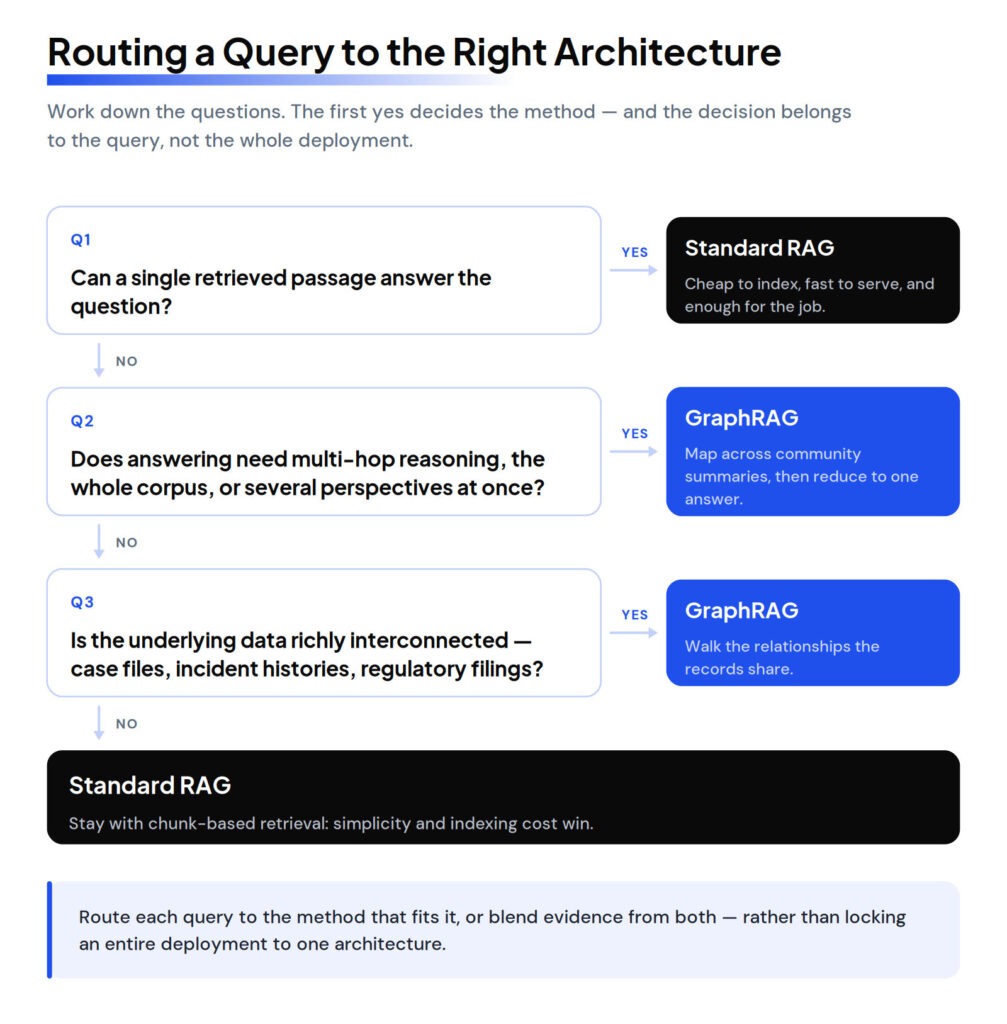
Strip out the hype and the call comes down to the shape of the question, not a platform-wide default. Reach for a knowledge graph when questions are multi-hop, cover the whole corpus, or ask you to synthesize several perspectives at once, and when the underlying data is richly interconnected, like case files, incident histories, or regulatory filings. Stay with standard chunk-based retrieval when queries are single-fact lookups, the corpus is small or flat, and simplicity and indexing cost matter more than a quality bump nobody will notice.
| Factor | Standard (Vector) RAG | GraphRAG |
|---|---|---|
| Question shape | Single-fact lookups a single passage can answer | Multi-hop, whole-corpus, or multi-perspective questions |
| Data shape | Small or flat corpus | Richly interconnected: case files, incident histories, filings |
| Cost profile | Cheap indexing, low operational overhead | Expensive graph build (LazyGraphRAG defers it to query time) |
| Best-fit example | Customer support and policy Q&A | Insurance claims reasoned across policies, history, and risk |
The studies point the same way in practice: route each query to the method that fits it, or blend evidence from both, rather than locking a whole deployment to one architecture.
Enterprise RAG Use Cases Where Each Wins
The split shows up clearly in real examples. Microsoft’s own walkthrough of GraphRAG in financial services uses post-disaster claims management as the illustration. Standard RAG retrieves and summarizes the most relevant individual documents efficiently. GraphRAG reasons across the full dataset, connecting claim histories, policy details, and geographic risk through their shared entities to produce a more connected answer. That fits enterprise RAG deployments in insurance, financial services, and any domain where the value lives in the relationships between records rather than the records on their own.
Customer support lookups, policy Q&A, and other single-document answers are the opposite case. Standard RAG handles them faster, cheaper, and without the graph-building overhead a simple lookup never needed.
Where Arivonix Fits
Retrieval architecture is one layer of a larger question we have written about before: whether an AI system is built to know your business or just labeled that way. Our approach to data-centric AI assurance treats the retrieval layer as something to govern on purpose, tracking which architecture served which answer and why, instead of trusting one default across every workload.
That matters more as the retrieval method and the data feeding it turn into a single decision. Our recent piece on data virtualization versus data replication covers the next-door question of how that underlying data reaches an AI system in the first place. The Agentic AI Designer lets a team route between retrieval approaches by workload, rather than committing an entire deployment to one architecture on day one.