As enterprises adopt Agentic AI, the real bottleneck is retrieval quality, not the model. Traditional methods rely on keyword similarity, often returning weak or irrelevant context. HyDE (Hypothetical Document Embeddings) improves this by generating an “ideal answer” first and using it to guide retrieval. Instead of vague matches, it pulls context aligned with intent and domain reasoning, turning shallow responses into accurate, decision-ready insights.
The Critical Gap in Traditional Retrieval
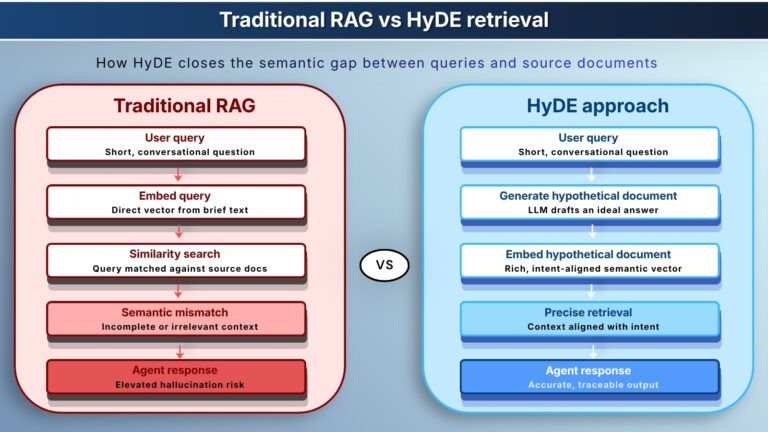
Enterprise data lives in many forms structured records, lengthy reports, compliance files, real-time streams, and scattered documents. User queries, however, are usually short, conversational, and imprecise. Traditional embedding-based retrieval struggles here because it tries to match these brief queries directly against dense, formal documents. The semantic mismatch leads to missed relevant information or irrelevant results.
This gap matters because poor retrieval is one of the main reasons AI agents fail in production. It causes:
- Reduced accuracy in responses
- Higher hallucination rates
- Slower decision-making
- Lower trust from business users
Recent industry benchmarks show that even advanced RAG systems often underperform when query-document language differences are significant. Without addressing this, scaling Agentic AI across complex data fabrics becomes risky and expensive.
Why HYDE Delivers Better Results
HYDE solves this by using an LLM to generate a hypothetical document based on the query first. This synthetic document captures what a good answer might look like in rich, document-style language. The system then uses its embedding to retrieve real documents from the corpus.
This method is important because it aligns the retrieval process more closely with how actual enterprise content exists. It performs especially well in zero-shot scenarios, where labeled training data is unavailable or impractical — common in dynamic enterprise settings.
Recent studies highlight its impact:
- Up to 18-25% improvement in retrieval precision on domain-specific and QA tasks. Stanford NLP Group findings
- Strong gains in fact verification, multilingual retrieval, and ambiguous query scenarios.
- Better performance than standard dense retrievers and BM25 in hybrid configurations, particularly with sparse or evolving data. Mlpills 2025
These improvements matter for Agentic AI because agents don’t just answer once — they chain multiple steps, pull live context, and execute actions. Every retrieval error compounds across the workflow.
Why HYDE Is Especially Valuable at Arivonix AI
At Arivonix AI, our platform unifies real-time data across 250+ sources — cloud, on-prem, data lakes, and streaming systems — without copying or moving data. Agents like Arivon operate directly on this live data fabric, handling summarization, classification, metadata generation, and intelligent routing.
In this environment, HYDE becomes critical for several reasons:
- Handles dynamic and ambiguous queries effectively as business needs change rapidly.
- Reduces hallucinations by surfacing more relevant context from complex, multi-source data.
- Supports zero-shot adaptability, allowing quick integration of new data sources without lengthy fine-tuning.
- Improves governance and compliance through more accurate and traceable agent outputs.
- Boosts overall agent reliability on live, ever-changing data streams.
The result is faster time-to-insight, higher adoption by enterprise teams, and stronger ROI on AI investments — particularly for sectors like finance, manufacturing, insurance, and utilities where accuracy and real-time operation are non-negotiable.
The Bottom Line
HYDE is important because it directly tackles one of the hardest problems in enterprise AI: making retrieval precise and reliable at scale. In Agentic systems built on real-time unified data, this capability separates agents that merely respond from those that consistently drive business value.
At Arivonix AI, we integrate HYDE-inspired techniques with hybrid search, multi-query strategies, and governed orchestration to make our agents more dependable. This focus on advanced retrieval is key to delivering Agentic AI that works effectively on live enterprise data fabric.
Whether you’re ready to adopt advanced retrieval from day one or still evaluating your current setup, we’re here to help.