Observability Is the Part Most Enterprises Underestimate
Security and observability are often treated as separate concerns. With agentic AI, they are not. An agent that cannot be traced is an agent that cannot be governed, and an agent that cannot be governed cannot be trusted at production scale.
Without deliberate structure, agentic behavior quickly becomes opaque shadow IT. Arivonix AI addresses this through capabilities embedded into deployment from the start, not added after the fact:
- Standardized Model Cards and Agent Cards capture training provenance, performance boundaries, bias evaluations, intended scope, and known limitations. These are living records that make every agent’s behavior traceable and defensible at any point in its lifecycle.
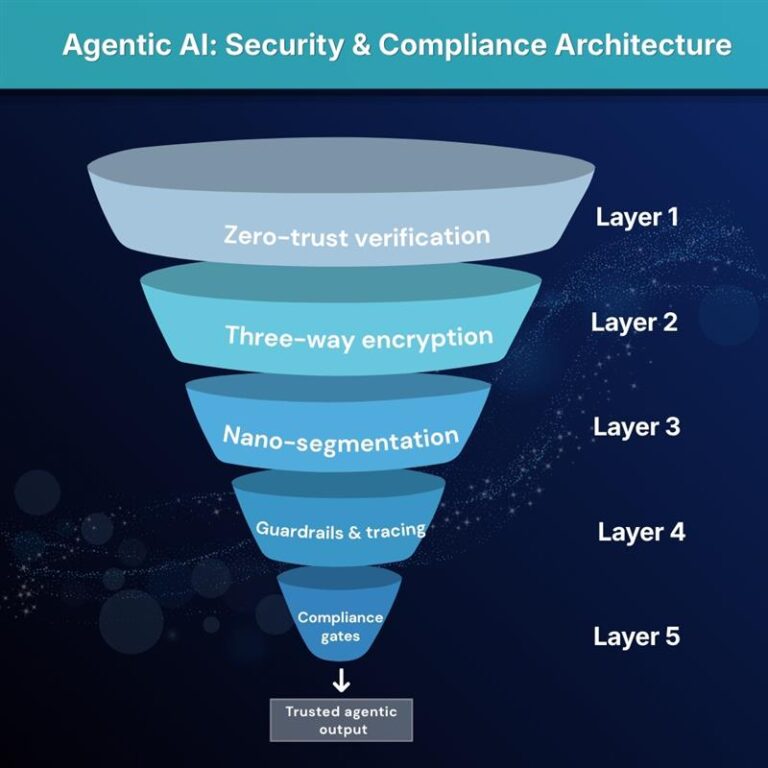
- Programmable guardrails, including content filters, PII detection and redaction, business-rule enforcement, and emergency circuit breakers, attach directly to agents at runtime, functioning as part of how agents execute rather than as external checkpoints.
- Automated compliance gates built into every deployment pipeline, so promotion from dev to test to prod carries built-in policy validation. Risk and compliance checks happen before release, not after an audit surfaces a gap.
- Full end-to-end tracing that captures every reasoning hop, tool call, and decision across multi-agent interactions, making replay and forensic review possible the moment a question arises from a regulator, an auditor, or an internal team.
What Data Leaders Are Actually Optimizing For
Most data leaders navigating this transition are not trying to build perfectly secure systems in the abstract. They are trying to build architecture that holds up under real operational and regulatory pressure and that continues to hold up as agentic AI spreads across teams, departments, and use cases.
That usually comes down to three questions:
- Can we understand what an AI agent did and why?
- Can we contain failures without stopping everything?
- Can we meet compliance expectations without slowing teams down?
The organizations that answer yes to all three are consistently the ones that treated AI governance as an architectural property from the beginning. They built lineage, policy enforcement, versioned configurations, and reproducible environments before scale exposed the gaps.
For enterprises operating under GDPR, CCPA, and the EU AI Act, where 2026 marks the shift from advisory frameworks to enforceable compliance law, this embedded approach is no longer just good practice. It is a competitive and regulatory requirement.
Arivonix AI’s Data-Centric AI Assurance framework is built precisely around this reality. It does not add governance to agentic deployments; it embeds governance into how those deployments are constructed, operated, and audited, from infrastructure through to the full compliance trail.
The Rethink Is Already Underway
Agentic AI does not demand a complete architectural reset. It asks for something more precise: a clear-eyed rethink of where trust, control, and accountability actually live in the stack.
The teams moving fastest are not the ones with the most capable models. They are the ones who recognized early that production confidence comes from the surrounding architecture and built accordingly.
When AI governance, security, and observability are thoughtfully embedded from the start, agentic AI stops being an experiment and starts behaving like infrastructure: repeatable, accountable, and scalable across the organization.
That is what responsible AI looks like in practice, not a policy document, but a living architecture built on clear principles at every layer.
This is the architecture Arivonix AI is built to deliver, end to end, out of the box.
Whether you’re ready to dive in or just exploring your options, we’re here to help.
Start Your Free Trial | Book a Consultation
This blog was first published on Medium.