The Enterprise AI Agent Platform:
From Pilot to Production
Table of Contents
The enterprise conversation about AI agents has changed shape. Two years ago the debate was whether agents worked at all. Now the question is more expensive to answer: can an agent hold up under a real security review, an audit, and the load of live traffic? For most, the honest answer is still no.
That gap is where the AI agent platform earns its place. It is the layer that decides how agents get built, secured, and run once they leave the sandbox, and it has now become the main thing separating a convincing demo from a system a business can depend on. What follows is a working picture of where that layer sits today and where it is headed.
Where AI Agent Platforms Stand Today
Demand has run well ahead of readiness. Gartner’s 2026 Hype Cycle for Agentic AI put the share of organizations that have actually deployed AI agents at 17 percent, even as a large majority say they intend to within two years. That distance between intent and operation is the story of the year.
The failure data explains why the gap is so wide. MIT’s research on the GenAI divide found that 95 percent of generative AI pilots produce no measurable business impact, and S&P Global reported that 42 percent of companies walked away from most of their AI initiatives during 2025. Agents that look impressive in a controlled demo tend to come apart in pre-production, where they meet security review, monitoring requirements, and the question of who is accountable when they act.
A few pressures are reshaping the market at once. Teams across an organization have built their own agents on their own frameworks, and the resulting sprawl has become a problem in its own right, one that pushes buyers toward consolidation. Governance keeps stalling projects the moment someone asks what an agent is allowed to do on its own and who answers for it. And finance leaders, watching the abandonment numbers, have started cutting programs that cannot show a return. The companies making progress share one habit: they stopped treating the model as the measure of progress and started treating the platform that way.
How AI Agent Platform Architecture Is Consolidating
AI agent platform architecture is settling around a control plane instead of a pile of scripts. Early projects were framework-first: a developer wired a reasoning loop to a handful of tools and shipped it. That works for one agent and falls apart at a dozen, which is why orchestration, tool access, memory, identity, and observability are moving out of per-agent code and into shared infrastructure. KPMG’s 2026 research on enterprise AI points to coordinating multiple agents as the bottleneck that surfaces when teams try to move from pilots to production, and it is the layer most homegrown stacks handle worst.
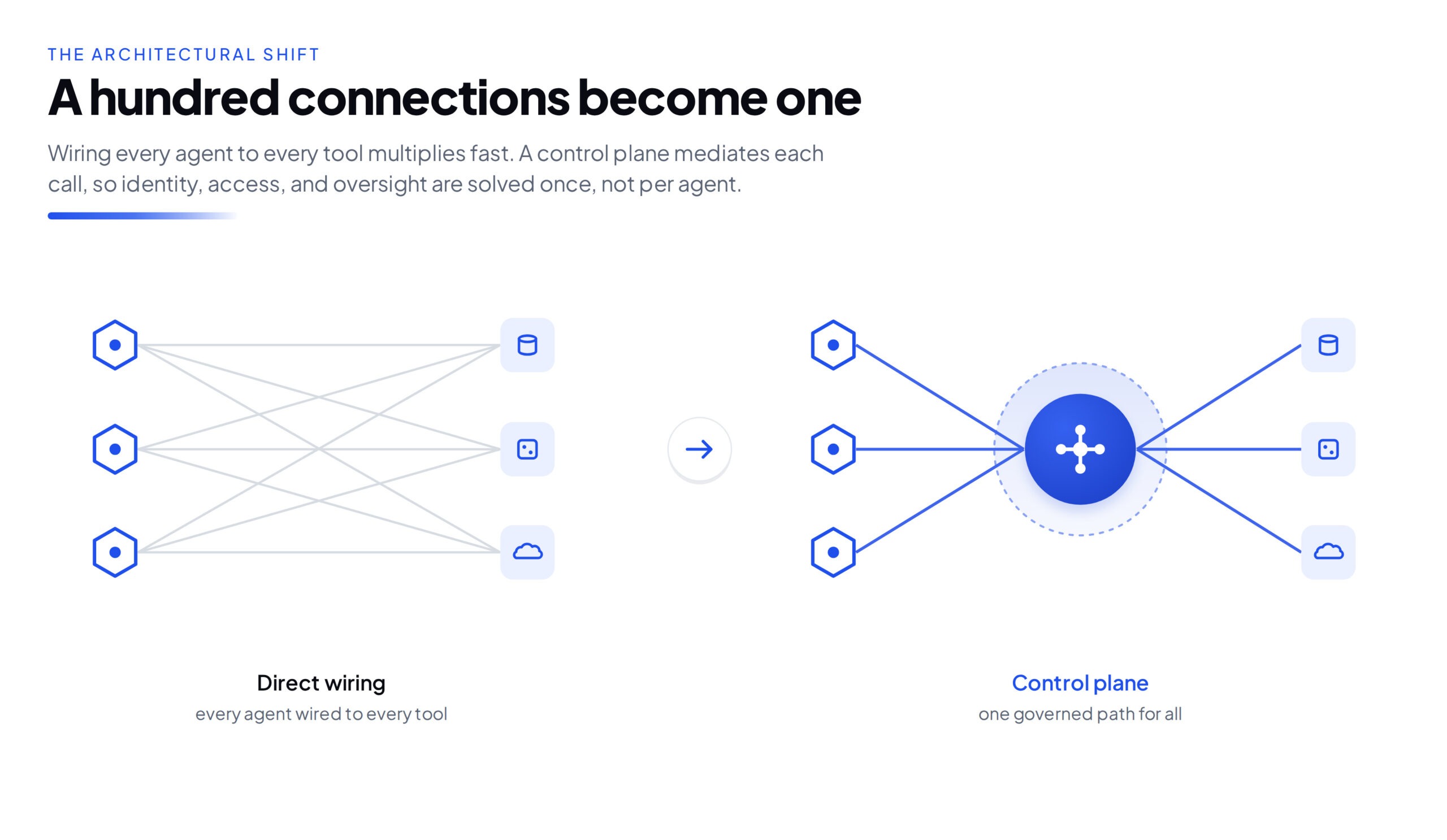
Interoperability is the other structural change. Enterprises have stopped tolerating a bespoke connector for every system, and open standards are closing the gap. The Model Context Protocol has become a common way for agents to reach tools and data under governed access, with agent-to-agent communication heading the same direction. Gartner naming agentic and multi-agent systems a top strategic technology trend for 2026 reflects the same move, from isolated agents toward coordinated systems a platform has to route, secure, and supervise.
| Platform layer | Function | What is changing now |
|---|---|---|
| Agent runtime | Executes reasoning, planning, and tool calls | Per-agent code giving way to managed, swappable runtimes |
| Orchestration and control plane | Coordinates multi-agent workflows and hand-offs | Now the primary production bottleneck; central control planes replace ad hoc chaining |
| Tool and data access | Connects agents to systems and knowledge | Governed access through open standards such as MCP; curated, permissioned connectors |
| Memory and context | Maintains state across steps and sessions | Governed, auditable context replacing unmanaged vector stores |
| Identity and policy | Establishes who an agent is and what it may do | First-class agent identity and purpose binding in place of shared credentials |
| Observability and governance | Logs, monitors, and enforces controls | Runtime enforcement, not documentation, becomes the standard |
AI Agent Frameworks vs Platforms: What Enterprises Are Consolidating Onto
The comparison that matters now is no longer agent versus chatbot. Most teams have that one figured out. It is the AI agent frameworks vs platforms question, the choice between a governed platform and everything else people use to build agents, and the pressure behind it is measurable. IBM’s 2026 Institute for Business Value study found that 77 percent of organizations say AI adoption is already outrunning their governance capacity, and two-thirds of CIOs and CTOs report being held accountable for AI systems they do not fully control.
So sprawl is no longer a tidiness problem. It has turned into a security and accountability problem, and it is what makes consolidation onto a governed platform look less like a preference and more like a decision most organizations have already made. The pattern holds across the market: frameworks and copilots spread fast and govern poorly, while a platform gives up some flexibility in exchange for the controls production actually demands. More enterprises are deciding that trade is worth making.
| Approach | Core principle | Best for | Key limitation |
|---|---|---|---|
| AI agent platform | A governed control plane for building, orchestrating, and operating agents | Enterprises running multiple agents that must be secured, audited, and scaled | Requires governance and integration maturity to adopt well |
| Open agent frameworks | Code-first libraries for composing agents and tools yourself | Well-staffed teams needing maximum flexibility on a bounded build | No native governance, identity, or observability; a primary source of sprawl |
| Vertical or embedded agents | Prebuilt agents inside a single application or workflow | A specific, contained automation need | Cannot extend across adjacent workflows without separate tooling |
| Copilots and assistants | Conversational augmentation layered over existing tools | Individual productivity gains | Passive assistance; no autonomous execution or multi-agent coordination |
AI Agent Governance: The Constraint That Decides What Ships
AI agent governance has turned into the gate that decides whether an agent ships. Gravitee’s 2026 security research found that fewer than a quarter of teams give their agents a distinct identity, and IBM’s data shows only 11 percent of organizations consider themselves ready for the scale of agent deployment they expect within a year. The projects that stall tend to stall on the same unanswered questions: what an agent may do without a human signing off, who is liable when it gets something wrong, and how it behaves when it fails. Answering those inside the platform before the pilot, instead of arguing them out afterward, is most of what separates the teams that reach production from the teams that do not.
The governance approaches that hold up in production have a few things in common. They classify agents by business impact and grant autonomy in proportion to that risk, which maps cleanly onto the tiered obligations in the EU AI Act and the NIST AI Risk Management Framework. They treat agent identity as a first-class control instead of leaning on shared API keys, a practice Gravitee still found at nearly half of teams and one that quietly destroys audit trails while over-privileging every agent at once. And they put human oversight for high-stakes actions into the platform as an enforceable control, with kill-switch and purpose-binding built in rather than written into a policy nobody reads at runtime. The direction is consistent: governance is moving from documentation into infrastructure, a shift we cover in more depth in our guide to AI agent governance.
AI Agent Security: Identity, Visibility, and the Control Gap
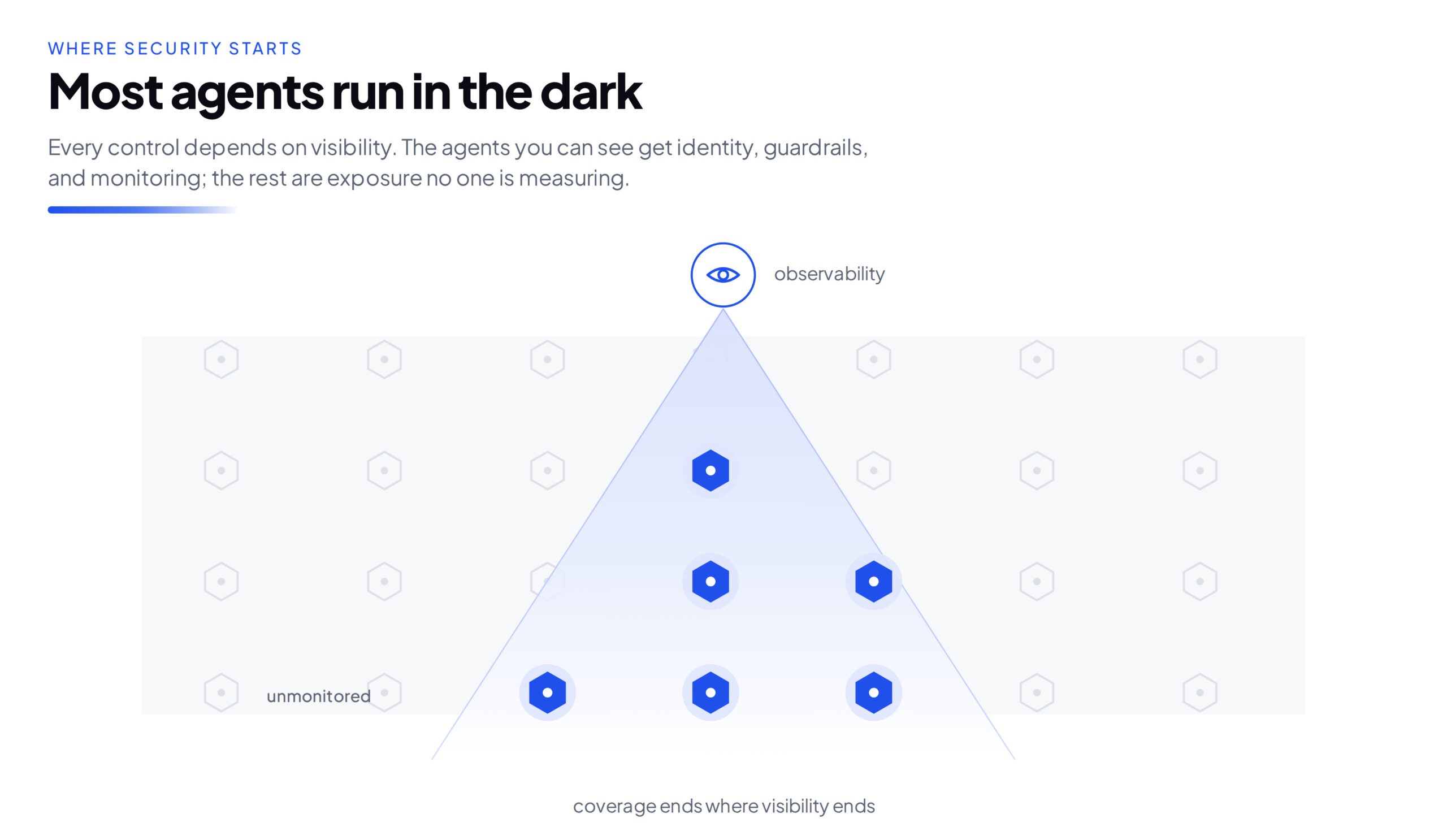
AI agent security has overtaken raw capability as the thing that gates deployment, and the numbers make the worry easy to understand. Gravitee found that 88 percent of organizations had a confirmed or suspected agent-related security incident in the past year, more than half of the agents in production run without monitoring or logging, and only 14.4 percent go live with full security and IT approval. Adoption is outpacing control, and the gap grows every time an agent fleet doubles.
The threat surface is particular to how agents work. Prompt injection sits at the top of the OWASP Top 10 for LLM Applications for the second edition running, and its indirect form is more dangerous for an agent than for a chatbot, because a poisoned document or tool response can hijack something that holds real permissions to act. Tool manipulation, privilege escalation, and unsafe delegation are variations on the same weakness. The defenses maturing in response center on identity and visibility: short-lived, least-privilege credentials tied to a registered agent, tool access routed through governed gateways, guardrails that enforce policy at the moment of execution, and monitoring that never stops. The principle underneath is plain. You cannot secure what you cannot see, and most organizations still cannot see most of their agents.
AI Agent Deployment: Why the Few That Reach Production Are Different
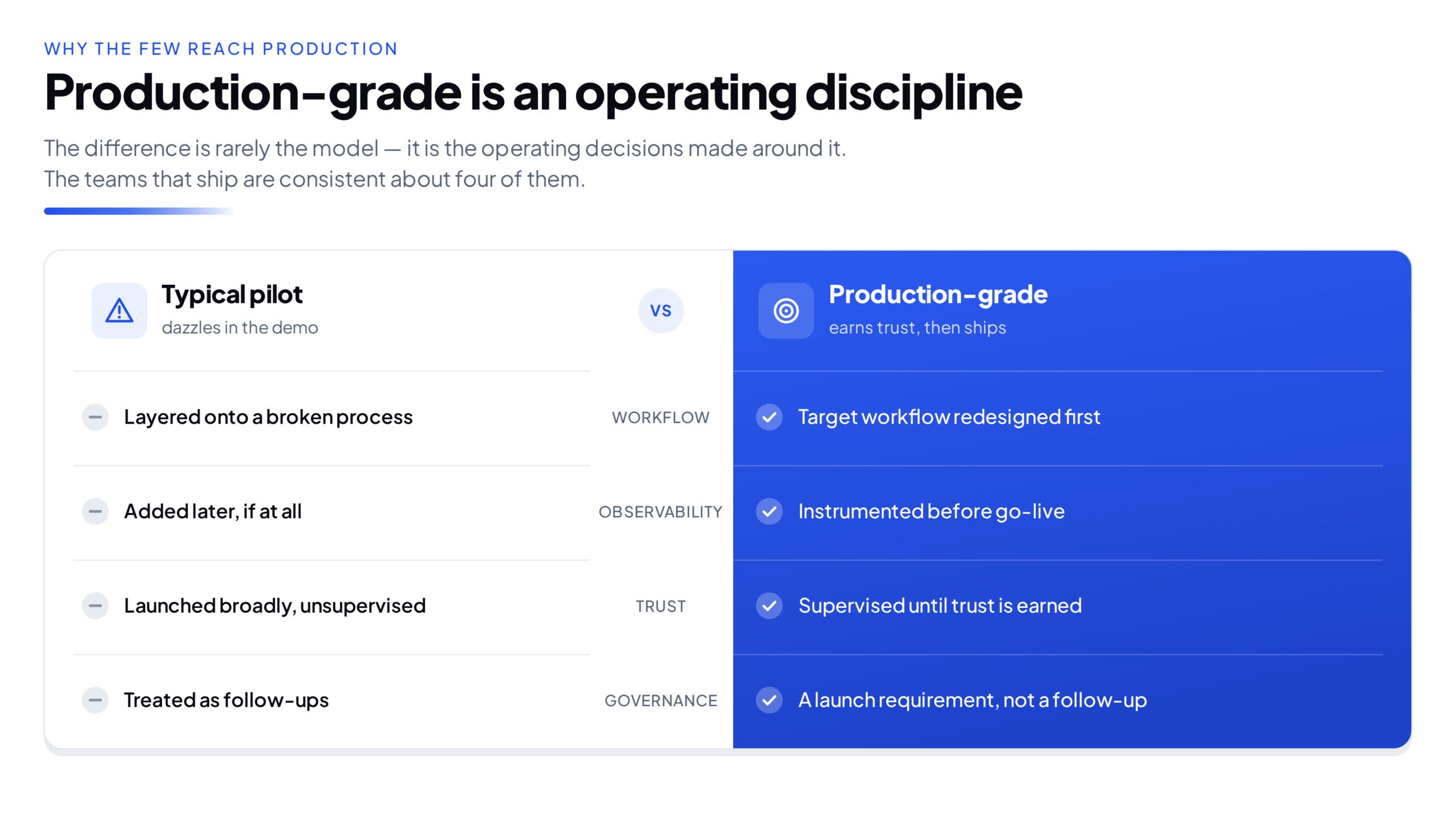
AI agent deployment is where the market pulls apart, and the deciding factor is rarely the model. It is the operating choices made around it. A team’s deployment pattern sets the ceiling on what an agent can safely do, and it comes down to a handful of decisions: how much autonomy an agent gets and where a human still has to approve, where the agent runs, whether it works alone or inside a coordinated set, and whether the organization assembles it on open frameworks or adopts a governed platform. Regulated data tends to force the hosting question first, since keeping activity inside a sovereignty boundary rules out cloud-only tooling.
| Decision axis | The choice enterprises are making | Why it matters now |
|---|---|---|
| Autonomy | Where humans must approve versus where agents act alone, set by risk tier | Sets the trust ceiling and the regulatory exposure of every workflow |
| Hosting | Public cloud, private cloud, or on-premises | Regulated data increasingly forces private or on-premises deployment to hold the sovereignty boundary |
| Coordination | A single agent versus multi-agent orchestration | Multi-agent lifts capability and governance load together, which is where most pilots stall |
| Build versus buy | Assemble on open frameworks versus adopt a governed platform | Open frameworks maximize control but inherit the sprawl, identity, and governance gaps that block production |
What the successful minority does looks fairly consistent. McKinsey’s State of AI research keeps landing on the same finding: redesigning the underlying workflow is the move most closely tied to real financial impact from AI, and that discipline carries straight into agent work. The teams that ship rebuild the target process for an agent instead of bolting one onto a broken one, stand up observability before go-live, run in a supervised mode long enough to trust the results, and treat governance and identity as launch requirements instead of follow-ups.
Where AI Agent Platforms Are Heading
A few things look fairly certain about the next phase. Standardized interoperability keeps advancing, and as protocols for tool access and agent-to-agent communication settle, the platform’s job shifts from hosting individual agents to governing a whole ecosystem of them, including agents that belong to partners and vendors. Gartner expects guardian agents, the software that watches and constrains other agents, to make up 10 to 15 percent of the agentic AI market by 2030, which tells you how much of the coming spend is aimed squarely at trust and control.
Autonomy will expand, but on a leash. The trend runs toward agents that need less step-by-step direction, though the license to operate that way gets earned through observability, policy enforcement, and audit trails a team can actually produce. A platform that cannot demonstrate control will not be allowed to widen it, least of all in regulated sectors.
The agent platform and the data layer beneath it are also converging. An agent is only as reliable as the governed, current data foundation it acts on, which is why the architectures that last pair multi-agent orchestration with a unified data layer instead of buying them separately. For the operational side of that foundation, Arivonix’s guide to agentic AI for data workflows covers how agents run inside data pipelines, and its analysis of specialized intelligence covers the accuracy layer agents lean on. The platform is turning into the place where intelligence, governance, and data operations meet.
How Arivonix Approaches the AI Agent Platform
Arivonix was built for the problem this piece describes: getting agents past the demo and into governed production without signing up for a multi-year infrastructure project. Instead of a framework that hands governance back to the customer, it offers a single no-code control plane that brings agent orchestration, data integration, and governance together in one place.
That shows up in a set of deliberate choices. Governance is native, with output lineage, confidence scoring, human-in-the-loop checkpoints, and GDPR, HIPAA, SOC 2, and CCPA controls enforced across every workflow from the first day. Orchestration is multi-agent by design, with specialized agents handling separate stages under configurable human oversight, the layer most teams struggle to run. Integration goes through governed, prebuilt connectors and a visual designer, so domain teams can put agents to work without inheriting the identity and observability gaps of a hand-built stack. Deployment is cloud-agnostic across AWS, Azure, GCP, and on-premises environments, with a first workflow live in a single business day and consumption-based pricing that tracks usage instead of seats. The goal is straightforward: a place to run agents safely at scale, built for teams that do not have years to spend on the plumbing.
Evaluating an AI Agent Platform: A Buyer’s Checklist
The criteria that mattered a year ago, model quality and demo polish, are now the baseline. The questions that predict whether an agent survives production are about control, and they fall into seven areas any evaluation should score directly.
| Evaluation area | The question that predicts success in production |
|---|---|
| Governance and identity | Does the platform give each agent a distinct identity, enforce least-privilege access, and bind it to an approved purpose? |
| Observability and runtime control | Are monitoring, audit logging, guardrails, and a kill switch enforced at execution time, not just documented in policy? |
| Orchestration depth | Does it support true multi-agent coordination with human-in-the-loop escalation, rather than single-agent chaining? |
| Security posture | Is it tested against prompt injection, tool manipulation, and privilege escalation, and does it use short-lived credentials? |
| Interoperability | Does it support open standards such as MCP so you are not locked into one vendor’s tools? |
| Deployment flexibility | Can it run on-premises or in a private cloud for regulated data? |
| Commercial model | Does consumption-based pricing align the vendor’s incentives with your outcomes? |
A platform that answers these convincingly is built for production; one that cannot is built for a proof of concept, and the difference tends to surface at the worst possible moment. The same checklist works at smaller scale. For a mid-market team, consumption-based pricing and a no-code control plane make a governed first agent realistic in days, provided the work is somewhere accuracy and governance matter more than open-ended flexibility.
Putting a Governed Agent Into Production
The move from experimental agents to governed, production-grade platforms is already underway, across industries, in organizations that decided to stop running agents in isolation and start operating them as managed infrastructure.
The operational payoff is concrete: agents that clear security review, reach production instead of stalling in prototype, and run under monitoring that makes every action auditable. Teams already operating at scale describe a compounding effect, where each new agent gets faster and safer to deploy because the platform, governance, and identity foundations are already in place. The strategic read is just as clear. An organization that stands up a governed AI agent platform now will move quicker, and carry far less risk, than competitors still wiring together ungoverned agents one framework at a time.
Arivonix is built for teams ready to make that move, whether you are deploying your first governed agent or standardizing multi-agent orchestration across a large estate. Book a consultation to map your workflows to a governed deployment path, or start a free trial and put your first governed agent into production in a single business day.
See specialized intelligence on your own data and workflows
Talk through where it fits, what it would take to deploy, and the advantage it can compound for your team.