
AI Agent Orchestration: What It Takes to Move Agents From Pilot to Production
Most agentic AI demos look great. One agent drafts an email, another summarizes a support ticket, and the result lands in front of a person who nods and moves on. The hard part shows up later, once a real business process needs several agents working the same task and handing off cleanly at every step.
With a single agent, there is nothing to coordinate. It reads a prompt, does its one job, and returns a result. Add a second agent, then a third, and a problem appears that no individual agent can fix on its own. Context drops between steps. Two agents redo the same work. When something breaks, nobody can say which agent did what, or why.
Closing that gap is the job of an AI agent orchestration platform. It has become one of the more consequential technology decisions an enterprise will make this year, and it marks the difference between agents that demo well and agents that hold up in production.
This piece is about what that layer actually does and why it ends up mattering more than the raw capability of any single agent. It also covers how Arivonix treats orchestration as infrastructure, not a feature bolted onto a pile of bots.
What Is AI Agent Orchestration?
AI agent orchestration is the practice of coordinating multiple AI agents so they behave as one system instead of a set of disconnected tools. A single agent is a specialist that is good at one job. Orchestration is what turns a group of specialists into a working team that shares context and knows who handles what.
People sometimes shorten this to AI orchestration, though the agent part is what makes it hard. In practical terms, an AI agent orchestration platform sits above the individual agents. It hands out tasks and keeps shared memory in sync across them. It also enforces the rules that decide what any single agent is allowed to touch.
Most enterprises already have plenty of individual agents. What they are missing is the layer that turns those agents into coordinated agentic AI workflows instead of a set of one-off experiments.
When Agents Multiply, Coordination Stops Being Optional
The moment more than one agent enters a process, you have a coordination problem, whether you meant to create one or not.
Picture a simple support workflow. One agent pulls the customer record. A second checks it against policy. A third drafts a reply, and a fourth routes it for sign-off. Without a coordination layer, each agent is guessing at what the others already did. With one, they share context automatically and the handoffs vanish from the point of view of the person waiting on an answer.
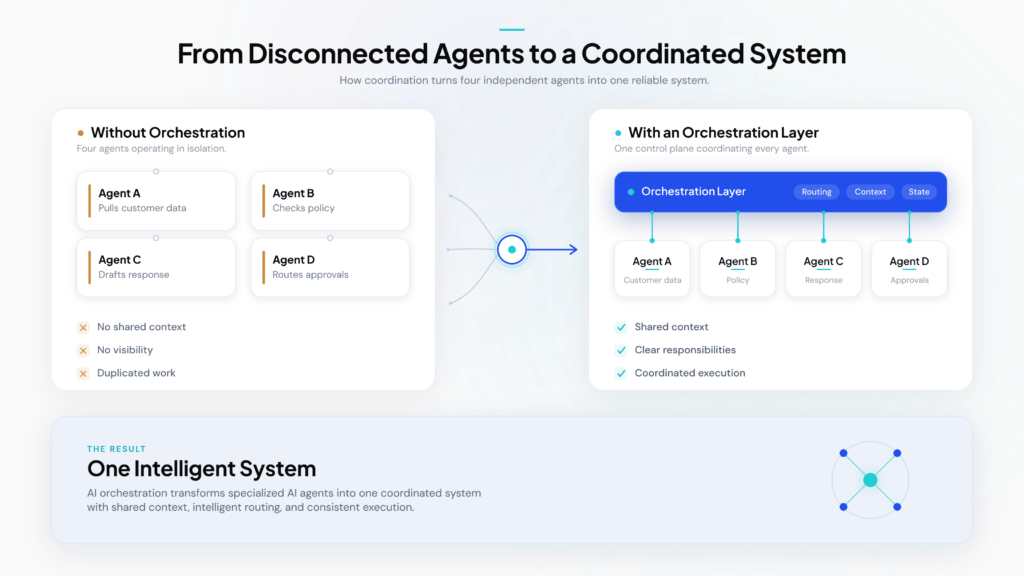
This is the shift from isolated automation to something that behaves like a coordinated system. It is also why agent coordination has grown into its own discipline rather than an afterthought.
Where Agent Orchestration Frameworks Came From
A few years ago, most of what people called orchestration was really scripting. A developer wrote a script, the script called an API, the API returned a result. That works right up until an agent needs to reason, retry, or change course partway through a task.
Agent orchestration frameworks showed up to handle exactly that. They give developers a structured way to define agent roles, wire them to tools, and manage the back-and-forth between agents without hand-coding every possible path. Open-source communities have moved fast here. Search GitHub today and you will find dozens of agent orchestration frameworks, each with its own view of how agents should hand off work.
CrewAI and the Open-Source Options
CrewAI is one of the better-known examples. It treats agents like members of a crew, each with a defined role and goal and a way to collaborate with the rest of the team.
Other frameworks go graph-based, mapping out every state a workflow can move through. Some sit closer to raw code and give engineers fine-grained control over a shared codebase that every agent draws from. None of these is wrong. They are different bets about where control should sit and how much autonomy a single agent should have. The common thread is simple: agents get more useful when something above them manages the relationships between them. Arivonix has written more on how agents get structured, connected, and governed if you want to go deeper on the design side.
Centralized Orchestration
In a centralized model, one component coordinates everything. It takes the incoming task, breaks it into pieces, and assigns each piece to whichever agent is best suited for it.
The payoff is predictability. There is one place to look when something goes wrong and one place to enforce policy across every agent. The catch is that the orchestrator becomes a critical dependency. If it is slow or poorly designed, everything downstream feels it.
Hierarchical Orchestration
Hierarchical orchestration adds layers. A top-level agent delegates to mid-level managers, which delegate to task-level agents doing the actual work. It mirrors how a lot of human organizations run, which makes it intuitive to design around. It also scales more gracefully than a single flat orchestrator, since responsibility spreads across the hierarchy instead of piling up in one spot.
Peer-to-Peer Coordination
A third pattern drops the hierarchy. Peer agents negotiate directly, passing context back and forth as equals rather than reporting up to a central authority. This suits fast-moving work where the right sequence genuinely depends on what earlier agents turn up. It also asks the most of your agent communication protocols, because there is no central referee to settle a disagreement between agents.
Traditional Automation vs. Autonomous Agents
The word automation gets thrown around loosely, and the distinction is worth getting right.
Traditional automation follows a fixed script. If X happens, do Y. The path rarely changes unless a person edits the configuration by hand. Autonomous agents work differently. They reason about a task, decide which tool or which other agent should go next, and adjust based on what they find along the way.
That is a real difference. One kind of system can only do what it was explicitly told to do. The other can handle situations nobody programmed for in advance.
Autonomy without structure carries its own risk, which is why orchestration and AI governance keep coming up in the same breath.
Why Coordination Beats Individual Agent Performance
It is tempting to judge agentic AI the way we judge language models, by benchmark scores and answer quality. Once agents move from answering questions to finishing multi-step work, that stops being the thing that matters most.
A brilliant agent that cannot reliably pass context to the next agent, or that repeats a task another agent already finished, creates more cleanup than it saves.
The analysts have started to say this plainly. Gartner expects 40% of enterprise applications to carry task-specific AI agents by the end of 2026, up from under 5% today. At that pace, coordination becomes a near-term requirement for anyone deploying more than a couple of agents.
Gartner’s 2026 Hype Cycle for Agentic AI reinforces the point, flagging governance and cost control as fast-emerging categories sitting right next to the core agent technology. That is a signal that accountability is becoming an urgent concern as these systems grow more autonomous and interconnected.
McKinsey lands in a similar place from a different direction. Its work argues for moving off static, LLM-centric infrastructure and onto a modular, governed environment built for agent-based intelligence, an approach it calls an agentic AI mesh. In that kind of architecture, any agent, tool, or model plugs in without reworking the surrounding system. That plug-and-play flexibility is exactly what a capable AI agent orchestration platform is meant to deliver.
Agent Selection: Getting the Right Agent on the Right Task
Once you accept that orchestration is the real challenge, a follow-on question appears. Which agent should handle which piece of work?
This is agent selection, and it is harder than it looks. A general-purpose agent can attempt almost anything. It just will not do it as reliably or as cheaply as an agent built for that specific job.
Specialized vs. Generalist Agents
Specialized agents trade some flexibility for depth. A specialized AI agent tuned for document extraction will usually beat a generalist on that task, even when the generalist runs on a bigger, more capable model.
Good orchestration platforms treat agent selection as a live routing decision, not a one-time setup step. As a task moves through a workflow, the platform keeps deciding which task-level agents are best placed to handle what comes next.
This is where specialized intelligence earns its keep. Rather than asking one generalist model to do everything passably, you build a bench of specialized AI agents, each strong at a narrow job, and let orchestration decide who gets called in and when.
Why Interoperability Matters as Much as Intelligence
Everything so far works cleanly in a demo. Production is where it gets harder.
Enterprises rarely run on one platform or one vendor’s tools. They run on years of accumulated systems, data sources, and integrations that were never built with AI agents in mind. So interoperability ends up mattering as much as intelligence. An agent that cannot reach the right data, or cannot hand off to a tool built by another team, is useful only inside a narrow lane.
Modern orchestration platforms lean on open standards to get around this. Shared protocols let agents built on entirely different frameworks talk to each other, exchange context, and call the same APIs without custom integration work for every new pairing.
McKinsey points to interoperability standards like the Model Context Protocol, which sets a common way for agents to reach and share context, plus agent-to-agent frameworks that let agents coordinate directly. Both count as foundational pieces of any serious agentic setup. Without that kind of communication layer, complex workflows splinter into a patchwork of point-to-point integrations that gets harder to maintain every time you add an agent.
There is a data side to this too. Reaching enterprise data without ripping out or duplicating existing pipelines is part of the orchestration story, not a separate one. The fewer custom connectors a team has to hand-build, the less brittle the whole system becomes.
What the Architecture Needs Underneath
None of this holds without solid architecture underneath.
A workable orchestration architecture needs a few things before it can scale past a pilot. Agents need shared memory, so they are not acting on stale or conflicting information, and clear permission boundaries, so one agent cannot quietly take an action that belongs to another. On top of that, every step has to be logged well enough that a person can reconstruct what happened, and why, long after the workflow finished running.
That last part, traceability, is where the orchestration layer stops being a convenience and starts being the backbone. Once agents are making real decisions across the organization, the layer that coordinates and governs them is what decides whether agentic AI delivers value or just adds noise.
Where Arivonix Fits
This is the problem Arivonix was built around.
Rather than treating orchestration as something layered on top of individual agents after the fact, Arivonix was designed as cloud-native infrastructure from the start, with coordination and governance built into the platform, not added later once the agents were already running. The no-code agentic AI designer is where teams assemble and route those agents on a single canvas.
Teams usually start with a handful of specialized agents on one workflow, then expand as they build trust in the system. What happens next is familiar to anyone who has scaled agentic AI. New agents get added. New data sources get connected. The orchestration layer has to absorb that growth without breaking what already worked.
Arivonix centralizes the parts that have to stay consistent, like agent selection and policy enforcement, while letting each agent run on whichever underlying model or framework suits the task. That balance matters, because customers rarely want to be locked into one model provider or one agent framework for good. They want an orchestration layer that will still make sense two model generations from now.
What Teams Are Actually Building
It helps to see what teams are doing with orchestrated agents today.
Support That Escalates on Its Own
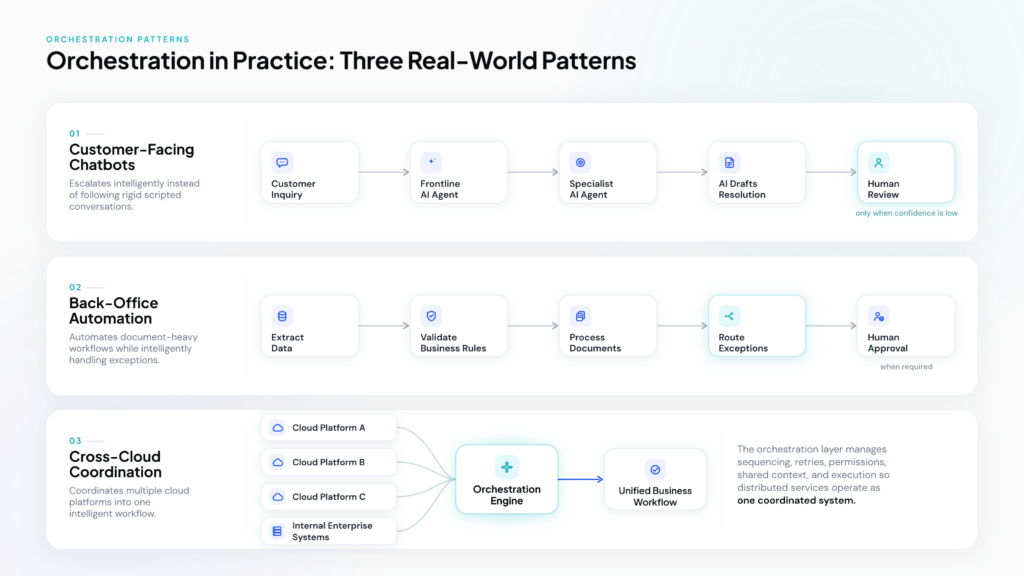
Customer support is still the most visible use case. Early chatbots followed a script and bailed to a human the moment a question fell outside their training.
Orchestrated systems behave differently. A front-line agent handles the opening conversation, a specialized agent checks account or policy details, and another drafts a resolution, with a human pulled in only when the situation actually calls for judgment. The customer sees a faster, more accurate exchange. What they do not see is the coordination running behind it.
Back-Office Work That Was Always Too Messy to Automate
A second common pattern is back-office processes that were technically automatable but too messy for traditional automation to handle end to end. Document-heavy workflows are the classic example. One agent extracts the data, another validates it against business rules, and another routes the exceptions to the right person, all coordinated by the same layer that runs the support workflow.
The Hard Cases That Span Many Systems
The most demanding cases span multiple cloud systems that were never built to talk to each other. Here, orchestration carries most of the weight. It handles the sequencing and the retries, and it keeps context flowing across a dozen underlying services so they behave like one coherent process from the outside.
What It Costs to Skip Orchestration
The downside of getting this wrong is not hypothetical.
Gartner expects more than 40% of agentic AI projects to be scrapped by the end of 2027, and it blames escalating costs, business value that stays fuzzy, and risk controls that were never really in place.
Most of that failure traces back to one thing: teams deploying disconnected agents with no layer to coordinate them. Costs climb because nobody has real visibility into how many agents are running or what they are doing. Value gets hard to prove when outcomes cannot be tied back to a specific decision path, and policy falls apart when there is no consistent way to apply it across every agent touching sensitive data.
That is the case for putting orchestration early in an agentic AI roadmap instead of retrofitting it once agents are already in production. Bolting governance onto a sprawl of independent agents is far harder than designing coordination in from the start.
What to Look For in an AI Agent Orchestration Platform
A handful of capabilities separate a real orchestration platform from a rebranded automation tool.
- Shared context and memory across agents, so information stays consistent from one step to the next.
- Role-based access control that spells out exactly what each agent can see and do.
- Audit trails that make every decision traceable after the fact, which matters as much to your own stakeholders as to any regulator. For an enterprise AI agent platform, that traceability is not optional.
- The freedom to add or swap agents without rebuilding the whole workflow, so the system keeps up as models and tools change.
None of this replaces skilled agent design. It gives that design a stable foundation to build on, where each agent can be excellent at its specific job without also having to solve the coordination problem itself.
Coordination Is the Quiet Decision
None of this is only a big-enterprise problem. Any team running more than one agent in a single workflow already has a coordination problem, named or not. Larger organizations just feel the cost of skipping orchestration sooner, because they hit multi-agent workflows earlier and at higher volume.
The reason AI agent orchestration platforms exist is straightforward. Coordination, more than raw model capability, decides whether agentic AI works once it leaves the demo. As companies move past isolated pilots into agents that touch real customers and real data, the ones that invest early in a proper orchestration layer will be the ones turning autonomy into a controlled advantage instead of a fresh source of risk.
Arivonix is built for that transition, so teams can grow from a handful of agents to a coordinated system without rebuilding the architecture every time complexity climbs. Coordination is the unglamorous work of agentic AI. It is also the work that decides whether the rest of it holds up.