The AI agent builder market just became its own category. Analysts started tracking it separately this year, and platforms that used to be pure no-code tools are now adding governance features that would have looked like overkill two years ago.
It’s part of a broader shift across the agentic AI platform space: from proving you can build something, to proving it can be trusted to run itself.
This matters most if you already have an agent running. Maybe you built it in n8n, Zapier, Make, or another AI agent builder platform, had it working by the end of the afternoon, and are now wondering what’s supposed to happen next. This piece is written for that moment.
The short version: your builder did its job. The problem you’re running into now is a different one, and the market has started giving it a name.
None of this is an argument against agent builders. They solve a real problem, and for a first agent, they’re still the right call. Where they fall short is everything that comes after the demo, once the agent starts touching things that matter.
A no-code AI agent builder is, at its core, a visual canvas for putting an agent together without writing code. The harder question is what has to be true once that agent stops being a demo and starts being a dependency.
The Builder Category Is Racing to Close This Gap
This ceiling isn’t a guess. Gartner recently classified the no-code agent builder market as its own category for the first time. That’s a signal on its own: the space between assembling an agent and running one responsibly had grown wide enough to need a name.
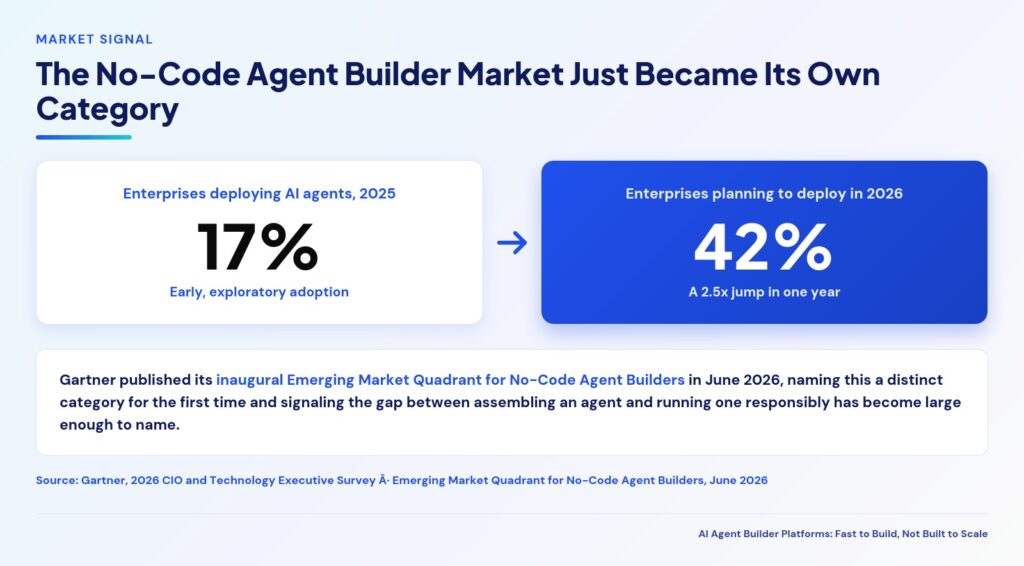
The vendors are reacting. Established builders are rolling out role-based permissions, audit logging, and policy controls, the kind of features that would have felt out of place in a no-code tool two years ago.
“An agent in an afternoon” made a great opening pitch. It was never going to cover what a team needs once agents are running at real scale.
None of this makes builders obsolete. If anything, it confirms something the industry is starting to treat as settled: one layer for getting an agent running fast, and a second layer, increasingly its own category, for governing what that agent does once it’s live. Teams paying attention to where their builder sits on that map are the ones least likely to be rebuilding in six months.
The Builder Ceiling: Where Speed Stops Solving the Problem
Every builder, no matter how well it’s designed, runs into the same handful of walls once an agent moves from prototype to something people depend on. A builder is optimized for how fast you can configure something, not for answering the question a compliance officer eventually asks: who can see what, and who signed off on this agent taking this action.
- Governance and access control. Most builders offer basic permissions, not the granular, role-based access control that specifies exactly which data an agent can touch and which actions need a human sign-off. That gap matters more as auditors expect AI programs to line up with a recognized AI risk management framework instead of an internal spreadsheet.
- Memory and context across steps. Builders tend to handle context fine inside a single workflow. The trouble starts when context needs to carry across separate agents, separate sessions, or a process that runs for hours instead of seconds.
- Model choice and vendor lock-in. Most builders default to an OpenAI model and offer a short list of alternatives. Fine for a prototype, limiting once you want to switch models as better ones ship. The model rarely sets one platform apart from another; the governance, memory, and orchestration built around it does.
- Debugging when something breaks silently. Most builders give partial visibility into what ran and why. Few offer a structured audit trail that lets someone reconstruct, months later, what an agent did and what it was authorized to do at the time.
None of this is a reason to skip builders for what they’re good at. It’s the reason a builder alone isn’t the finish line for anything meant to run in production, whether that work stays inside a no-code canvas or spills into a code-first framework like CrewAI.
This is the exact list Arivonix was built to close. Role-based access, audit trails, and Trust Scores are part of the platform from day one rather than a later add-on, and agents can run on whichever underlying model fits the task instead of whatever the builder shipped with.
What “Quality of Intelligence” Actually Means
Speed to build and quality of intelligence are two different problems that get lumped under one word: capability. Speed to build is about how fast you can assemble something that works in a demo. Quality of intelligence is about whether that system holds up once it’s making decisions on live data, for paying customers, with consequences if it gets something wrong.
It’s the same distinction behind what we call specialized intelligence: depth built for one purpose, instead of breadth built for everyone.
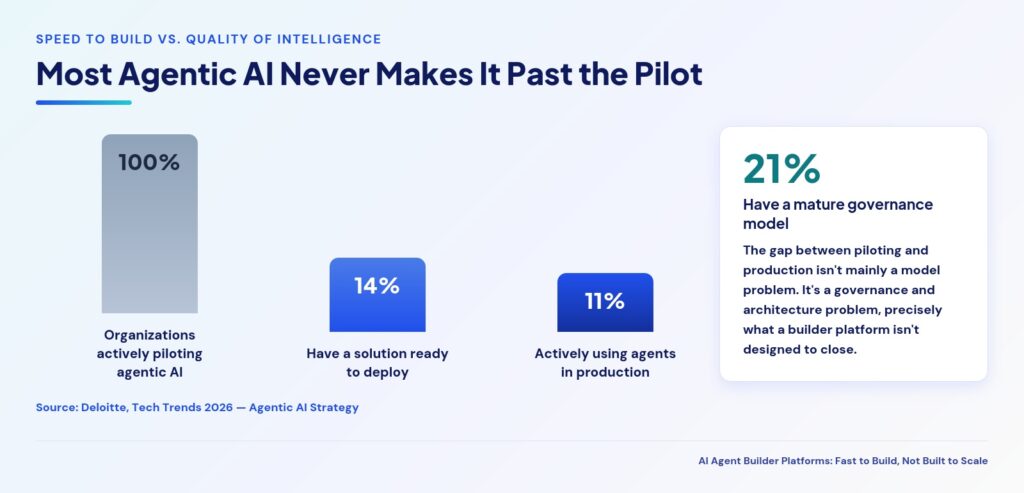
The data backs this up. Deloitte’s research found that only 14 percent of organizations exploring agentic AI have solutions ready to deploy, and just 11 percent are actively using agents in production, even though a much larger share are piloting. That gap between piloting and production comes down to governance and architecture more than the model itself, and closing it was never what a builder platform was designed to do.
Separately, Deloitte found that only 21 percent of organizations have a mature governance model in place for agentic AI, even as expectations for agent use keep climbing. Build fast without building governed, and you get the kind of exposure that stalls a pilot indefinitely.
The Legacy Integration Problem and Its Real Cost
Most builder platforms ship with a marketplace of prebuilt connectors, and for common tools, that coverage holds up well. The trouble starts with everything that isn’t common. Enterprise AI agents have to work alongside a mix of modern SaaS tools and older systems nobody designed with agents in mind, and a builder that limits you to its connector marketplace works fine, until you hit the one system that isn’t listed.
The cost shows up in the numbers. Gartner predicts that more than 40 percent of agentic AI projects will be canceled by the end of 2027, citing rising costs, unclear business value, and weak risk controls, with legacy system incompatibility a quiet factor behind a good number of them. Deloitte separately found that 42 percent of organizations are still building their agentic AI strategy roadmap, and 35 percent have no formal strategy at all.
A lot of that stall happens inside teams that built something useful in a no-code tool, then found nobody could answer the governance questions that came up once leadership started asking about scale.
Arivonix works from the data layer up, connecting to 250-plus enterprise systems through real-time virtualization instead of a fixed connector marketplace. The legacy system nobody put on an integrations list stops being an automatic dead end.
Signs You’ve Outgrown Your Agent Builder
A handful of patterns show up again and again in teams that have quietly moved past what a builder can support:
- You’ve stopped building one agent and started building several, and now need them to share context instead of working in isolation.
- A compliance or security reviewer wants proof of what an agent is allowed to do, not just a log of what it happened to do the last time it ran.
- You’re maintaining workarounds, custom API calls, and manual monitoring, because the builder’s native capabilities stopped being enough.
- You need to swap models based on cost or performance, and the platform has already made that decision on your behalf.
Agencies managing agents across several clients tend to hit this ceiling first. Asking one agent to handle five clients’ data under a single set of permissions is a governance problem long before it’s a technical one. When two or more of these signs show up, the builder is simply being asked to do a job it was never built for.
From Builder to Orchestration Platform: What Changes
Moving from a builder to an AI agent orchestration platform means putting a governed, coordinated layer underneath what you’ve already built, not throwing any of it out. An orchestration platform treats agents as components in a managed system rather than standalone workflows: shared memory across agents, permissions enforced consistently, a genuine audit trail, and the ability to swap the underlying model without rebuilding the agent from scratch.
In one sentence, an AI orchestration platform is the governance and coordination layer that sits above individual agents, deciding what a group of agents is allowed to do once they exist, rather than helping build them in the first place.
This is the layer Arivonix is built around. Instead of treating governance and orchestration as something bolted on after agents are already running, the platform folds coordination, access control, and audit logging into the foundation.
Teams making this move typically keep the logic they already validated in a no-code tool and connect it to an orchestration layer that enforces policy, shares memory across agents, and hands off between them without someone stitching the pieces together by hand.
Teams build and route those agents through the Agentic AI Designer, a no-code canvas that sits on the same governance layer instead of bolting one on afterward. The platform’s specialized intelligence approach fine-tunes each agent on a company’s own data and decisions, rather than leaving it on a generic, one-size-fits-all model.
Real-World Use Cases: What Teams Build Next
Here’s what this transition tends to look like once a team moves past its first builder-made agent.
- Customer support that spans multiple systems. A support agent built in a no-code tool usually answers questions from a single knowledge base. Once it needs to check order status in one system, refund eligibility in another, and account history in a third, consistently across thousands of conversations, the coordination need outgrows a single builder workflow.
- Internal operations agents with real access. Teams building agents that touch payroll data or customer financial records find out quickly that proving who approved an agent to see specific data stops being optional once legal or security gets involved.
- Multi-agent orchestration for research and analysis. One agent summarizing a document is builder-friendly. A workflow where one agent researches, a second checks the findings, and a third drafts a recommendation is a coordination problem, which is what an orchestration layer is built to manage.
How to Evaluate What Comes Next
Whether you stick with a builder a while longer or start evaluating orchestration platforms, a few questions cut through more noise than connector counts or pricing tiers ever will.
- Visibility into approvals. Can the platform show, in plain terms, what data each agent can access and who approved it? If the honest answer involves a spreadsheet someone updates by hand, that’s worth flagging early.
- Model flexibility. Can the underlying model be swapped without rebuilding the agent from scratch? This matters more the longer something runs in production.
- A genuine audit trail. Is there an actual audit trail, not just a run history, that lets someone reconstruct a decision after the fact?
- Complexity that doesn’t compound. Does adding a second or third agent multiply the complexity, or does the platform absorb that growth? That’s usually the clearest sign of whether you’re looking at a builder or a genuine orchestration platform.
Bringing It Together
AI agent builder platforms are genuinely good at what they’re built for: getting a working agent in front of a business user fast, without an engineering queue in the way. That’s not a small thing, and for most teams, it’s still the right starting point.
What a builder can’t do is govern twenty agents across three teams, prove to an auditor what each one is allowed to touch, or keep shared context consistent as a workflow grows past a single canvas. That’s a different job, and the market is already saying so.
If you’ve already tried a builder and are starting to ask what comes next, that usually means you’ve outgrown the tool, not that it failed you. Arivonix is built for that transition, helping teams grow from a handful of builder-made agents into a coordinated, governed system without rebuilding the architecture every time complexity climbs.
Coordination is the unglamorous part of agentic AI. It’s also the part that decides whether everything else holds up.