Single Agent vs Multi-Agent Systems: When More Agents Make Things Worse

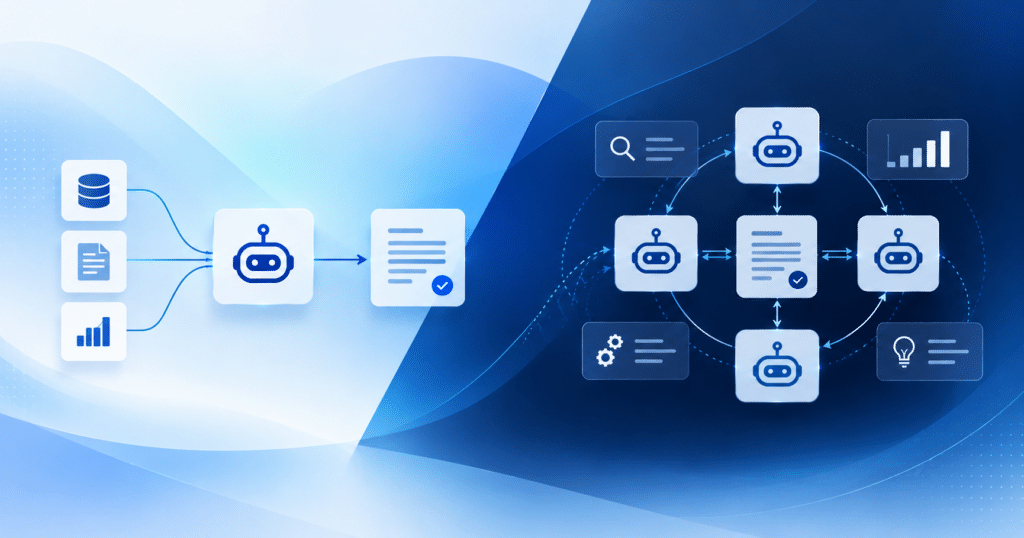
For most of the past two years, the single agent vs multi agent debate had a default answer: add agents. A planner split the job across specialist agents, and a supervisor stitched the results together. Diagrams of multi-agent systems became a fixture on enterprise AI roadmaps.
In October 2026, the evidence behind that habit got a lot thinner. On October 9, Vals AI published a controlled test of GPT 6 Sol and Claude Opus 5.5 building full web applications. Each model worked alone and as a team, with a lead agent that could run up to five subagents at once.
The teams cost 1.8 to 5.1 times as much as the single agents. Only one of the four team setups scored significantly better than its single-agent counterpart.
Thirteen days later, Anthropic published guidance on folding subagents back into a single agent loop. One customer that made the switch saw its single loop run about twice as fast as the multi-agent harness it replaced.
Academic work has been heading the same way. In June, researchers from Salesforce Research and three universities reported that automatically designed multi-agent systems consistently underperformed a single model using self-consistency, while costing up to 10 times more.
Multi-agent architecture still has a place. What’s changed is the burden of proof. A second agent now has to show it beats one agent doing the same job before it goes anywhere near production.
Our position at Arivonix is that most enterprise teams should start with one well-instrumented agent and add more only when their own evals justify it. In practice, that means a single agent for sequential work, and extra agents for parallel, read-heavy tasks or independent review. The rest of this piece explains why, and how to run that test.
Single Agent vs Multi-Agent: What the 2026 Evidence Shows
The past year’s studies use different methods. Once cost and token budgets are held constant, though, they point in the same direction.
| Study | Published | What was compared | Finding |
|---|---|---|---|
| Google Research, Google DeepMind, and MIT | Dec 2025 (revised Apr 2026) | 260 agent configurations across five architectures, six benchmarks, and three model families | Every multi-agent variant cut sequential planning performance by 39% to 70%; centralized coordination improved structured financial reasoning by about 81% |
| Amazon and university researchers | Jan 2026 | One agent vs. homogeneous and automatically optimized multi-agent workflows on seven benchmarks | The single agent matched them, with an efficiency edge from KV cache reuse |
| Tran and Kiela | Apr 2026 | Single vs. multi-agent systems on multi-hop reasoning at equal thinking-token budgets | Single agents consistently matched or outperformed multi-agent setups |
| Salesforce Research and university partners | Jun 2026 | Automatically designed multi-agent systems vs. chain-of-thought with self-consistency | Automated designs underperformed while costing up to 10x more |
| Vals AI | Oct 2026 | Single agents vs. agent teams building web apps | Teams cost 1.8x to 5.1x more; one of four comparisons showed a significant quality gain |
Sources: Kim et al., Xu et al., Tran and Kiela, Jwalapuram et al., Vals AI.
Equal Token Budgets Changed the Comparison
Many early multi-agent wins came partly from spending more. Anthropic’s own 2025 write-up of its multi-agent research system was candid about this. Its multi-agent runs used about 15 times as many tokens as a chat interaction.
On the BrowseComp evaluation, token usage alone explained 80% of the variance in performance.
Tran and Kiela’s April paper tested what happens when that spending is equalized. With thinking tokens held constant across three model families, single agents matched or beat multi-agent setups on multi-hop reasoning. The authors also found quirks in API budget controls and standard benchmarks that can inflate apparent multi-agent gains.
So when you review a vendor’s claim, ask how the comparison was run. A team of agents that wins while burning five times the compute has mostly shown that compute helps.
Where Multi-Agent Systems Still Win
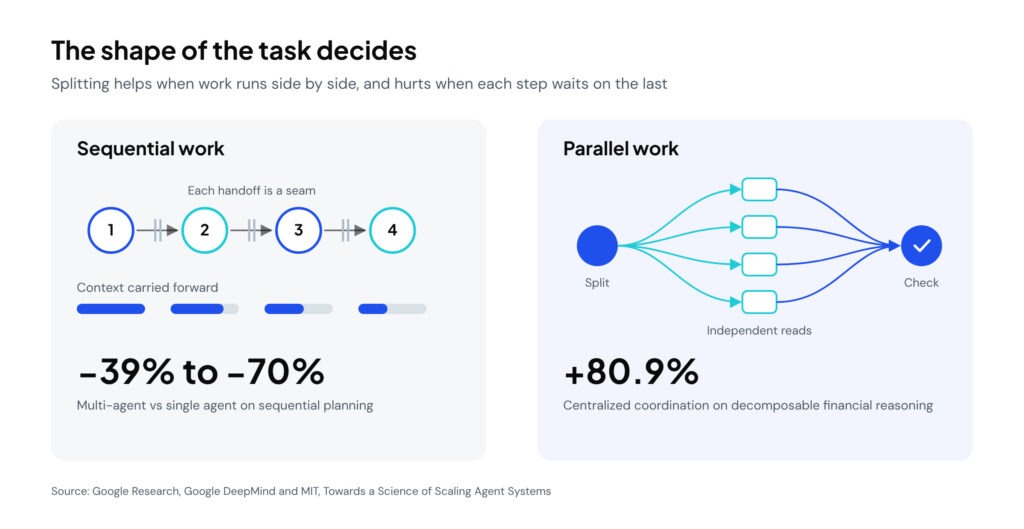
The same research shows where splitting work pays off. Google’s study found large gains on structured financial reasoning, where subtasks can run independently and a central coordinator checks the results.
Anthropic’s research system beat a single Claude Opus 4 agent by 90.2% on its internal eval. Those were breadth-first research questions that fan out across many sources at once.
Cognition, which argued publicly against multi-agent designs in 2025, revisited its position in April 2026. The patterns it reports working are narrow. They include read-only subagents that gather context and a code reviewer that starts with a clean context. Manager agents that split up large jobs work too, though Cognition says getting there took significant fixes.
Its organizing rule is worth borrowing: writes stay single-threaded. One agent makes the changes, and any other agents contribute analysis and review.
Why Do Multi-Agent LLM Systems Fail in Production?
When multi-agent systems disappoint, the model is rarely the main culprit. UC Berkeley researchers built the MAST taxonomy from more than 1,600 annotated traces across seven multi-agent frameworks. It groups failures into system design issues, misalignment between agents, and weak task verification.
Each of those is shaped mostly by choices teams make while designing the system, which is good news. It means they can be fixed.
A few patterns come up again and again in enterprise multi-agent coordination.
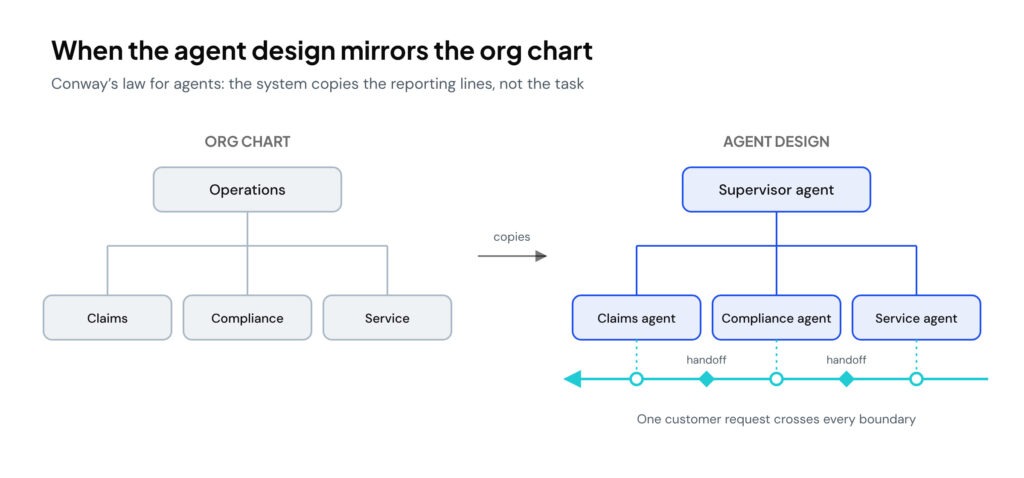
The architecture mirrors the org chart. Anthropic’s October guidance invokes Conway’s law here. When every department gets its own subagent, the agent system copies the company’s reporting lines. Handoffs then follow internal ownership instead of the shape of the task.
Prompts turn into committee documents. The same guidance describes the “Frankenprompt,” a system prompt where every team adds a sentence. You end up with conflicting rules and no consistent voice.
Extra agents mostly agree with each other. In the debate-style systems the Salesforce-led study examined, agents reached immediate, unanimous agreement in about 70% of GPT-4o cases and more than 90% of GPT-5 cases.
The study also inspected 14 workflows produced by AFlow, a popular automated workflow designer. Half of them boiled down to a single prompt run three times, with the outputs aggregated. Plenty of agent “teams” turn out to be an expensive way to sample the same model over and over.
Errors compound without a checker. Google found that independent agents working in parallel, with no coordinator checking their work, amplified errors 17.2 times. Centralized setups held that to 4.4 times.
The same study found that once a single agent already scores above roughly 45% on a task, adding agents tends to produce negative returns. Put simply, the stronger your single agent, the less a team adds.
When to Use Multi-Agent Systems: A Practical Test
There’s no universal threshold. Still, this year’s guidance points to a short list of conditions that justify a second agent.
Start with a single agent and an evaluation set. Anthropic says even 10 golden examples are enough to begin. Then look for these signals:
- Measured context saturation. The single agent’s quality drops as its context grows, and the drop shows up in your evals. A long prompt on its own isn’t evidence.
- Independent, read-heavy subtasks. Work that can run in parallel without sharing state, such as searching several sources at once, benefits from fresh context windows.
- Tool overload. Anthropic reports that tool choice tends to degrade once a prompt carries more than 30 to 50 tool definitions. Try grouping tools by user intent before you add an agent.
- A need for independent review. A checker that hasn’t seen the original agent’s reasoning catches different errors.
- Hard separation requirements. Some data or permissions shouldn’t share a context window at all. Here, the boundary between agents works as a security control, so its cost is easier to justify.
Two measurement habits belong in every comparison. First, hold the token budget constant between the single-agent and multi-agent versions. Second, run each task more than once.
In Anthropic’s sample support agent, the merged version answered a delivery question on its own instead of checking with the shipping specialist. That failure showed up in only one of two runs. A single test run would have missed it.
What Experienced Agent Teams Are Doing Differently
The teams with the most production experience are shrinking their multi-agent architecture. Four practices are worth copying.
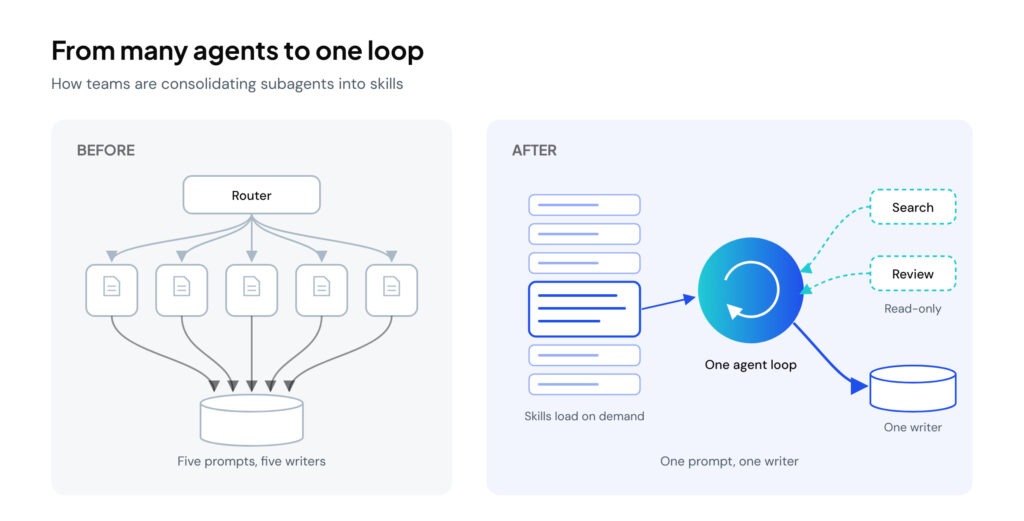
Replacing subagents with skills. Instead of a separate agent for each capability, teams give one agent a library of skills and tools. Each one appears as a short description and loads in full only when it’s needed.
Anthropic calls this progressive disclosure, and it reports cutting Claude Code’s system prompt for more advanced models by over 80%. It has also released an open-source migration kit that scores every consolidation step against the same eval, before and after.
Folding one agent at a time. The recommended path folds a single subagent into the main loop and reruns the evals. The subagent stays only if the folded version scores worse.
Keeping writes single-threaded. Where teams keep several agents, only one of them changes records. Subagents can search and review, while the primary agent is the one that acts. That alone removes many of the coordination failures MAST describes.
Testing reasoning effort before adding agents. In the Vals test, raising GPT 6 Sol from medium to maximum reasoning effort lifted its single-agent score by 11.4 points. That’s more than any team configuration added. The effect varied by model, but reasoning effort is a cheaper dial to test than a new agent.
Taken together, these practices shrink multi-agent orchestration down to the places where it pays for itself, like parallel reading and independent review.
When Not to Split Work Across Agents
Before you approve a multi-agent proposal, test it against four situations where coordination costs usually outweigh the benefit.
When the Work Is Sequential
Google’s results were starkest here. On sequential planning, every multi-agent variant it tested did worse than a single agent, by 39% to 70%.
When each step depends on the last, splitting the work adds handoffs without adding parallelism. Most case files that move from intake to review to decision fit this description.
When the Agents Would Mostly Agree
If several agents running similar models would usually reach the same answer, as the Salesforce-led findings suggest, the extra agents add cost without adding information. A single agent that samples a few times and checks for consistency is the cheaper baseline to beat.
When the Design Follows Ownership
If the proposed agents map one-to-one onto teams or budget lines, the design probably reflects who owns what more than what the task needs.
Anthropic suggests a different split. One central team owns the system prompt and end-to-end quality, and each domain team owns its own skills.
When the Economics Don’t Clear the Bar
Agent teams cost more to run, and the premium is hard to predict. In the Vals test it ranged from 1.8x to 5.1x, depending on the model and effort level. Claude Opus 5.5 teams at maximum effort also took up to 2.3 times as long as a single agent.
For high-volume, thin-margin processes, that’s a hard bar to clear.
Where Arivonix Fits
Teams rarely run short of ideas for more agents. The harder part is proving each one is worth what it costs, and good AI agent orchestration now includes deciding when not to add one.
Our Agentic AI Designer lets teams assemble agents on a visual canvas from a library of reasoners, retrievers, tools, and models. Its Test Agent feature validates each agent’s behavior before it ships. That makes it practical to start with one agent and add specialists one at a time, with a test at every step.
If you already run several agents, our analysis of AI agent orchestration covers the coordination layer they need. For the production side, our guide to the enterprise AI agent platform walks through what it takes to run agents in production, from architecture to governance. And our guide to specialized intelligence in agentic AI platforms explains how to build domain-specific AI on your own data.
Example: A Carrier Scopes a Claims Agent
Here’s a hypothetical. A property and casualty carrier is reviewing a vendor’s claims intake design that uses five agents. They cover first notice of loss, coverage checks, fraud signals, reserves, and customer correspondence.
Before approving the design, the carrier’s team needs answers to four questions:
- Which steps depend on the previous step’s output, and which could run independently?
- Does a single agent with the same tools and skills fall short on the carrier’s eval set, at the same token budget and across repeated runs?
- Which agents would write to the claims system, and which would only read from it?
- Does any decision need a reviewer that hasn’t seen the original reasoning, such as a coverage denial or a large payment?
The answers usually lead to a smaller design. One agent owns the claim file from intake to recommendation. Read-only subagents pull prior claims and third-party data in parallel. An independent reviewer checks high-stakes decisions before they reach an adjuster.
That’s the kind of scoping we work through with carriers in AI for underwriting and claims.
Multi-agent AI in insurance will keep growing, and some workflows do need it. The carriers that get the most from it will make every additional agent prove its value against a strong single-agent baseline first.

Product Manager at Arivonix AI, focused on enterprise AI, Agentic AI, and data platforms. Contributes to product strategy, market research, and go-to-market planning for enterprise software products, with a focus on translating complex business challenges into practical technology solutions. Works across product development, industry research, and cross-functional collaboration to build products a