Private AI Deployment: Why Audit Evidence Now Depends on Where Your AI Runs

For the past two years, the case for private AI deployment rested on one worry: would sensitive prompts end up training someone else’s model? Zero-retention clauses and enterprise API terms mostly put that worry to rest.
In 2026, regulated enterprises started asking a harder question. When an examiner asks you to reconstruct a specific AI decision from last spring, whose systems hold the record?
The infrastructure numbers point the same way. Broadcom’s Private Cloud Outlook 2026, published in June and based on a survey of 1,800 senior IT decision-makers, found that 56% of enterprises are running or planning to run production AI inference on private cloud. Public cloud’s share of those workloads dropped from 56% to 41% in a year.
Among organizations moving workloads back from public cloud, security and compliance was the top reason, cited by 51%.
Regulators have moved too. The EU AI Act ties a deployer’s log-retention duty to logs “under their control.” The NAIC’s draft exam supplement asks insurers, model by model, who built each high-risk model and whether they can change it. And US banking regulators replaced SR 11-7 in April 2026 with guidance that leaves generative and agentic AI outside its formal scope, which puts the evidence burden on the bank.
At Arivonix, we think private AI deployment decisions should now start with evidence custody: who holds the records a regulator can ask for. Data residency still matters, but it comes second. Where your models run decides which records you can produce yourself and which ones you’ll have to request from a vendor.
What Private AI Deployment Means in 2026
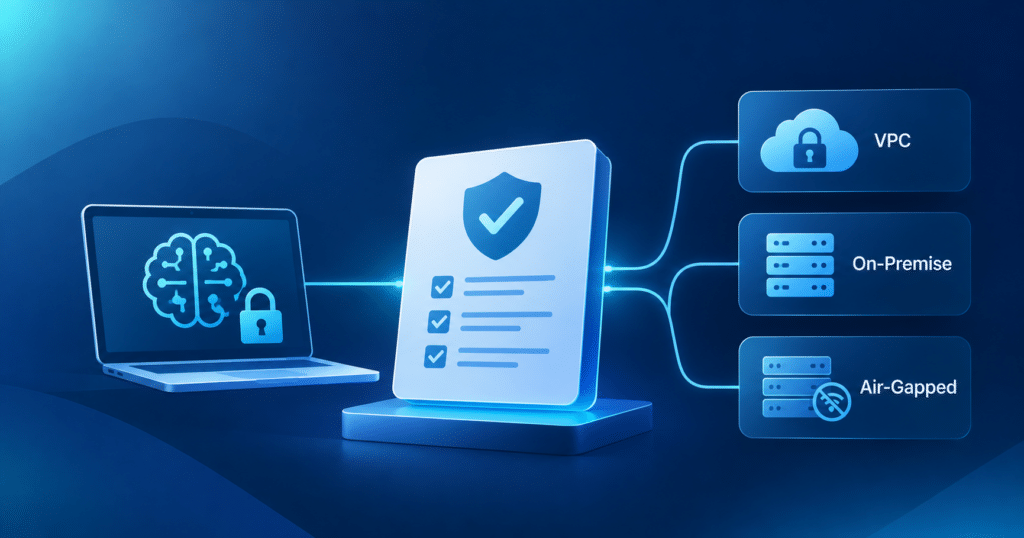
Private AI deployment means running models, the agent runtime around them, and the records they generate inside an environment the enterprise controls. That can be a virtual private cloud (VPC) in your own cloud account, your own data center, or an isolated facility with no outside network connection.
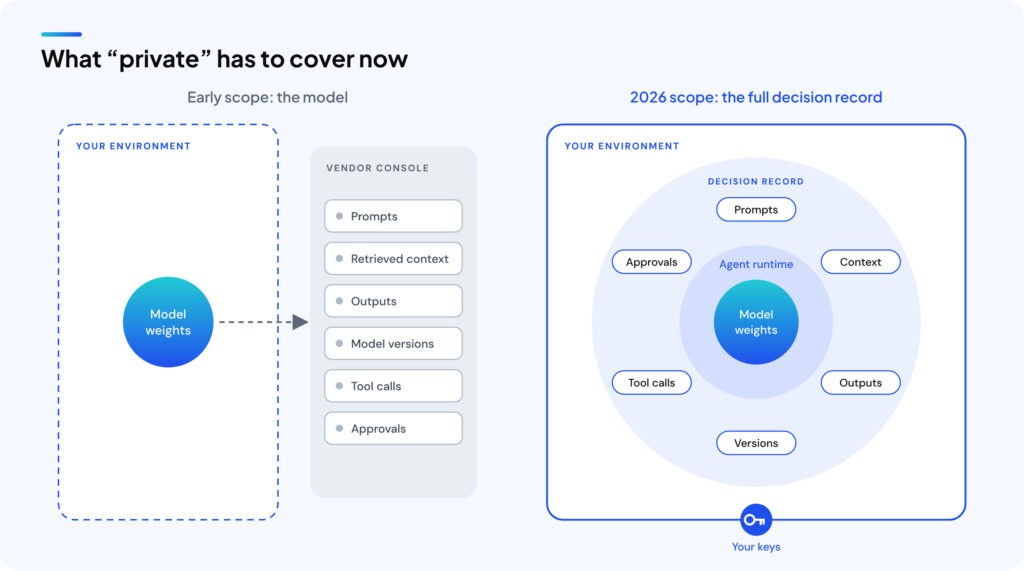
The scope has grown. Early private LLM projects focused on where the model weights sat. Today it covers everything an auditor might ask for, including prompts, retrieved context, outputs, model versions, tool calls, approvals, and the encryption keys that protect them.
That wider scope is why a deployment can keep the weights in-house and still leave half of the record in someone else’s console.
The AI Audit Trail Has Moved Ahead of the Data Question
Across 2026, regulators landed on a shared expectation: the company deploying AI should hold its own AI audit trail and be able to produce the evidence itself.
- EU AI Act. Article 26(6) requires deployers of high-risk systems to keep automatically generated logs for at least six months, to the extent those logs are under their control. If the logs sit in a provider’s environment, your evidence lasts only as long as the provider’s retention settings allow. The Digital Omnibus pushed Annex III obligations, which include life and health insurance pricing, to December 2, 2027. The duties still apply; they just start later.
- US banking. SR 26-2 replaced SR 11-7 on April 17, 2026, and placed generative and agentic AI outside its formal scope. Moody’s cautions that the carve-out is no reprieve, since examiners will still expect sound governance of those tools. In practice, banks now set their own evidence standard for LLMs and agents, and they can only commit to evidence they can retrieve.
- US insurance. The NAIC’s draft AI Risk Evaluation Supplement asks, for each high-risk model, whether the insurer developed it internally or got it from a third party, and whether it can modify the model. Version 6.0 closed for comment on October 30, and the working group is moving toward a final version 7.0, with its next session scheduled for November 16 at the Fall National Meeting.
Teams preparing for December 2027 are working backward from these requirements. They decide which records must stay under their control, then choose the deployment model that keeps them there. Our EU AI Act timeline analysis explains why that date is closer than it looks for insurers.
Private AI Deployment Options Compared: Who Holds the Record
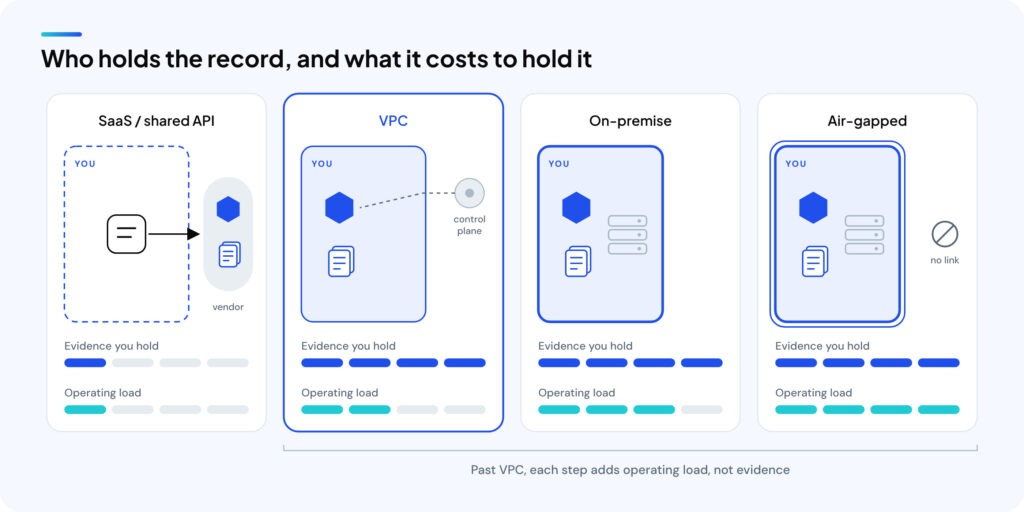
Most comparisons of VPC, on-premise, and air-gapped AI weigh isolation and cost. For regulated workloads, we’d add the factor that often settles the decision: custody. Where does each record live by default, and what can you produce without asking anyone?
| Deployment model | Where inference runs | Who holds prompts, outputs, and logs | What you can produce on request | Main trade-off |
|---|---|---|---|---|
| SaaS or shared API | Vendor's cloud | The vendor, under its retention terms | Whatever the vendor exports, if it kept it | Fastest to adopt; evidence depends on the contract |
| VPC deployment (BYOC) | Your cloud account | You, often with a vendor-run control plane | Full inference records in your own log store | Some metadata may still flow to the vendor's control plane |
| On-premise LLM | Your data center | You | Everything the stack records | GPU capacity and operations fall on your team |
| Air-gapped AI | Isolated facility with no outside network | You | Everything, inside the isolated environment | Slower model updates; every dependency mirrored internally |
Sources: TrueFoundry, Google Cloud, Arivonix analysis.
VPC deployment is a form of self-hosted AI, and it’s often the right default. TrueFoundry points out that plenty of teams asking for on-premises infrastructure would be better served by a VPC, which carries far less operational weight.
Zero data retention deserves a closer look. It became a standard request in enterprise AI contracts because it answers the training-data worry. It also means the vendor deletes the prompts and outputs an examiner may later request.
Unless your own systems capture those records first, a zero-retention agreement protects your privacy and leaves a hole in your evidence.
Frontier Models Moved Inside the Perimeter in 2026
Regulated firms used to face a trade-off. The strongest models ran only as cloud APIs, and anything you could run as a private LLM on your own infrastructure lagged behind. In 2026 that gap narrowed sharply.
Google made Gemini generally available on air-gapped Google Distributed Cloud in August 2025. At Cloud Next in April 2026, it added Gemini Flash models in preview for connected on-premises customers, along with an AI gateway that has built-in tracing and logging for auditability. That last detail is telling. The vendors are building for the evidence question too.
Agent infrastructure is following. E2B, for example, says its bring-your-own-cloud option keeps templates, snapshots, and runtime logs in the customer’s VPC and sends back only anonymized metrics. Budgets are moving with it: Gartner forecasts that sovereign cloud IaaS spending will reach $80 billion in 2026, up 35.6% from 2025.
The remaining constraint is operational. In NTT DATA’s 2026 Global AI Report, about 35% of chief AI officers named building, integrating, and managing models in private or sovereign environments as their top adoption barrier. More than 95% of respondents called private and sovereign AI important, yet only 29% are prioritizing sovereign AI in a concrete, near-term way.
Smaller, task-specific models help close that gap by making an on-premise LLM practical on modest hardware, as our comparison of SLM vs LLM for agentic AI shows.
How We’d Approach a Private AI Rollout
Treating private AI deployment as one decision for the whole estate usually means overspending on low-risk tools and underprotecting high-risk ones. Here’s how we’d break it down.
- Tier workloads by evidence requirement. An internal drafting assistant can run on a SaaS API. A model that scores submissions or sets reserves should run where you hold every record.
- Default to VPC and save air-gapped AI for named requirements. An air-gapped install means mirroring every dependency and giving up managed updates. It makes sense when a specific rule or contract prohibits outbound connectivity. For everything else, a VPC gives you self-hosted AI without running your own hardware.
- Check what customer-managed keys cover. A customer-managed key controls the encryption of stored data. It doesn’t govern what an agent reads or where it sends results. Microsoft’s documentation for Azure AI also lists components, such as compute OS disks, that stay on Microsoft-managed keys.
- Get control plane data flows in writing. Many VPC products manage workloads from the vendor’s cloud. Ask exactly what crosses that boundary, including telemetry, licensing data, support sessions, and update traffic. TrueFoundry, for instance, says that with a self-hosted control plane, only licensing information leaves the customer’s environment. Ask every vendor for that level of detail.
- Write evidence terms into contracts. Log export formats and retention periods belong next to the security questionnaire, along with a deadline for producing records on request. Our 12-point checklist for evaluating an enterprise AI agent platform includes deployment and audit criteria.
Private AI for Regulated Industries: One Underwriting Model, Three Deployments
Here’s a hypothetical. A commercial lines carrier uses an AI model to triage small business submissions. During a market conduct exam, the examiner picks three declined submissions from last March and asks the carrier to explain each decision.
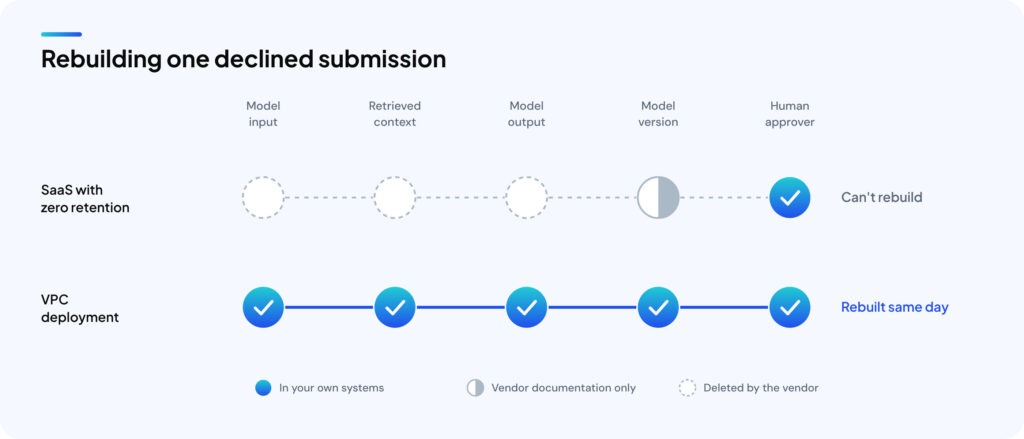
- SaaS with zero data retention. The carrier can produce the vendor’s model documentation and its own decision log. It can’t show what the model received or returned for those three submissions, because the vendor deleted that data.
- VPC deployment. Inputs, retrieved context, outputs, and model versions sit in the carrier’s own log store. The team pulls all three records the same day.
- On-premise LLM. The evidence matches the VPC case. The carrier also takes on GPU capacity and operations, which is worth it only if a rule or its own risk appetite requires it.
As of November 2026, 29 jurisdictions have adopted the NAIC model bulletin, which holds insurers responsible for AI systems they buy as well as those they build.
The quickest readiness test is to rehearse that exam before go-live. Rebuild one pilot decision from your own systems: the input, the retrieved context, the output, the model version, and the approver. If any step needs the vendor’s help, your AI audit trail has a gap. Our piece on human-in-the-loop AI governance covers where the approval step belongs.
Where Arivonix Fits
Picking a model has become the easier part of private AI deployment. The work that takes longer is making sure every record a regulator might request is created and kept inside your own environment.
The Arivonix platform is deployed inside your own secure environment and connects to 250+ data sources with zero data movement. Agent Arivon traces every step for audit, and Data-Centric AI Assurance adds lineage and guardrails, so the evidence stays where your compliance team can reach it.
For insurers, we apply this to AI for underwriting and claims. Our guide to the enterprise AI agent platform walks through running agents in production from end to end.
Each year, more frontier models will be able to run inside your perimeter. That leaves evidence custody as the question that decides where each workload belongs.
Want to map which of your AI workloads belong inside your own environment? Talk to our team, or try the platform yourself.

Ramesh heads marketing at Arivonix AI, where he leads product marketing and growth strategy. He brings over a decade of experience across B2B SaaS and technology, with expertise spanning go-to-market strategy, positioning and messaging, and demand generation. At Arivonix, he focuses on taking AI products to market and translating complex capabilities across data, agentic AI, and specialized intelligence into clear business value.