Data Products for AI Agents: Why Analysis-Era Designs Are Being Rebuilt

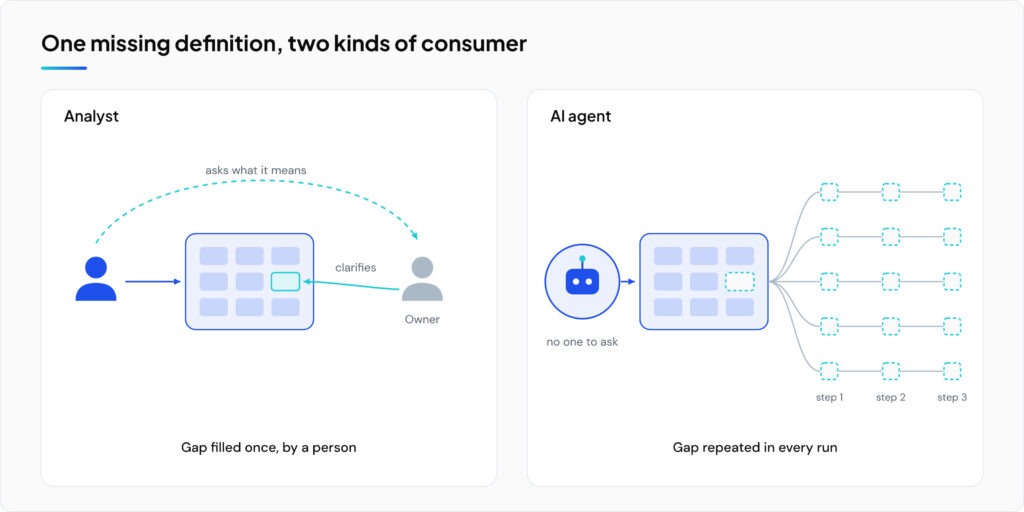
For most of the data mesh era, a data product had a predictable reader. An analyst opened the catalog entry, skimmed the documentation, noticed that the revenue figure excluded refunds, and messaged the owner when something looked off. The product worked because a person filled in what it left unsaid.
That reader now has company. Over the past year, Snowflake, Databricks, and Google Cloud have each given agents a standard route to governed data through the Model Context Protocol (MCP). Data products for AI agents now get called directly and at volume, with nobody in the loop to ask what a column means.
The adoption numbers back this up. Fivetran’s 2026 Agentic AI Readiness Index, a survey of 400 data professionals at mid-sized and large enterprises, found that 41% of organizations already run agentic AI in production. Only 15% say they’re fully prepared to support it, and data quality and lineage topped the list of barriers at 42%.
Analysts have moved too. In May 2026, Gartner predicted that by 2027, organizations that prioritize semantics in AI-ready data will improve agentic AI accuracy by up to 80% and cut costs by up to 60%. In July, it followed with a playbook on launching and scaling agentic AI-ready data products.
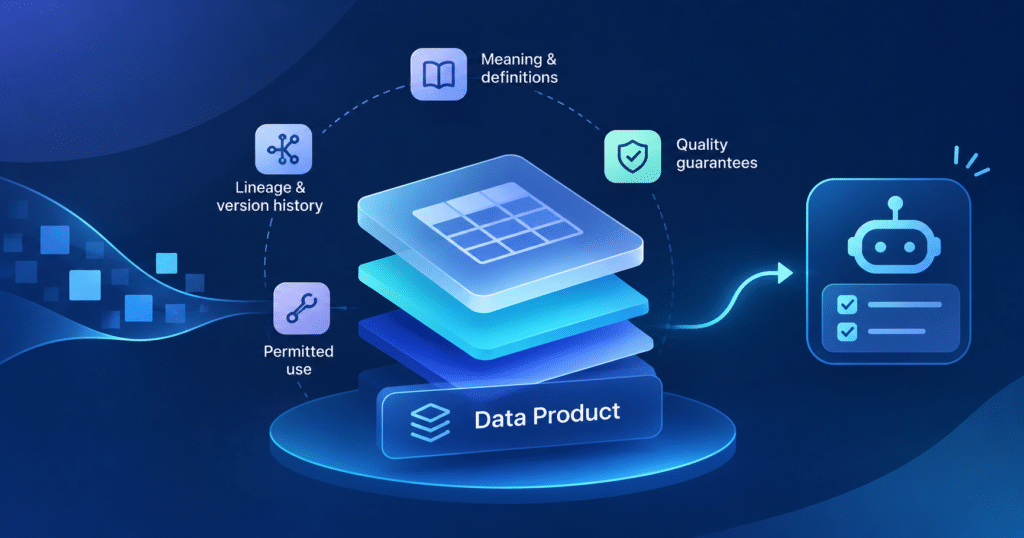
At Arivonix, we see the work ahead as moving promises to a new place. Everything a person used to learn from the docs or a quick message to the owner now has to live inside the product, in a form an agent can read and a platform can check at runtime. That includes definitions, guarantees, permitted uses, and version history.
In practice, an agent can only trust what the product declares. The rest of this piece covers what that looks like in 2026 and how we’d approach the retrofit.
What Data Products for AI Agents Look Like in 2026
Data products for AI agents are governed data packages that state their meaning, quality guarantees, permitted uses, and version history in machine-readable form. Agents reach them through a defined interface such as MCP or an API.
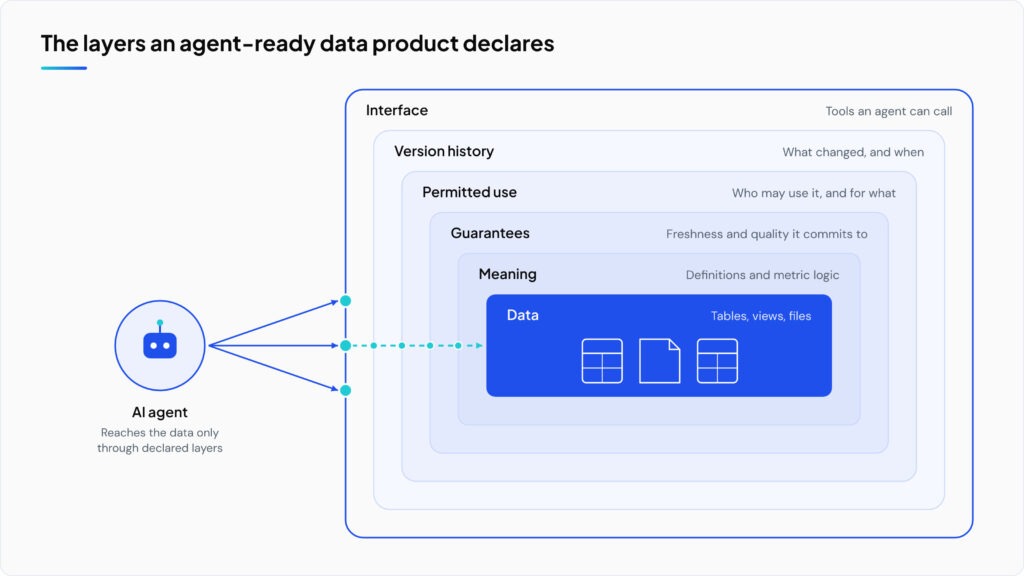
Google Cloud describes the data product as the container that packages data, semantics, and governance together.
This year’s releases show what goes in that container. Google’s Knowledge Catalog data products bundle tables and views with documentation, sample queries, and access groups, plus contracts that can state refresh cadence and quality standards. Databricks introduced Domains, now in public preview, which people browse and agents query through an internal marketplace.
The principles of data as a product still hold. Clear ownership and service levels matter as much as they did before. The difference is that each one now has to be written down so software can act on it without a follow-up question.
How AI Agents Consume Data Products Differently From Analysts
Analysis-era data products assumed a human would supply missing context. Agents can’t do that. They pick tools at runtime, chain one result into the next step, and run the same query thousands of times.
So a gap that one analyst would have caught once gets repeated in every run.
Builders already feel this. In Monte Carlo’s 2026 Agents in Production survey of 260 AI practitioners, 64% named context and data quality as their biggest visibility blind spot. Only 47% said their systems were easy to trace end to end when something went wrong.
| Dimension | Analyst-era data product | Agent-ready data product |
|---|---|---|
| Meaning | Documentation, glossary pages, and tribal knowledge | Definitions and metric logic declared in a semantic layer the agent queries |
| Trust signal | Owner reputation and dashboard history | Freshness, quality, and certification status readable at query time |
| Access | Requested once, then used broadly | Tied to the agent's identity and a declared purpose |
| Change | Release notes and a heads-up email | Versioned definitions with deprecation windows an agent can detect |
| Interface | SQL, BI connectors, and file exports | A small set of MCP tools or APIs with scoped outputs |
| Feedback | User complaints and adoption counts | Per-agent usage telemetry linked to downstream actions |
Source: Arivonix analysis.
The access row is usually where projects stall. Most entitlement models were written for people and service accounts, and an agent acting on someone’s behalf fits neither cleanly.
Our analysis of AI agent identity covers why credentials alone don’t settle what data an agent should see.
AI-Ready Data Products Are Moving Into Code
The biggest shift this year is that the parts of a data product people used to read are turning into versioned specifications that machines can parse.
- Semantics. The Open Semantic Interchange (OSI) specification published its first version in January 2026 as a vendor-neutral format for metrics, dimensions, and relationships, and Databricks joined the working group. In July, the project entered the Apache Incubator under a new name, Apache Ossie. Databricks’ Unity Catalog Metrics, launched in June, are defined once, can be queried from SQL, BI tools, APIs, and agents, and are labeled OSI-ready. Portability is still early, though. Reference converters for dbt and Apache Polaris exist, but native import and export across the major platforms remains thin.
- Contracts. The Linux Foundation’s Bitol project maintains both the Open Data Contract Standard and the Open Data Product Standard, which reached version 1.0 in September 2025. Together they give teams one machine-readable way to declare a product and the guarantees attached to it. Gartner’s playbook lists machine-verifiable data contracts among the practices that make data products ready for agentic AI.
- Metadata as a release artifact. When Starburst ran its own analytics agent for company leadership, one lesson was to version metadata like source code, so every answer can be traced to the definition it used. Deprecated versions get retired and hidden from agents.
The teams furthest along handle a change to a business definition the way they’d handle a code change. It gets reviewed and versioned before it’s promoted.
The open problem is semantic sprawl. An agent working across two platforms can still meet two definitions of the same metric, and no interchange format settles that yet.
For relationship-heavy domains, some teams add a knowledge graph next to the semantic layer, an approach we compared in GraphRAG vs standard RAG.
MCP Turned Data Products Into Agent Interfaces
A year ago, connecting an agent to a data product usually meant a custom integration. In 2026, MCP became the common way in.
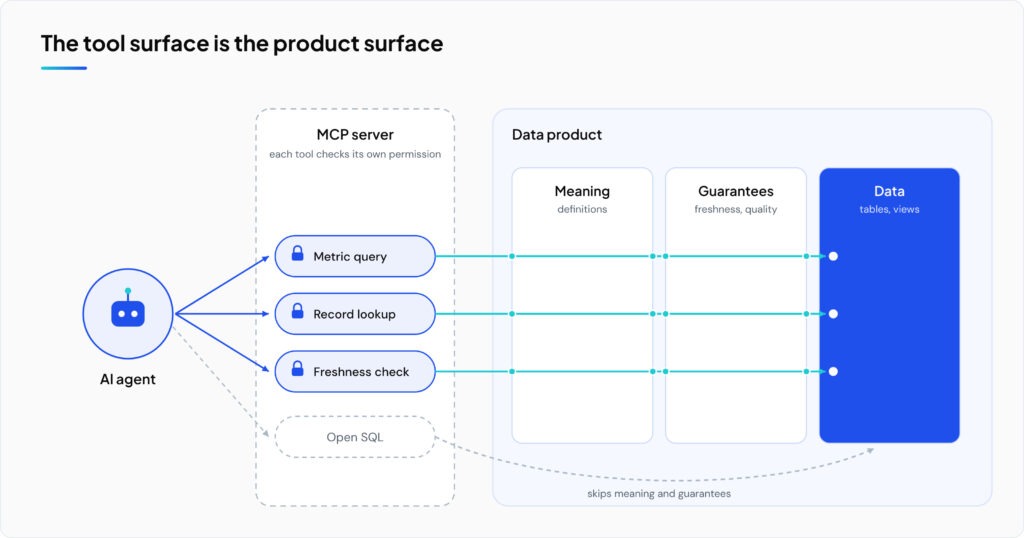
Snowflake’s managed MCP server exposes semantic views and search services as tools. Its setup guide makes a point worth copying: access to the server doesn’t grant access to its tools, because the connecting role needs privileges on each underlying object. Snowflake extended the pattern to Native Apps when agent and MCP support went GA in August 2026.
Since late May 2026, Google has let agents list, create, and update Knowledge Catalog data products through MCP tools. Agents can now produce data products as well as consume them. Databricks exposes Unity Catalog business semantics over MCP and captures model and MCP activity in one tracing layer.
A research paper on Data Product MCP, first published in January 2026, shows where this could go. Agents find, request, and query data products while contracts are enforced in real time, and each generated query is checked against approved business purposes before it runs.
For MCP data products, the tool list is the product’s front door. A product owner now decides which questions an agent can ask, on top of which tables it can read. Hand an agent a generic SQL tool and the ambiguity the product was built to remove comes right back.
Data Minded, which built an MCP server for its own data product portal, advises picking the three to five most valuable tools and getting those working before exposing anything else.
How to Design Data Products for AI Agents: Our Approach
Retrofitting every product at once spreads effort across products no agent will touch this year. Here’s how we’d sequence it.
- Start from one agent decision. Pick a decision an agent will make, such as routing a submission or flagging an account, and work back to the data products it depends on.
- Run an unasked-question audit. Pull the last few months of questions analysts sent the product owner. Each question that keeps coming up is a field the product needs to declare, whether that’s what a metric excludes, how fresh the data is, or what it shouldn’t be used for.
- Declare definitions once and serve them. Put metric and entity definitions in the semantic layer the agent queries. Definitions restated in prompts drift from the source within weeks.
- Keep the tool surface narrow. A handful of purpose-built tools per product, like a governed metric query and a freshness check, leave agents less room to misread the data than open SQL access does.
- Make guarantees checkable. Express freshness, certification, and quality commitments as machine-verifiable data contracts, so an agent can confirm a product is current before it acts. A last-reviewed date on a wiki page can’t do that job.
- Version with visible deprecation windows. A breaking change to a definition gets a new version. The old one stays readable, with a sunset date the agent can see.
- Instrument consumption by agent. Record which agent called which tool, against which version, and what it did next. In the Monte Carlo survey, 52% of builders said customer complaints are one of the main ways they find out about production issues. Per-agent telemetry can surface a misread definition before a customer does, and it doubles as the product’s adoption metric.
- Test the product with the agent. Before promoting a new version, run a set of known questions with expected answers against it. We cover where these checks belong in our piece on the agent harness.
Data Products for AI Agents in Insurance: One Loss History Product, Two Consumers
Here’s a hypothetical. A commercial lines carrier has published a loss history data product for years. It reports incurred losses by account and policy year, and underwriting analysts use it every day.
The analysts know things the product never states. “Incurred” here means paid losses plus case reserves, excluding IBNR and allocated loss adjustment expense. The latest policy year is still developing, so they discount it.
Now the carrier deploys a triage agent that screens renewals against an appetite rule based on five-year loss ratio.
- Analysis-era product. The agent reads the incurred column at face value and treats the immature year like the others. It also applies a threshold someone wrote assuming expenses were included. Some accounts get referred that shouldn’t be, others get cleared that should be referred, and nobody notices until an underwriter questions a referral.
- Agent-ready product. The product declares what incurred includes, the valuation date, a maturity flag for each policy year, and a freshness commitment. Its permitted purpose is renewal triage, and pricing is out of scope. Its tool returns the loss ratio with maturity flags attached, so the agent can send immature-year accounts to a human.
The quickest readiness test is a back-test. Give the agent 20 renewals an experienced underwriter has already triaged and compare the outcomes.
Most disagreements trace back to something the product never declared, and each one becomes another entry in the unasked-question audit. Our notes from ITC Vegas 2026 cover where underwriting agents are already holding up in production.
Where Arivonix Fits
Most of the work in building data products for AI agents is unglamorous. It means getting definitions and permissions out of people’s heads and into the product itself.
The Arivonix Data Products Hub packages data into governed products and publishes them to a marketplace for internal teams and partners. The Arivonix platform runs inside your own secure environment and connects to 250+ data sources with zero data movement.
Agent Arivon traces every step for audit, and Data-Centric AI Assurance adds end-to-end lineage and guardrails across the products agents consume. For insurers, we apply this to AI for underwriting and claims. Our guide to the enterprise AI agent platform walks through running agents in production from start to finish.
Agent traffic against data products will keep growing faster than the teams that maintain them. The products that hold up will be the ones that answer an agent’s questions before it needs to ask.
Want to find out which of your data products agents can use reliably today? Talk to our team, or try the platform yourself.

Product Manager at Arivonix AI, focused on enterprise AI, Agentic AI, and data platforms. Contributes to product strategy, market research, and go-to-market planning for enterprise software products, with a focus on translating complex business challenges into practical technology solutions. Works across product development, industry research, and cross-functional collaboration to build products a