Agent Harness: The Layer Enterprises Should Evaluate Before the Model

For most of the agentic AI boom, enterprise evaluations started with one question: which model? Teams ran model bake-offs and redrew roadmaps every time a new frontier release landed.
In 2026, a growing share of that conversation moved to the agent harness, the runtime layer between a model and everything it touches.
In February, LangChain reported that its coding agent climbed from 52.8% to 66.5% on Terminal Bench 2.0. The model stayed the same. The entire 13.7-point gain came from the harness around it.
Since April, Anthropic, AWS, and Microsoft have all started selling the harness as a product. The latest move came on October 28, when Microsoft opened up the harness behind its own Copilot products to customers.
Our position at Arivonix is that enterprises should now evaluate the agent harness before they evaluate the model. Models keep getting easier to swap. The harness decides what each task costs and whether a regulated workflow can be audited after the fact.
What Is an Agent Harness?
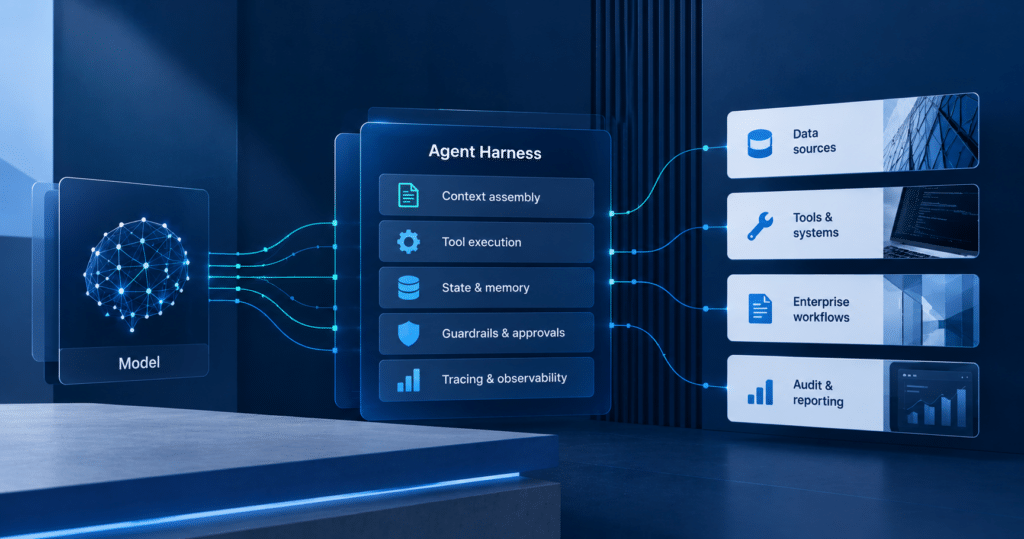
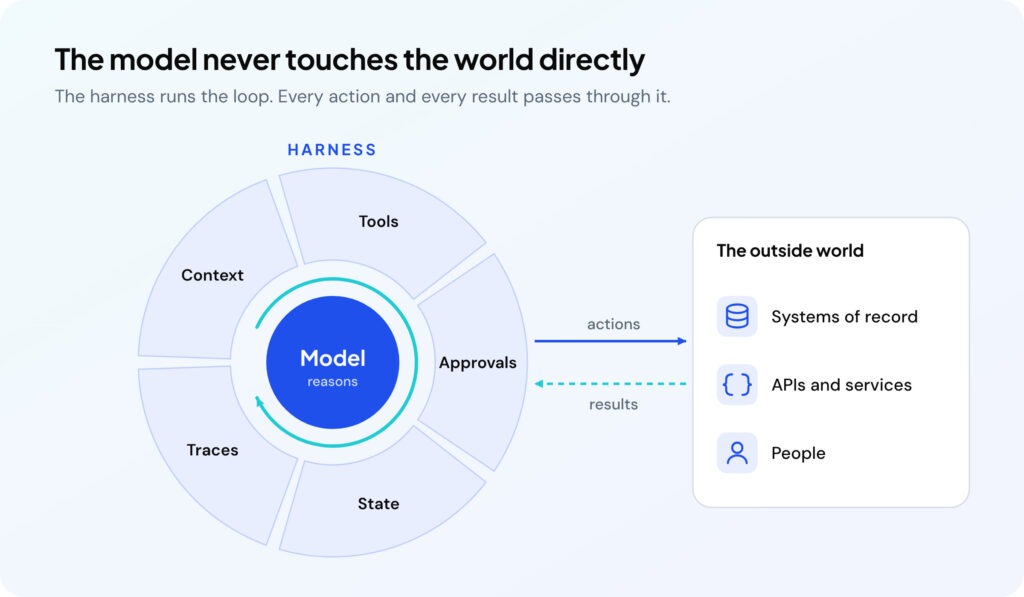
An agent harness is the software layer that runs a model’s loop. It assembles the context the model sees, executes tool calls, checkpoints state, enforces approvals, and records what happened. When two agents use the same model and behave differently, the harness is usually why.
That also makes the harness the part of the agent stack you can most directly inspect and change. The model sets the ceiling on reasoning. The harness decides how close a production workflow gets to that ceiling.
Same Model, Different Results: What the 2026 Agent Harness Evidence Shows
Harness design can move agent performance as much as model choice does. Each 2026 study below holds the model constant, or controls for it, and changes what surrounds it.
| Study | Published | What changed | Finding |
|---|---|---|---|
| LangChain (Deep Agents) | Feb 2026 | Harness only, with gpt-5.2-codex held fixed | Terminal Bench 2.0 score rose from 52.8% to 66.5% |
| Meta-Harness (Lee et al.) | Mar 2026 | Automated search over harness code | On online text classification, beat a state-of-the-art context management system by 7.7 points while using 4x fewer context tokens |
| Zhang et al. (position paper) | May 2026 | Review of benchmarks and deployments, plus a controlled variance decomposition | Harness-induced variance can substantially exceed model-induced variance, and model rankings can reverse |
| PawBench (AgentScope) | Jun 2026 | 9 models across 3 harnesses on 150 tasks | qwen3.6-35b-a3b scored 68.3, 68.2, and 56.7 depending on the harness, an 11.5-point spread |
Sources: LangChain, Lee et al., Zhang et al., PawBench.
None of LangChain’s changes is exotic. Before the agent can exit, a checklist makes it verify its work against the task spec. At startup, the harness maps the working directory and locates the available tools. If the agent keeps editing the same file, loop detection nudges it to rethink its approach.
The team also added time-budget warnings that push the agent toward verification before the clock runs out. And it spent the most reasoning effort on planning and verification, with less in the middle.
Look across this year’s evidence and the gains keep coming from the same two places: how the agent checks its work and when it decides to stop. A team owns both of those decisions. No model upgrade makes them for you.
Benchmark Scores Now Need a Harness Disclosure
An agent benchmark score is incomplete without the harness that produced it. That’s the core of the Binding Constraint Thesis from Yunbei Zhang and colleagues, whose position paper was presented as a poster at an ICML 2026 workshop. For long-horizon tasks among models of comparable frontier capability, they argue, harness configuration drives more of the performance variance than model choice does.
Their fix is disclosure. Publish a harness specification, which they call a Harness Card, alongside any agent score. For buyers, the takeaway is practical: a vendor’s headline model benchmark tells you little about its product unless the vendor’s own harness produced that score.
Harness Engineering Is Being Automated
Meta-Harness, from a group that includes Omar Khattab and Chelsea Finn, has an agent read the code, scores, and execution traces of earlier harness versions and then propose new ones. One harness it discovered raised accuracy on 200 IMO-level math problems by 4.7 points on average across five held-out models it was never tuned on.
Automated search changes the governance picture. Once a search process can rewrite the code that decides what an agent sees and does, harness changes need the same change control your team already applies to model upgrades.
How the AI Agent Harness Became a Product
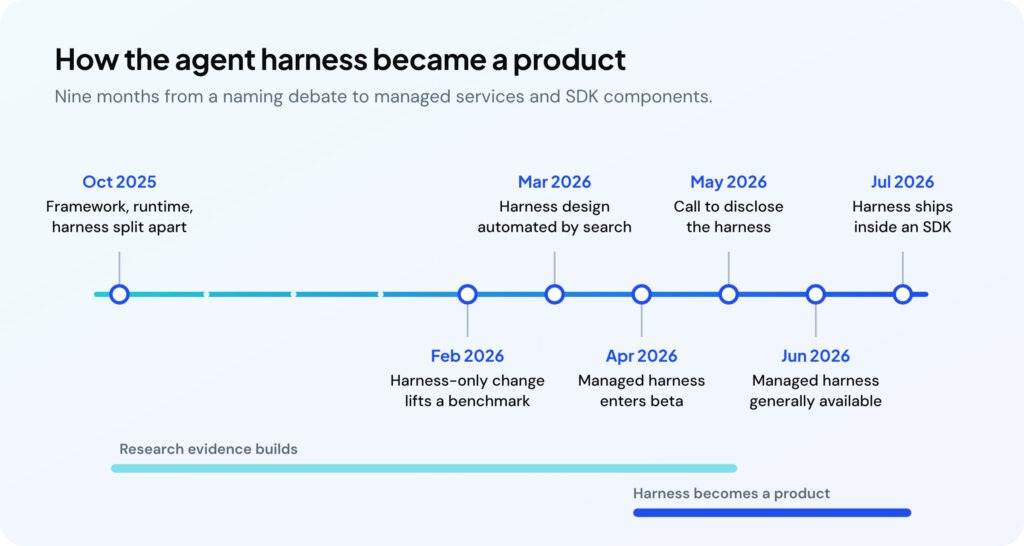
Until this year, most enterprise teams built their own AI agent harness from a framework, a runtime, and a good deal of glue code. Between April and October, the major platforms started shipping it ready-made.
Anthropic, April 8. Claude Managed Agents launched in public beta, built around what Anthropic describes as an agent harness tuned for performance. Sandboxing, scoped permissions, and execution tracing come built in, and long-running sessions keep their progress through disconnections.
AWS, June 17. The managed AgentCore harness reached general availability after an April preview. Each session runs in its own isolated microVM with persistent memory and automatic tracing. Immutable versions let you roll back instantly, and an agent can switch model providers mid-session without losing context.
Microsoft, July 22. The Agent Framework harness shipped for Python and .NET as a library that runs inside your own application. It includes an iteration-capped tool-calling loop, chat history saved after every model call, context compaction, tool approval rules, and OpenTelemetry.
Microsoft, October 28. The Copilot harness, the layer that already runs GitHub Copilot and Copilot Studio, became available to customers through Microsoft Foundry. The pitch is multi-model: more than 20 frontier models, plus bring your own key.
Put those feature lists side by side and they look a lot alike, which usually means a category is maturing. The differences that matter are shifting to configuration and domain fit. That puts more of the outcome in the buyer’s hands than most vendor pitches admit.
The Lock-In Has Moved From the Model to the Harness
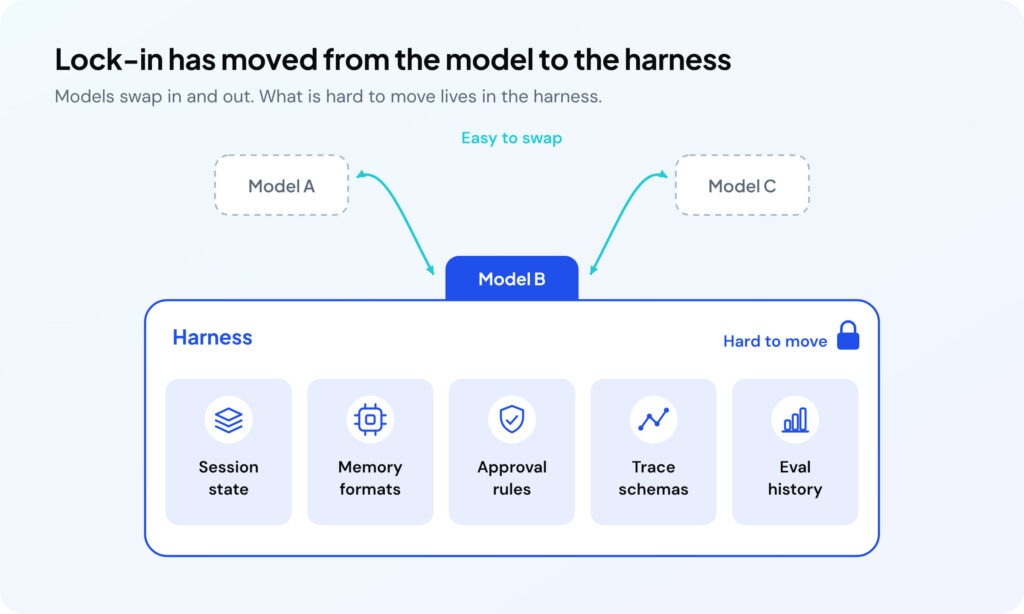
As models get easier to swap, lock-in now accumulates in the harness. Session state, memory formats, approval rules, trace schemas, and eval history all live there, and none of it moves easily.
Managed harnesses are still a sound choice. The portability questions procurement teams used to ask about models now belong to the harness. Can you export your configuration and session history? Can your traces leave the vendor’s console in a format your own tools can read?
AWS, for one, lets you export a harness to Strands code. Confirm an exit path like that before you commit to any vendor.
Agent Harness vs Agent Framework: The Line Is Blurring
The line between an agent harness and an agent framework is getting harder to draw, because frameworks now ship harnesses of their own. In October 2025, LangChain CEO Harrison Chase labeled LangChain a framework, LangGraph an agent runtime, and Deep Agents a harness. In the same post, he acknowledged that there’s no clear definition separating the three.
In practice, the layers divide up like this:
| Layer | What it owns | Examples | Who usually builds or runs it |
|---|---|---|---|
| Framework | Abstractions for defining agents: prompts, tool interfaces, and workflows | LangChain, Strands Agents, Microsoft Agent Framework | Your developers, using the library |
| Runtime | Execution over time: state persistence, durable execution, and resumption | LangGraph, AgentCore Runtime, Temporal | A platform team or a cloud vendor |
| Harness | The production loop around the model: context, tools, approvals, checkpoints, and traces | Deep Agents, Claude Managed Agents, AgentCore harness, Microsoft Agent Framework harness, Copilot harness | Assembled in-house or bought as a managed service |
Sources: LangChain, AWS, Microsoft, Anthropic, Temporal.
For buyers, the label matters less than one question: which layer owns the loop, state, approvals, and traces in production? If your AI agent framework leaves those to you, your team is building a harness, whatever it calls the work.
Coordinating several agents adds another layer on top of all this, which we cover in our analysis of AI agent orchestration.
Why Agent Pilots Stall at the Harness
Most of the reasons agent pilots stall trace back to the harness.
Camunda’s 2026 survey of 1,150 senior IT leaders, business decision makers, and enterprise architects at organizations with more than 1,000 employees found that 71% of organizations use AI agents. Yet only 11% of agentic AI use cases had reached production in the previous year. And 80% of respondents were concerned about a lack of transparency in how AI is used.
Gartner’s forecast that over 40% of agentic AI projects will be canceled by the end of 2027 cites escalating costs, unclear business value, and inadequate risk controls. Look closely and the harness shapes each of those more than the model does.
Start with cost. Token spend depends on how the harness assembles context, when it compacts, and when it stops. Iteration limits and loop detection control spend as much as they control quality.
Risk controls sit in the approval path. Whether an agent can issue a payment or change a record without review is a harness setting. So is whether that action gets recorded in a form someone can reconstruct six months later. Our piece on human-in-the-loop AI governance covers where those checkpoints belong.
Business value is the hardest to prove without the right harness. If your team can’t replay traces or score runs against a fixed eval set, it can’t show that last month’s change made the agent better. That’s usually where the business case starts to wobble.
Harness Engineering: What Leading Teams Do Differently
Leading teams now treat the harness as a versioned, tested artifact that engineers design on purpose. The industry has started calling this practice harness engineering.
OpenAI’s write-up from February describes the most extreme version. Over about five months, a team that grew from three engineers to seven shipped roughly a million lines of code across about 1,500 merged pull requests. None of that code was written by hand. The engineers’ job became designing the environment the agent works in.
Few enterprises will go that far. The practices behind it still carry over.
Version the harness like a model. Prompts, tool definitions, approval rules, and context policies form one artifact. Change them together, and run every change against the same eval set before release.
Enforce rules with code. OpenAI’s team enforced its architecture with custom linters and structural tests instead of longer instructions. Its AGENTS.md file stayed at roughly 100 lines and worked as a table of contents pointing to deeper documentation.
Verify before the agent says it’s done. LangChain’s pre-completion checklist is a small change that paid off. The call on when a task is finished belongs in the harness, where your team can test it.
Keep the model swappable. With harness effects this large, the safer design runs more than one model and uses evals to show when a cheaper or newer model is good enough for a given step. If you’re weighing whether to split that work across several agents, our look at single agent vs multi-agent systems covers when it helps.
Questions to Ask Before You Choose an Enterprise Agent Harness
Whether you build or buy, a production-ready enterprise agent harness should answer four questions that a polished demo usually skips. We suggest treating the answers as your own version of a Harness Card: a one-page spec you ask every vendor to fill in before the pilot starts.
Can the Vendor Show the Harness Behind the Benchmark?
Ask which harness produced any score you’re shown and whether it’s the one you’d run. If the number came from a research configuration, rerun the comparison on your own tasks.
How Are Harness Changes Versioned and Tested?
Every prompt edit, new tool, or automated optimization should produce a new version with its own eval result and a way to roll back. A harness change that reaches production without those will eventually cause a regression nobody can trace.
What Survives a Crash Mid-Task?
Durable execution means an agent’s progress is checkpointed, so a crash or restart resumes the work from where it stopped. It matters most where a half-finished action has consequences, such as a payment or a policy change. Ask what gets checkpointed and whether a retry can repeat a side effect, like sending the same letter twice.
Expect this question to matter more each quarter. When Temporal, which builds durable execution infrastructure, raised $550 million in September, it said customers increasingly want agents that run for weeks or longer.
Where Do Approvals and Traces Live?
Tool approval rules, permission scopes, and traces should be configured and inspected in one place. When they’re spread across prompts and application code, nobody can say with confidence what the agent was allowed to do. For identity and data access, see our analysis of AI agent identity.
Agent Harness for Insurance: Two Claims Agents, One Model
Here’s a hypothetical. A commercial lines carrier is shortlisting two vendors for first notice of loss and coverage triage. Both build on the same frontier model. In the carrier’s pilot, one agent handles noticeably more test claims correctly and costs less per claim.
The model can’t explain the difference, so the carrier’s team asks four questions about each agent harness:
- What context does the harness assemble for each claim, and how does it decide what to leave out?
- Which actions, such as updating a reserve or sending a coverage letter, require approval, and where is that rule enforced?
- If a session fails after a reserve update but before correspondence goes out, what happens on retry?
- Can the vendor export traces in a form the carrier’s compliance team can review?
The answers explain the performance gap. They also decide whether the agent fits the carrier’s AI governance program.
That second part carries regulatory weight. As of October 8, 2026, close to 30 jurisdictions had adopted the NAIC model bulletin on insurers’ use of AI systems. The bulletin expects a documented governance and risk management program, and it applies to AI systems bought from vendors as well as ones built in-house. It also encourages audit rights in vendor contracts.
A harness that can’t show what its agent did makes all of that hard to satisfy. For carriers, an agent harness for insurance gets judged on what it can prove in an audit. Pilot performance is the first test, and the easier one.
Where Arivonix Fits
Choosing a model is now the easier decision. Whether an agent reaches production depends on the harness around it and on the evals that prove each change helped.
Our Agentic AI Designer lets teams assemble agents on a visual canvas from a library of reasoners, retrievers, tools, and models, with human approval gates built in. Its Test Agent feature validates behavior before anything ships, so you can change one part of the harness at a time and see what that change did.
Underneath, Data-Centric AI Assurance tracks lineage, applies guardrails to outputs, and records each decision for audit. For insurers, we work through evaluations like the claims example above as part of our AI for underwriting and claims. Our guide to the enterprise AI agent platform walks through running agents in production end to end.
Models will keep changing every few months. The harness is what your team lives with between those releases, so give it the same scrutiny you’d give the model.

Karthik Subramanian is the Chief Growth Officer at Arivonix AI, where he leads product and growth strategy. He brings over 20+ years of experience across information services and consulting, with expertise spanning product management, consulting, product development, and strategic AI initiatives. At Arivonix, he focuses on building product and service portfolios and translating evolving customer a
- Writes about
- Data FabricData MonetizationArtificial Intelligence (AI)AI-Powered SearchSQL Cleanroom