
Overview
- Overview of Arivonix Platform
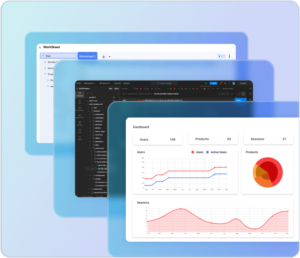
A comprehensive environment for data management, analytics, and collaboration through integrated components.
Browse by topic, or search above.
New to Arivonix? Start here to learn what the platform is and set up your workspace.
A comprehensive environment for data management, analytics, and collaboration through integrated components.
Connect data sources and set up the storage and clusters that everything else builds on.
Manage and access data sources through a centralized integration and sharing interface.
Connect and configure a new data source for data access and integration.
Update a data source's connection details and metadata.
Centrally manage datasets so you can organize and access data resources efficiently.
Create new storage to centrally manage datasets within Arivonix.
Manage cluster operations by starting, stopping, and modifying configurations to adjust resources.
Create a cluster to run analytical and query workloads against your data pipelines.
Centrally organize, discover, and manage enterprise data assets across the platform.
View key information and metadata about a data source in the Knowledge Catalog.
Visualize the relationships and dependencies between tables across your data ecosystem.
Package, share, and collaborate on data securely through clean rooms and APIs.
Manage centralized data products in a secure environment built for cross-team collaboration.
Create and configure a data product to organize and manage related data sources.
Update a data product through inline editing or the full edit workflow.
Transform data and build, schedule, and publish pipelines with the Workflow Designer.
Create and manage end-to-end data workflows through a visual interface with minimal coding.
Build an end-to-end data workflow in the Workflow Designer.
Update an existing transformation's configuration and parameters.
Sort data columns in ascending or descending order to organize information.
Apply filtering conditions so only relevant records continue through the workflow.
Merge multiple data sources by defining rules for how records are combined.
Combine multiple columns into a single unified field to create composite attributes.
Split a single table into multiple tables by assigning specific columns to each.
Bring specific data-processing tools into a transformation to support your workflow.
Schedule a pipeline to automate its execution at set intervals or based on triggers.
Stop or reschedule a scheduled pipeline execution.
Publish a pipeline to make it available for production use and version control.
Create agents, prompts, tools, and chatbots that power the Arivonix AI platform.
A unified environment for designing, configuring, and operationalizing AI-powered solutions.
A centralized workspace for building, orchestrating, and managing intelligent AI agents for production.
Design and deploy an AI agent that combines prompts, reasoning, retrieval, validation, and tools.
Modify an agent's configuration using inline editing in Arivonix AI.
Centrally manage and standardize prompts for consistent interactions across agents and language models.
Create a reusable prompt for a specific use case with Arivonix AI models.
Test, iterate on, and optimize prompts before deployment.
Create and manage custom tools that let AI agents perform tasks like API calls, script execution, and data ret…
Create and configure a custom tool to extend Arivonix functionality.
Build a custom tool with specific functionality using the Tool Designer's Code Runner.
A centralized hub for managing Agentic AI services and controlling agent access across teams.
Configure and deploy a new A3 Registry to manage AI agents and their access controls.
Test and validate A3 Registry agents in real time through an interactive chat interface.
Manage MCP services that expose server-side capabilities to agents and workflows.
Register and configure an MCP Registry to handle server-side execution of analytical workloads.
Modify an MCP Registry's settings after it's been created.
Your unified workspace for analytics, queries, and AI workflows, all in one place.
Access a unified suite of analytical and AI tools for working with data and managing workflows.
Organize connected enterprise data as graphs to enable insights, analytics, and AI use cases.
Model entities and their relationships in a logical graph structure.
Share a knowledge graph with other users and teams while managing permissions.
Access and manage analytics dashboards in a centralized, collaborative workspace.
Create and configure a custom dashboard to visualize data from selected schemas and tables.
Connect Tableau Server to Arivonix databases to build analytics and dashboards from Tableau Desktop.
Run SQL queries and analyze governed data in a secure, compliant environment.
Run SQL queries against databases and schemas in the secure SQL cleanroom environment.
Save and update worksheets to preserve your data and analysis.
Organize API access groups that expose datasets as APIs with configurable controls and monitoring.
Create and configure an API for secure data access and querying.
Modify a Data Access API group's configuration and access settings.
Centrally create, manage, and run data exploration and analysis notebooks.
Create an interactive notebook for querying data, testing code, and validating results.
Remove outdated or unnecessary notebooks to keep your workspace organized.
Manage and configure chatbots with custom settings, knowledge sources, and deployment options.
Create and configure a new chatbot to enable automated conversations.
Modify a chatbot's configuration, including its data sources, guardrails, and prompts.
Control who can access what using groups, entitlements, and data rules.
Manage organization- and user-level access permissions with role-based controls.
Create a group and add multiple users with specific entitlements to manage access.
Build hierarchical group structures by adding a child group under an existing parent.
Control data access and sharing with granular permission rules.
Define data-access permissions with column-level controls.
Modify an entitlement's settings and permissions to keep access controls accurate.
Validate and maintain data accuracy through automated monitoring and quality checks.
Create a data rule to enforce data-quality and governance standards across workflows.
Modify an existing data rule's sources, description, and tags.